It’s a sunny day in Aoraki/Mt Cook National Park. There’s a gusty nor’wester high up, but also warm alcoves of shelter to take advantage of in the lee of the mountains. The Aoraki/Mt Cook Alpine Rescue Team (AMCART) is keen to do some training and happy for me to tag along.
While there is a number of skilled search and rescue crews spread around New Zealand, AMCART provides the country’s only full-time, professional mountain rescue service. Jono Gillan is in charge of the team. He’s Australian, has a quirky sense of humour and a more than decent pedigree in mountain climbing and guiding as well as rescue. He, along with team leaders Mark Evans and Jim Young, is employed year-round by the Department of Conservation. Another four team members join them for the busy months of October to April.
Emergency callouts come to AMCART from either the police or the Rescue Coordination Centre in Wellington. The rescue team assembles at the rescue centre at Aoraki/Mt Cook Village as quickly as possible. First, they ascertain the nature of the response required, be it a climbing fall, an avalanche or someone overdue.
Gillan tells me that transport is the main consideration for any rescue and is dependent largely on the weather.
“How can we get to them is key. We quickly decide whether to use a helicopter or mount a terrestrial response,” he says. “For a speedy response, a helicopter and longline rescue is vital.”
This past season, the team has been using a new type of longline which allows for an increased working limit. Gillan is very keen on the result.
“It means we can have more rescuers and patients on the same line, up to 500kg in optimal conditions,” he says. “Primarily, the longline is used at 100ft length, but we can also do 150 or even 50 which helps in dealing with proximity to terrain, a lower cloud base and rotor wash.”
Usually, one or two rescuers will first complete a flyby of a site with the pilot to assess conditions, and then come in on the longline to secure the patient in either a lifting bridle or a stretcher.
“Speed and safety is always paramount,” says Gillan, “along with a bloody good pilot, of course. We rely on them 100 per cent to keep us safe in what can be pretty testing flying conditions.”
I hadn’t been to Plateau Hut since 1994, which was also the first, and only time, I climbed our highest, most revered maunga. As the helicopter hovers for landing close to the hut, situated on a rocky knoll overlooking the Grand Plateau, I glance out the window. On the other side of the glacier, Aoraki/Mt Cook’s east face rises in one clean, shimmering, still enticing, shield of ice and snow.
I remember looking down from the top of that face all those years ago, an absolute greenhorn climber attached by rope to another who wasn’t much more experienced, both of us trying to work out what this alien alpine world was all about and how to continue staying safe in it. There were others up there seemingly as naive as us. A few climbers were wandering through the broken icefall of the upper Linda Shelf unroped, and then for some inexplicable reason, a foreign pair decided to cross over our ropes as both teams were pitching through the summit rocks. If somebody fell, everyone was going with them. Now, getting through that was lucky.
Today, Gillan gets me to tie-in to the other end of his rope and we wander easily up snow slopes to a ridge leading towards Mt Dixon. First up for the team training is some helicopter drop-offs and pick-ups. Gillan watches as team leader Evans works with the others through the finer points of longline rescue, the picturesque sweep of the Tasman Glacier curving away in the background. For a few moments, I wonder to myself why it has taken so long to return here.
Gillan rates Evans as both a highly skilled rescuer and someone with the ability to communicate his skills and knowledge to the newer team members. Now in his second season with the team, Evans has a background in ski patrolling and is currently working towards getting his summer guiding ticket. His team nickname is Tubbs, and it’s obvious that he is quick to find something positive in most situations.
“I love being here (in Aoraki/Mt Cook Village),” he says. “I get to live and breathe climbing. Everyone has the same hobbies. At every chance, I’m climbing with team members or others in the village.
“Of course, there’s a bit of FOMO when the weather’s good and other guys are getting to go climbing while I’m stuck on call. I guess every job has its downside.”
Gillan encourages the team to do as much climbing as they possibly can outside of their on-call hours.
“It’s great for the team dynamics, and they are always up-skilling themselves in the mountain environment,” he explains.
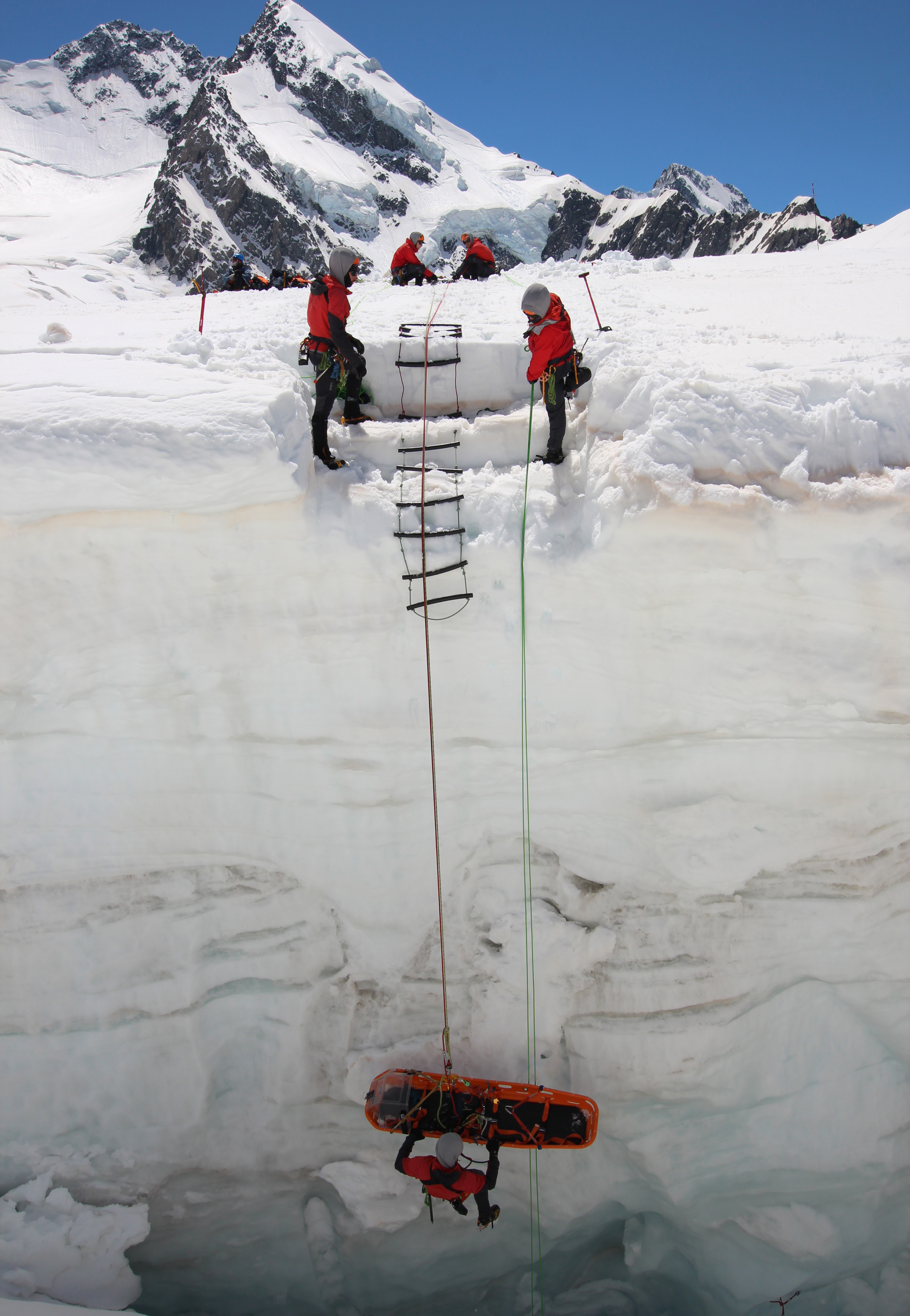
Later, we move down to a crevassed area of the Grand Plateau. This is where I get to experience my first ‘rescue’. Needless to say, it’s a little unsettling being placed in a Ferno stretcher and lowered into the abyss of a crevasse. But there’s nothing I can do other than lie back, dodge bits of falling ice from the overhanging edge of the crevasse, admire the professionals at work and be thankful that this isn’t for real.
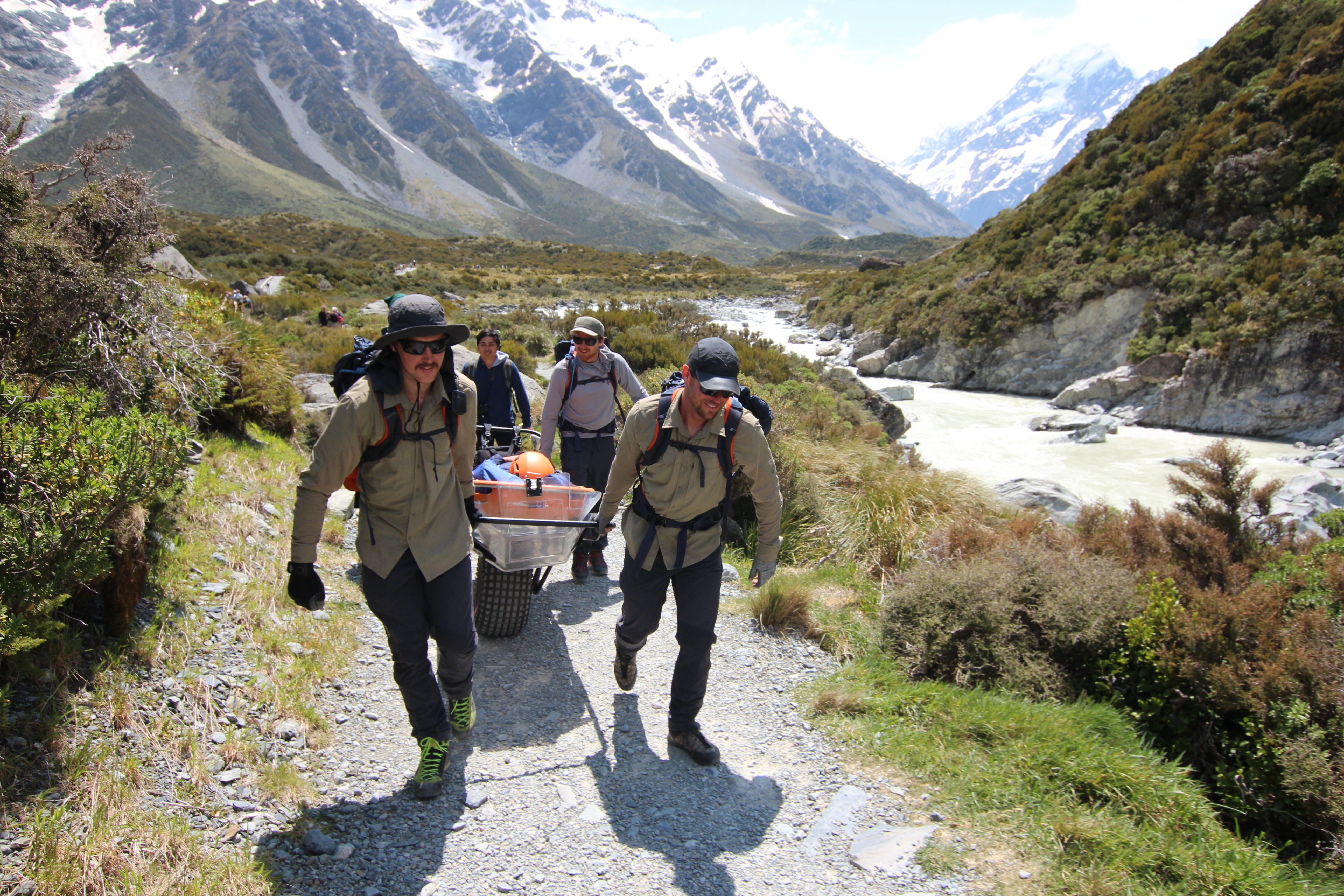
Being in a mountain environment, there is a defined edge to how far the inexperienced can safely venture from Aoraki/Mt Cook Village into the surrounding valleys and peaks. The popular Hooker Valley Track is a classic example. In the height of summer, thousands of tourists complete the 2-4hr round trip every day, pausing to take photos of themselves in front of the Hooker terminal lake, with Aoraki/Mt Cook and Mt Hicks dominating the skyline. On this day, an international tourist has somehow managed to get a leg injury on what I, and most others, would consider very mellow terrain.
Instead of calling in a helicopter, the team uses a contraption known as Mule 1, a kind of super-sized, human transporting wheelbarrow. Onlookers stop, gawk and take photos as the team ferries the injured tourist along the track to an ambulance waiting at the White Horse car park.
“Accidents here, in the mountains, tend to be minor or permanent,” Gillan explains in the evening over a beer.
Considering my own experiences, my near misses, especially that day with the ice falling in the Hopkins when we were literally seconds from never coming home, and then about mates I have lost to the mountains, I understand Gillan’s observation only too well. It makes me value even more AMCART, and the volunteer teams around the country, knowing they are trained and waiting if I, or any others, get into difficulty in the mountains.