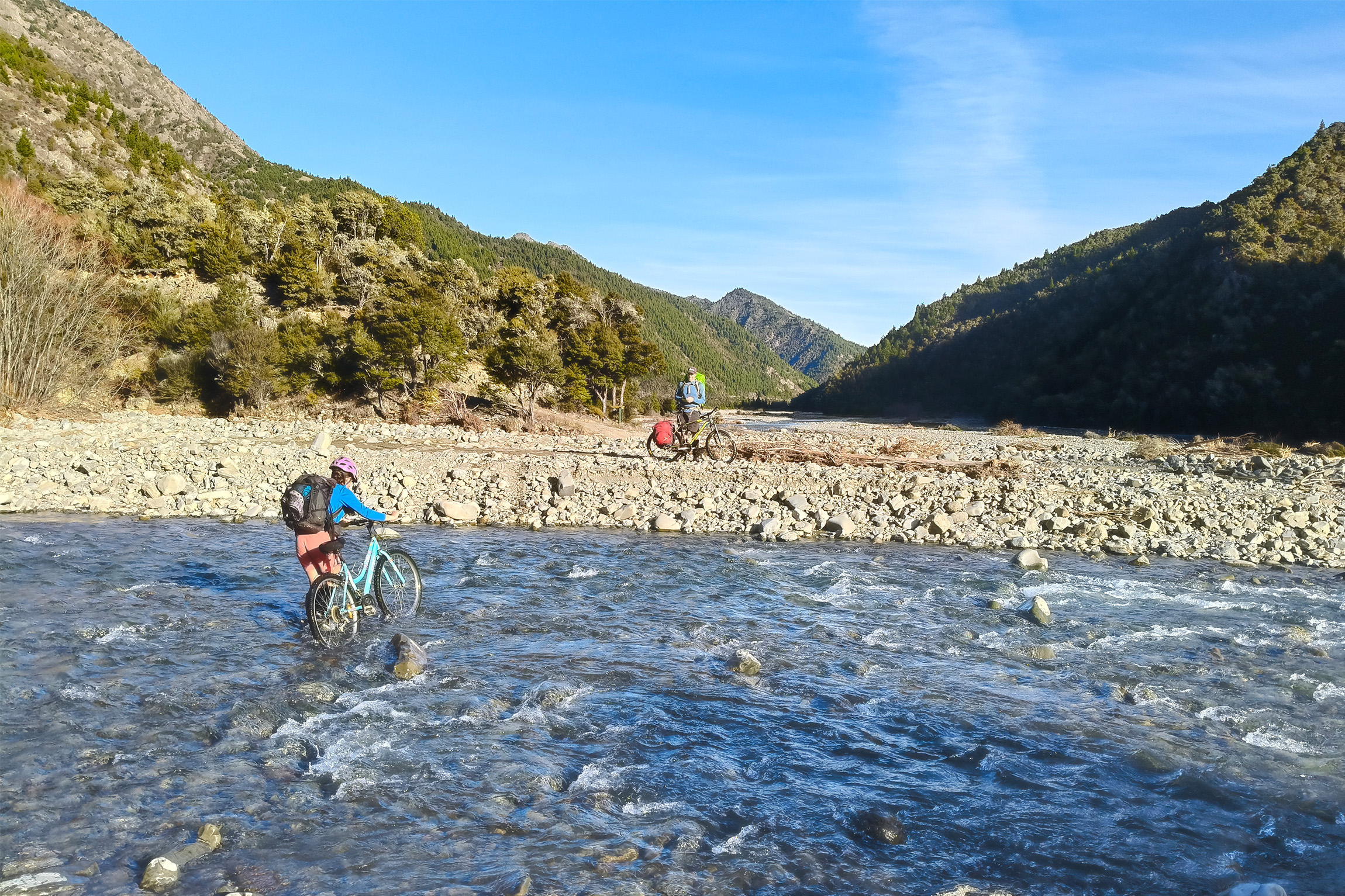
Our journey began on bikes. The 4WD tracks that thread through Leatham Valley offered a way in, a long, stony corridor winding deep into the interior.
Bikes and packs loaded with gear, we pedalled steadily, tyres crunching over frozen gravel, the air biting at exposed skin. River crossings came frequently, each one a small negotiation: how deep, how fast, how numb our feet would be on the far side.
There is a particular clarity to winter travel. The light is sharper, the air cleaner, the distances feel both expanded and more defined. Sounds carry – the click of a freewheel, the rush of water, the occasional call of a bird cutting through the stillness. We moved slowly, deliberately, aware of the shortness of the days and the potential consequences of misjudgement in these temperatures. There is little margin for error. Wet becomes dangerous quickly; delays stretch into cold, long nights.
Some two kilometres before Bottom Gordons Hut the tracks gave way to terrain better suited to boots. We stashed the bikes and shouldered packs, a transition not just in mode of travel but also in pace and attention. On foot, the land presses closer and there is more time to notice the nuances of vegetation and birdlife.
We pushed through glades of mānuka, serenaded by bellbirds. Ahead lay our route: from Bottom Gordons Hut to Top Gordon Hut, a climb to Saxton Saddle and a descent into Saxton Valley. After that we would begin an off-track route from Saxton Hut to Severn Hut, swapping icy valleys for the high tops via Severn Peak – a line that, in winter conditions, demanded both respect and flexibility.
After signing the intentions book at Bottom Gordons we continued a further 5km up-valley to Top Gordon Hut.
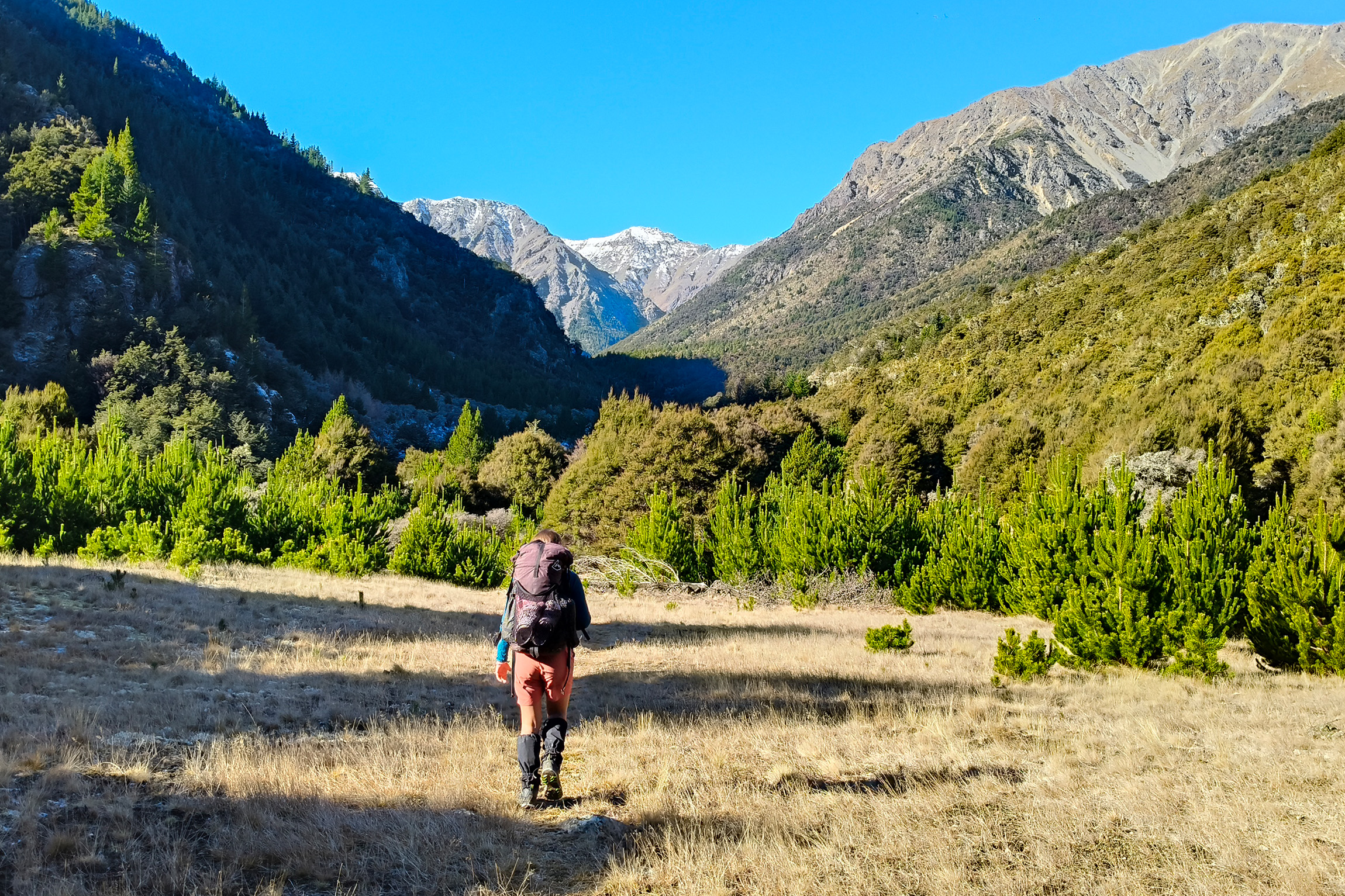
From there the route wound through bush then climbed steeply to Saxton Saddle. Markers led through scrub before giving way to cairns and a faint ground trail. Reddish-gold dracophyllum glowed in the winter light. We crossed the saddle and dropped into the upper Saxton where the river ran blue and intensely cold, the tussock still frozen solid in places. By the time we had passed Team Hut and reached Saxton Hut, the sun had already slipped behind the ridges.
Leaving Saxton Hut the next morning, we paused hopefully on the riverbank, eyeing the icy rocks for a safe passage across that would avoid wetting the boots so carefully dried by last night’s fire. Alas, the slippery surfaces offered no safe purchase, so we splashed through with sharp intakes of breath from the burning cold.
As we climbed away from the valley floor the world opened out in widening arcs. We aimed for the sunshine as the muted tones of the basins gave way to snow-flecked ridgelines, the ground hard underfoot, the wind sharper, more insistent.
Wilding pine seedlings dotted parts of the route. Left alone, they would grow, seed and spread. Armed with a folding saw and a willingness to stop often, we cut what we could. It was slow, tedious work and, in the scale of the Molesworth, felt almost insignificant, and yet it mattered. Each seedling removed was one less tree contributing to the slow encroachment on the high country.
Route-finding became a quiet, continuous conversation with the land. There were no markers, no worn lines to follow, only contours, intuition and the slow assembling of a route. We angled across faces, gained ridges, dropped slightly where needed, each decision small but cumulative. Not just moving through the landscape, but reading it, shaping a line that worked.
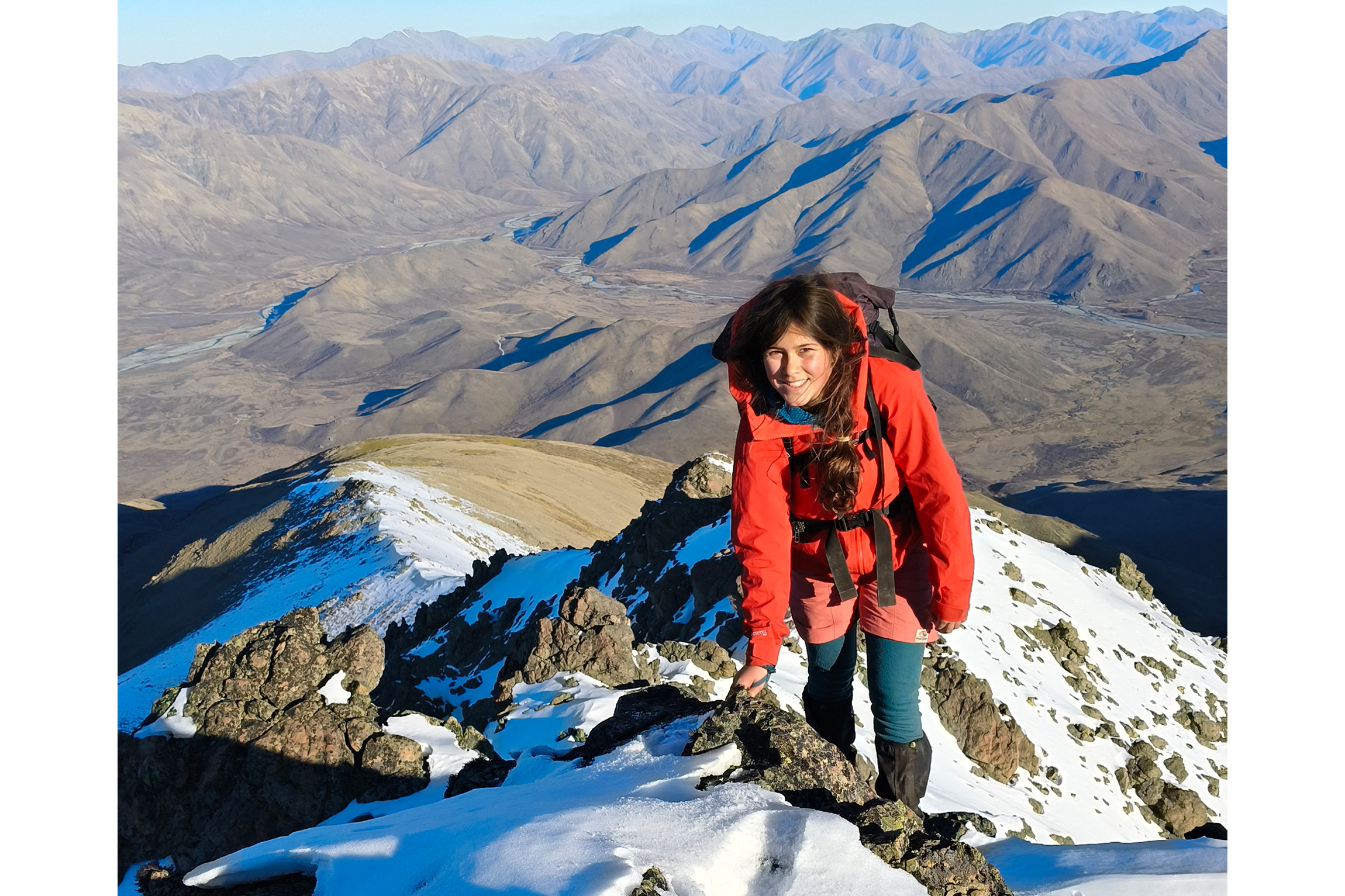
Emilie moved steadily in her bright red jacket, a vivid contrast against dark rock and frost-bleached tussock. She picked her way through broken outcrops, finding balance and rhythm among the loose stone. There was something grounding in watching her, a reminder that even here, in a place that felt stripped back and severe, movement could still be light, instinctive, playful.
Not everything lay dormant. In sheltered pockets where the sun reached and the wind dropped away, grasshoppers flickered into life. We paused in those places, tucked beneath bluffs, backs against sun-warmed rock, hands ungloved for a few precious minutes. Muesli bars shared, faces turned toward the light. Out of the wind the warmth felt almost generous.
Above us the peaks held their sharpness, snow lingering along ridgelines, shadows defining every fold and crease. Our progress was steady, the terrain demanding attention, the day slipping by almost unnoticed in the rhythm of movement and pause.
There was no fanfare on reaching the summit of Severn (2027m), just a shift and the knowledge that, from here, the land began to fall away.
The descent into the Severn Valley demanded as much care as the climb as patches of ice waited in shady corners. We moved steadily, aware that the day was already leaning toward evening. When Severn Hut finally came into view, it carried with it a simple undeniable promise: shelter, warmth, rest.
If the days belonged to the land, the nights belonged to the huts. There is a particular intimacy to backcountry huts in winter. The cold presses in from all sides, the dark arrives early, and within those thin walls small acts take on a quiet significance. Lighting the fire or lighting the candles is not just routine; it is transformation. A cold, inert space becomes, gradually, somewhere habitable.
We moved through these rituals with the ease of long familiarity. Setting the fire, coaxing flame from reluctant wood, building heat slowly and steadily. At each hut we chopped wood – not because it was required for us alone but because it needed doing.
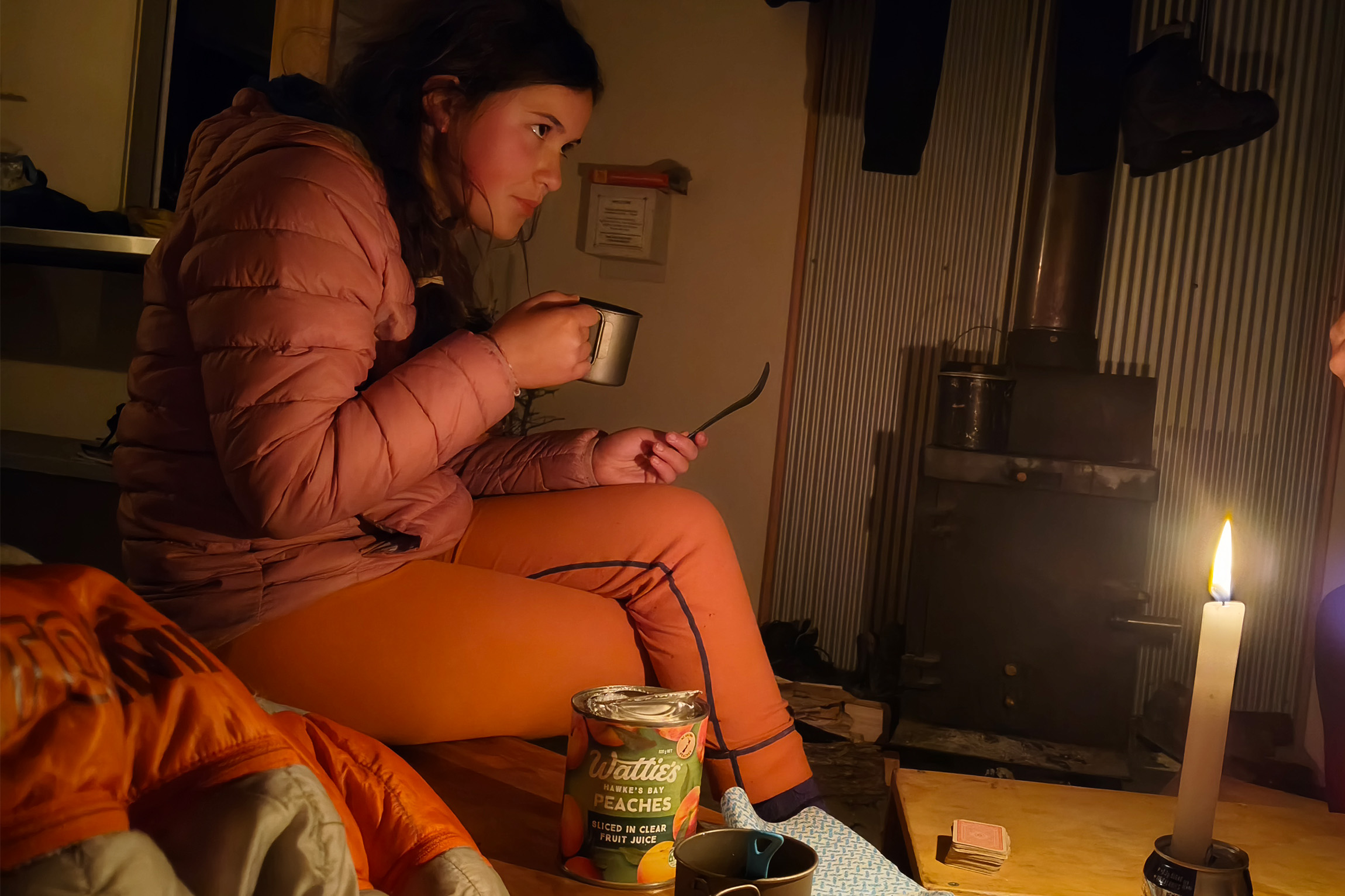
Evenings settled into a rhythm: boots off, damp layers hung to dry, water boiled, simple meals prepared. The soft clink of mugs, the low murmur of conversation, repetition of card games, long stretches of companionable silence. Outside, the temperature dropped, frost forming again in the dark.
By candlelight the world contracted to a small circle of warmth and presence. The vastness of the day gave way to something contained, human, shared.
On our final morning the headwaters of Leatham Valley lay quiet once more, the cold having settled in overnight. The first light touched the upper slopes then slipped gradually downward, finding again the frozen edges of the creek, the rime clinging to stone. It was a familiar scene now, but no less striking. We moved more easily than we had at the start – not because the land had changed but because we had learned how to read it.
Over the days the journey had strung itself between eight new huts, each one a small destination in a landscape that otherwise offers few markers. In summer the Molesworth can feel vast, but in winter those distances contract into something more intimate, measured from one pocket of warmth to the next. For hut-baggers, it’s a quietly compelling circuit. The hut spacing lends itself to steady travel, even in the short days of winter.
As we moved down-valley, the hills opened out once more, wide and weathered and carrying their layered histories. The frost would lift, the light would shift and the country would return to its quiet, enduring state.
We left with something gathered along the way. Not just the memory of places passed through, but of fires lit, routes made, and the small, steady comforts found in the frozen wide spaces. Proof that even in the most stripped-back landscapes there is richness – and that, sometimes, the stories we carry home are the quietest ones.