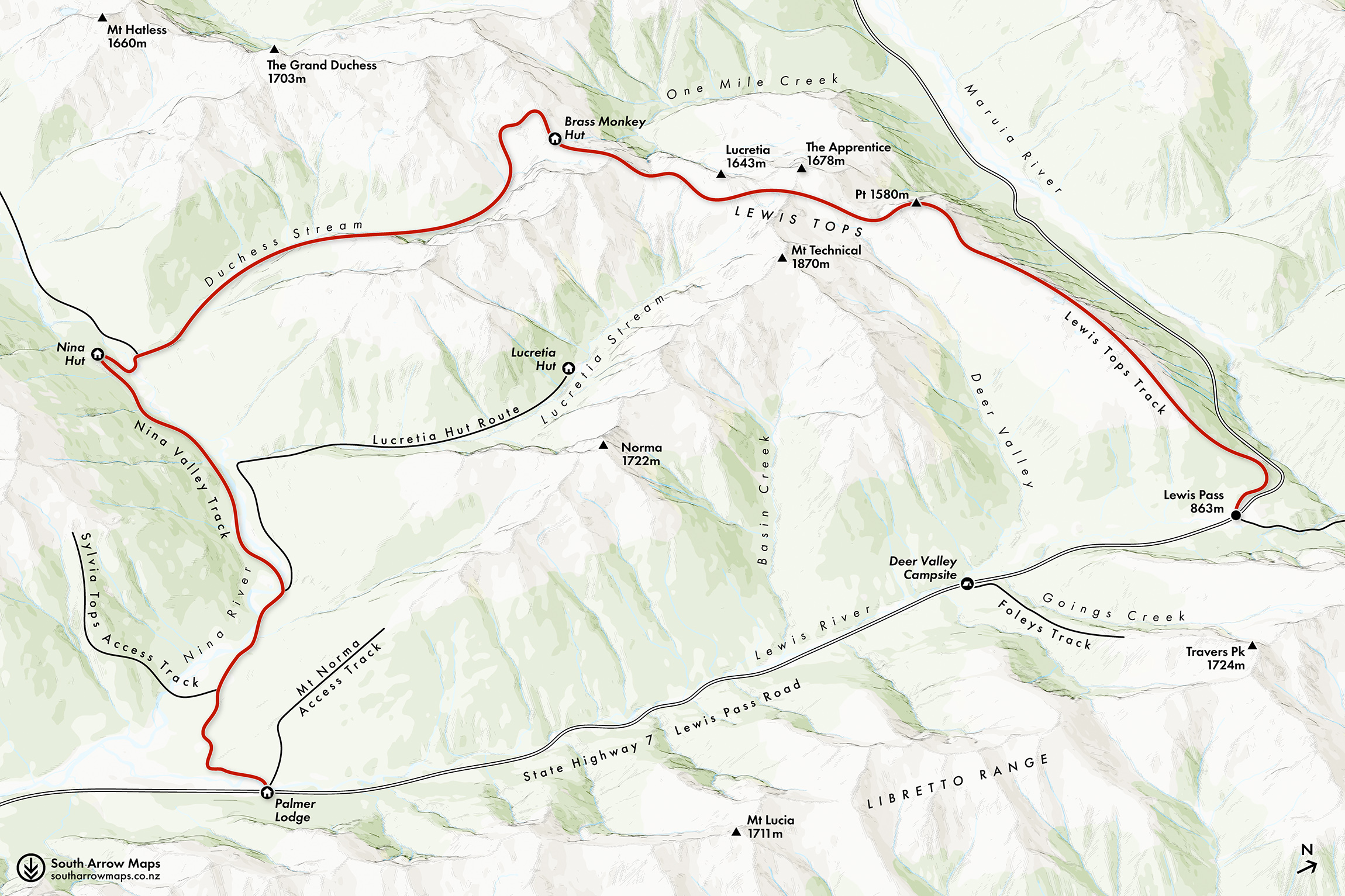
There are several access points and routes to Brass Monkey. Many people begin the trip from the St James Walkway car park at Lewis Pass, which has the advantage of starting at higher elevation and climbing straight to the spacious Lewis Pass tops. Our route, however, would be up Nina Valley and Duchess Stream to the hut and out via the Lewis Pass tops to the car park.
We left Christchurch on a Friday afternoon and meandered up the gentle Nina Valley with its many inviting clear pools for late-summer dips. We arrived at Nina Hut on sunset and spent a pleasant night camping on the edge of an enchanting forest with a groundcover of moss.
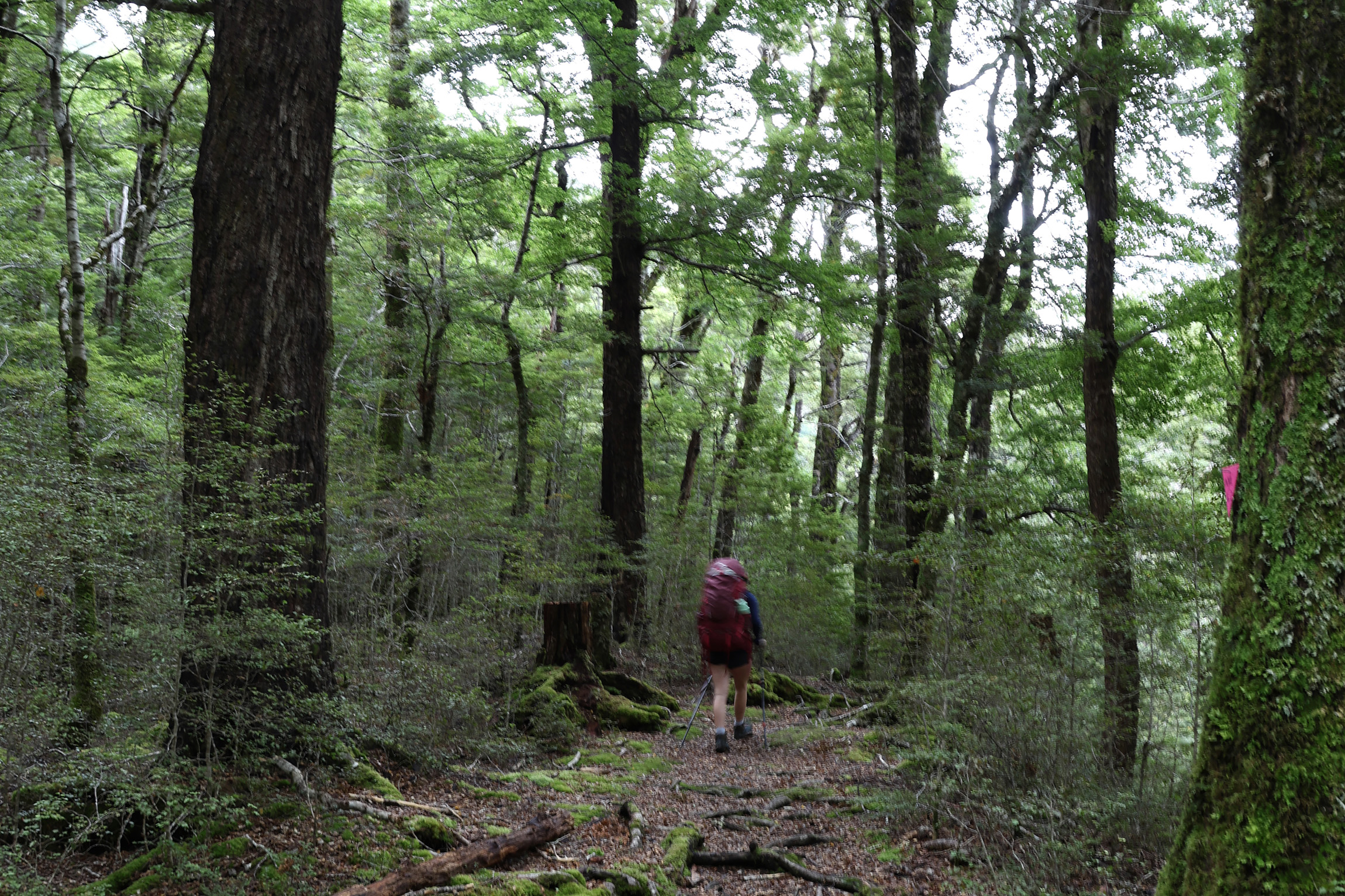
The next day, with no route marked on maps for travel up Duchess Stream, our first challenge was to find the entry point. Dutifully following the orange track markers, we crossed the lower Duchess to its true left. From that point on there were a handful of markers, but they, and any obvious traces of a track, soon vanished.
The terrain made it relatively easy to persist with our efforts, but as the GPS had us climbing steadily and not in the direction desired, we eventually cut our losses and retraced our steps to the starting point. It didn’t take long to locate the correct route, which is well marked with a large orange triangle on the true right of the stream, near the start of the track to Upper Nina Biv. After wasting two hours scrambling around, and with slightly muddied minds, it was now midday and we still faced a five-hour walk.
From that point, our eyes locked onto every track marker on this relatively new track that was constructed to service the predator trapline up the valley. As it wove back and forth across Duchess Stream and through a glorious variety of bushscapes, any lingering frustration with our earlier navigation error dissipated.
Popping out of the bush into the dramatic landscape of the upper valley, we were a bit eager and started climbing to the left as our route to the top. Our path, however, soon became impassable with thick, scrubby, scratchy, bull-headed flora. Retracing our tracks for the second time that day, we continued up the river to the confluence of a small stream that provided a clear line of sight to the ridge top.
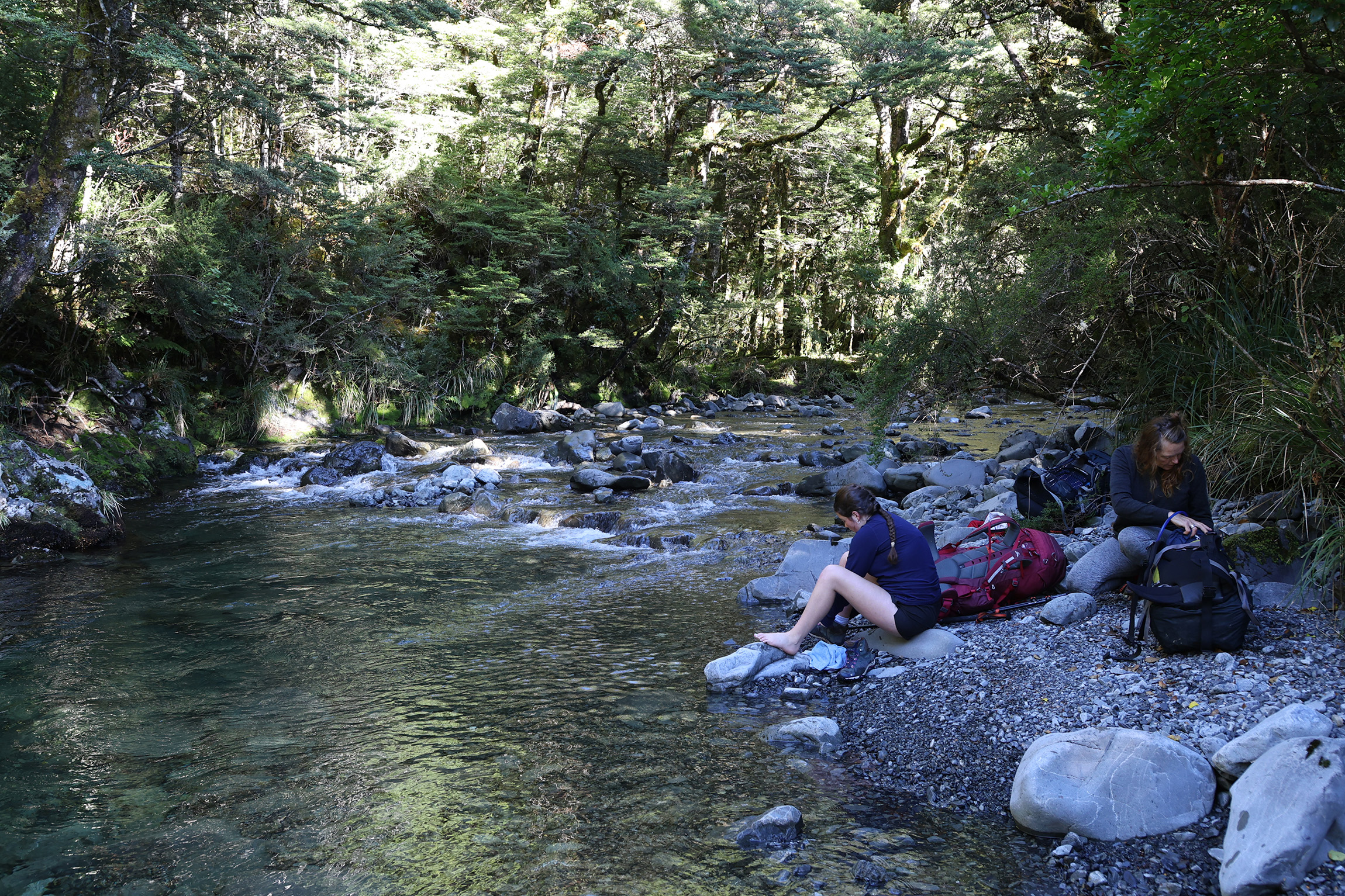
Looking up, it appeared an insurmountably steep climb, but knowing that Brass Monkey Hut sat just a few stones’ throws away from that high point, we rested on the sun-drenched river rocks, refuelled, and recalibrated ourselves for the day’s final challenge.
Gripping the low-growing vegetation, we hauled ourselves up and out of the riverbed onto the slope. Every step required care, stable footing and a fight with the gravity that seemed to want to topple us backwards to the river below. Every step meant progress, and each came with the benefit of rapidly gained elevation.
Brass Monkey Hut’s striking red roofline revealed itself in the early evening sun, and it was a welcome relief to walk into a postcard-perfect scene. The north-facing hut is nestled in a spot overlooking two tarns, surrounded by peaks and positioned to take in a panorama of ranges that stretch away into the distance.
Ana had explained that her vision for the hut was first and foremost a sanctuary. “I wanted it to be a place of retreat from the elements, and to have a big window to take in the panoramic views and splendour of the landscape.” She laughs when she describes Jackie’s independent and hard-working nature: “She believed in working hard to earn rewards, and getting to Brass Monkey definitely requires some grit.”
During a summer in which perfect weekend weather windows had been rare, there was clearly interest in the hut – several tramping parties were already there. One of the beautiful aspects of Brass Monkey is that it can be accessed from several routes, including Rough Creek, Lake Christabel, Duchess Stream, Lucretia Stream and the Lewis Pass Tops. In this way it creates a meeting point.
Having set up our tent among a scattering of others, and relieved of heavy boots, I savoured exploring the surroundings in bare feet and found a small tarn surrounded by gentians for a quick dip to wash away the day’s challenges. As the sun lowered, the larger tarns beside the hut came alive with a soundscape of frogs.
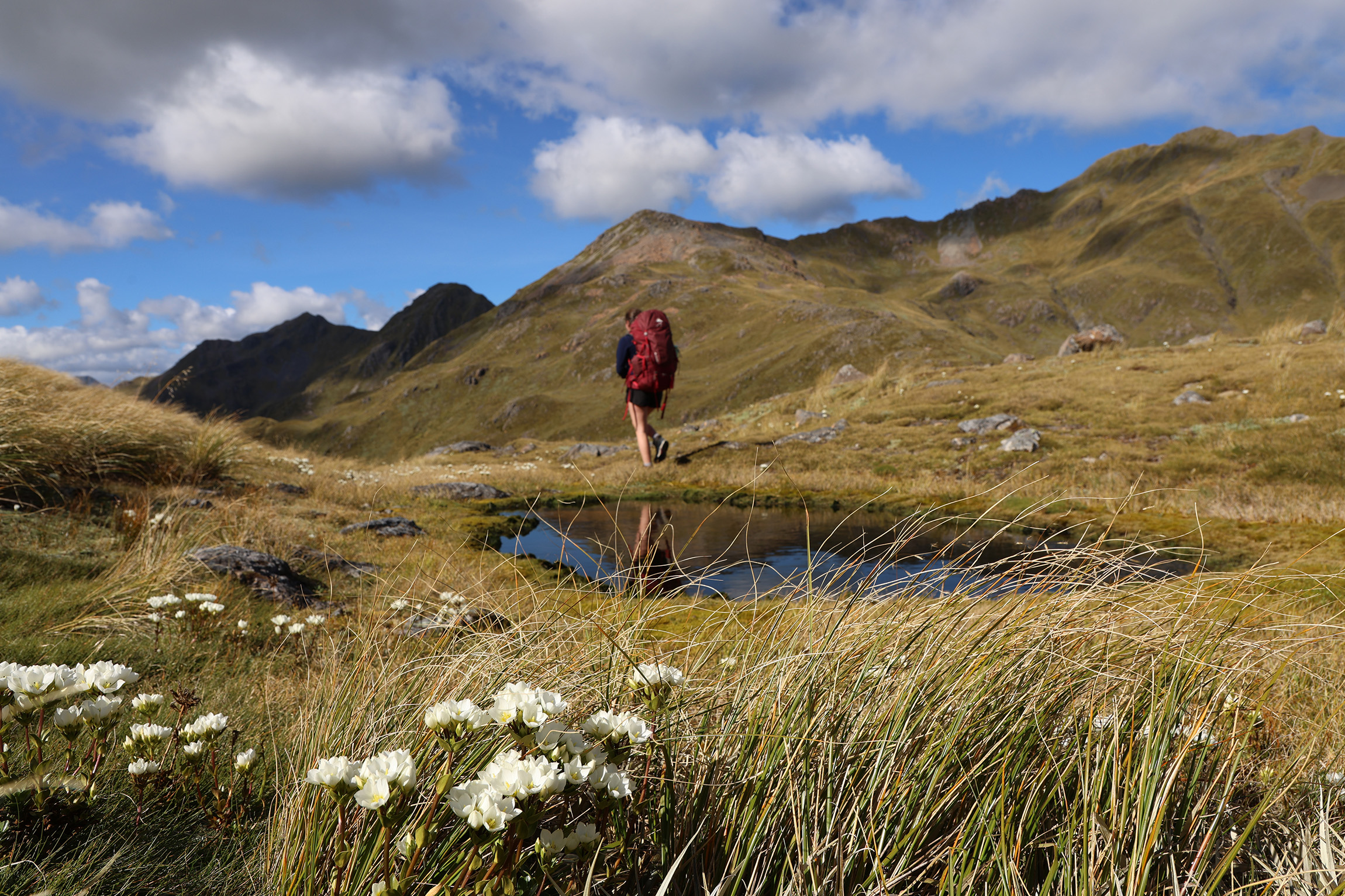
The dusk sky slowly filled with stars and constellations that reflected in the tarn’s surface. Even though Jackie never tramped in this area, she relished the natural environment as a place of peace with space to think. The new Brass Monkey Hut and its location offer that in abundance.
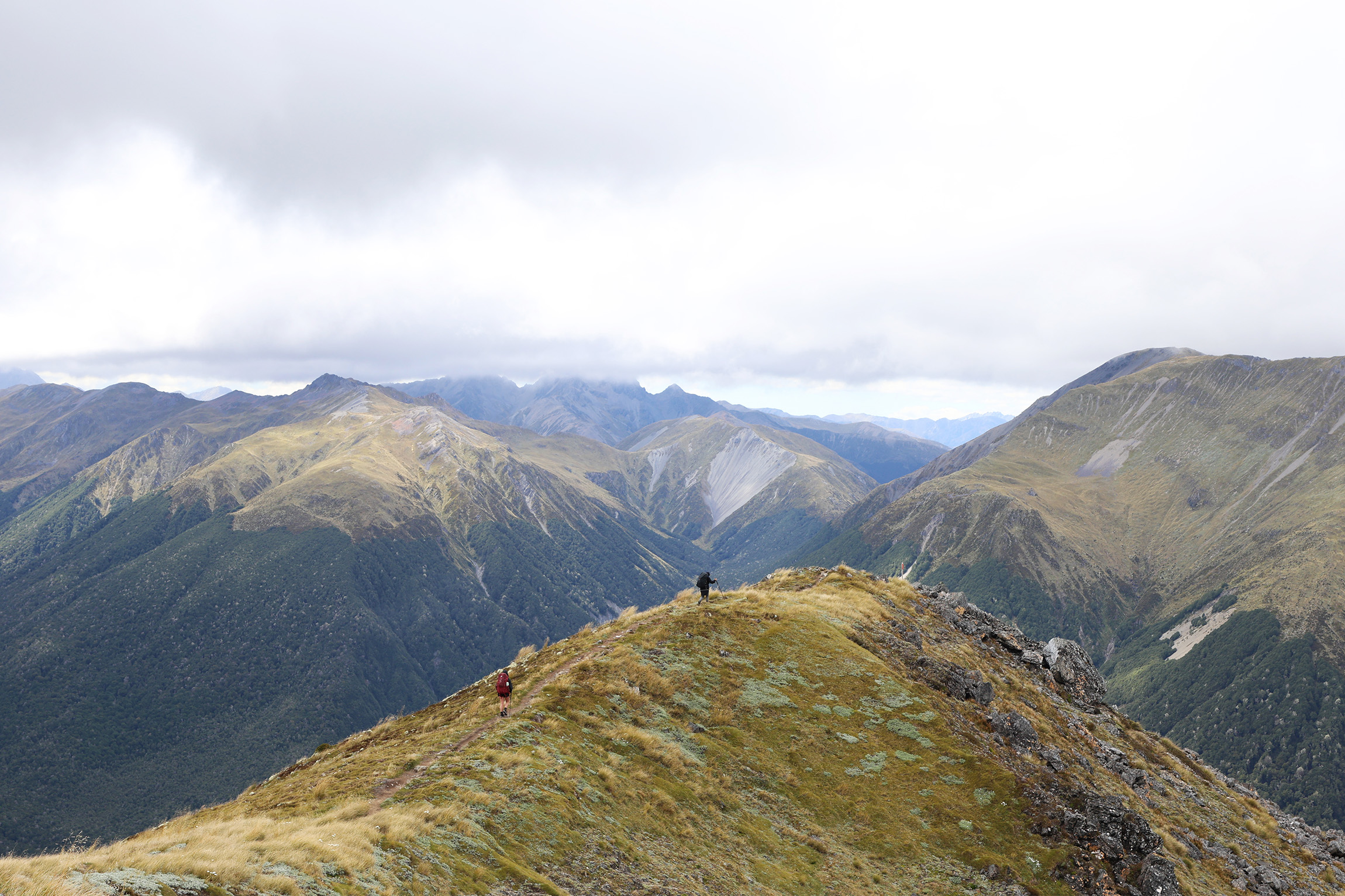
Our third day dawned to slightly deteriorating weather, and knowing a southerly was forecast to arrive later in the day, we were keen to hit the trail. The route out via the Lewis Tops Track would, in theory, involve straightforward navigation traversing ridges and open country.
That proved to be the case – with the exception of Mt Lucretia, where we met our biggest challenge of the walk. Avoiding the ridgeline, we attempted to sidle round the southern slopes. Towards the far end we didn’t like the look of the bluffs and backtracked a little to access the ridge, which also proved impassable for us. Once again we retreated to our initial lower route, and mindful of the worsening weather, we came to a spot that pushed us to our limits of comfort and technicality. It was a moment of realisation: in these environments, the fine line of safety can easily be crossed at any time. In the back of my mind I was thankful for the PLB tucked in my pack.
Without knowing what lay on the other side, a scale up a small rock face requiring both confidence and determination proved a fruitful choice, as over its lip the open basin at the base of The Apprentice stretched before us.
From that point on, travel was easy and fast and we could lose our minds to the open vistas and surrounding passing peaks, including the striking Mt Technical. Banks of clouds rolled in but cleared, making it possible to keep an eye on landmarks for navigation.
With the wind picking up, we relaxed into the final leg of the walk across the tops, making note of the many tarns as ideal future tenting spots. The Freyberg Range on the opposite side of Maruia Valley provided a dramatic backdrop for the last few kilometres prior to the final steep descent through the bushline on Lewis Tops Track.
The wipers worked on double speed keeping the windscreen clear of the southerly blast as we began the drive back to Christchurch. We’d made it, and were a little bit shocked and in awe of what we had done as a family. Strongest, however, was the overwhelming sense of accomplishment and joy that comes with a collective shared experience in the outdoors.
In the rear vision mirror the peaks surrounding Lewis Pass had disappeared behind the mass of dark clouds. It was comforting to know that in that high lofty place, sitting in its own solitude, Brass Monkey Hut would be offering a safe and warm shelter to those who wandered in. Exactly what Jackie would have wanted.
Brass Monkey Hut, built to replace the previous Brass Monkey Biv, is situated in a serene spot on the Main Divide that can also be wild – the official opening was postponed several times due to the weather. Finally, in February, the small informal opening was held, attended by Ana, her partner Don (who had also volunteered to help the build), representatives of the Backcountry Trust (who oversaw the build), and several others who’d contributed time and expertise to help bring the hut to life.
Those present spoke of the former Brass Monkey Biv and its role in providing shelter and safety for so many over the years. The ceremony also included stories about Jackie, who was private by nature and known as a practical soul who always spoke her mind and called a spade a spade. After several years working as a postie, in 1999 Jackie had purchased land near Northland’s Kaiwaka where she established and ran a small stud farm.
Describing her first visit to the new hut, Ana said she was gob-smacked. “It’s absolutely exceeded all expectations, but what Jackie would really appreciate is that it’s way more than just a hut. Not only is the design stunning, but the hut contains weather monitoring equipment and is now the subject of a study of internal moisture levels and human occupancy for the purposes of future hut construction. It also sits at a point central to all the predator trapping work taking place in the area.”
The key to it all, she added, was the amazing group of people and the collaborative effort that brought it all together.
After the opening, Ana and Don spent their first night in the hut alongside other trampers, and say Jackie would have loved to hear the hut fill with laughter and joviality as it did that evening.
For a small non-profit like Backcountry Trust (BCT), managing the building of a new hut is rare. However, a fortuitous alignment of circumstances, including the closure of the old Brass Monkey Biv due to mould issues, lead to the new construction.
Completed in just over 18 months, the build was a big effort: 25 volunteers spread across seven different site visits, almost 30 hours of helicopter logistics, and three weeks of off-site prefabrication.
The BCT design team took to the task, combining artistic vision, functionality and structural integrity with clever engineering. Totally funded by Jackie Winters’ bequest, the final cost for the hut was about $300,000, and a gift from a second donor supported the addition of monitoring equipment for the hut’s ongoing research capabilities.
Lead builder Matt Hewat described the challenges associated with a backcountry build. “You don’t get to nip to the suppliers or even back to the truck if you’ve forgotten something, but it all becomes part of the fun of the experience. More so, it was great to work with industry professionals and volunteers of all ages and backgrounds. Each shared a love for the outdoors and all were passionate about making this project a reality.”
BCT project manager Ollie Clifton says the process was meaningful in many ways. “I’ve had the chance to hear many of the stories from those closest to the action, and without exception it’s been a special journey for all of us. I feel honoured to have been part of bringing it together, to help bring the collective dream to fruition and support a space for reflection, stillness and mountain solitude.”