“Water management is critical and the number one rule is to get water off the track as soon as possible, so swales are a good solution,” he says. “If you have culverts, you need constant inspections. You only need a ponga frond to fall in a culvert to block it.”
In Tongariro, there’s a special problem: a base of volcanic ash and pumice that’s highly erodible. Grose says trying to come up with a scheme to prevent tracks washing away used to keep him awake at night.
“The Taranaki Falls Track got so badly scoured it took years to fix,” he says. “We had to backfill the sides. We filled them with pumice, which was light and cheap to fly but you had to cap it quickly otherwise rain would wash it all over the landscape. Volcanic rock would get frost heave and fret, so we used tunnel rock from the Turangi power scheme. There is an ethical debate about using rock from another region; it’s also practical.”
Ken Bradley agrees that good quality metal is worth flying in. “We’ve crushed and flown Hollyford metal to the Milford Track and it pays off in the long run because it lasts longer,” he says.
More recently, on the Tongariro Alpine Crossing, new ‘JakMats’ were track builder John Wilton’s answer to the constant trampling by thousands of feet over the soft volcanic base. At the time, Wilton was overseeing the deviation away from the Ketetahi Springs, an area sacred to Ngāti Tuwharetoa and excluded from the park.
JakMats are honeycomb cell structures made of recyclable plastics. They interlock, are lightweight and easily transportable, and the cells are designed to fit the size of aggregate used on the track.
“To achieve the best possible surface you have to compact the aggregate against something more resilient than the mountain’s soft volcanic soil, so the JakMat provided the solution,” says Wilton.
Local metal was used on the Paparoa Track but there were challenges and exceptions, says Mark Nelson.
“Bringing gravel from outside is expensive, and there’s a risk of introducing weeds so we crushed a lot of Pororari River gravel,” he says. “However, this contains no clay fines, which help set and seal the surface. Our answer was to compact it with a big, hand-driven compactor machine. That works the fines up through the gravel, like liquefaction, and makes the track bombproof.”
Along the escarpment section, gravel was flown in from the Thirteen Mile Quarry, near Barrytown. Nelson says it’s much better quality than the Pororari gravel and will “last a long time”.
Without doubt, the biggest new thing in track building has been the Paparoa Track, says Nelson.
“Paparoa was the mechanism for a whole bunch of ideas from my past and from others, including my grandfather who built and maintained a lot of tracks before and after the First World War,” he says. “I walked with him often and learned his skills and philosophy.
“Grandad would say, ‘when I walk in the bush, I like to become immersed in the environment. I don’t want to see man-made stuff, I only want to see and feel the bush’. I was about 10 at the time and that really struck a nerve.”
The Paparoa Track has been designed and built on strong environmental principles. Right down to replanting along the lower side of the Moonlight Tops section so that people looking up from Grey Valley don’t see a scar along the hill. The construction crew were asked to shift rocks by hand along 150m of track on the tops to safeguard habitat for lizards and Powelliphanta snails.
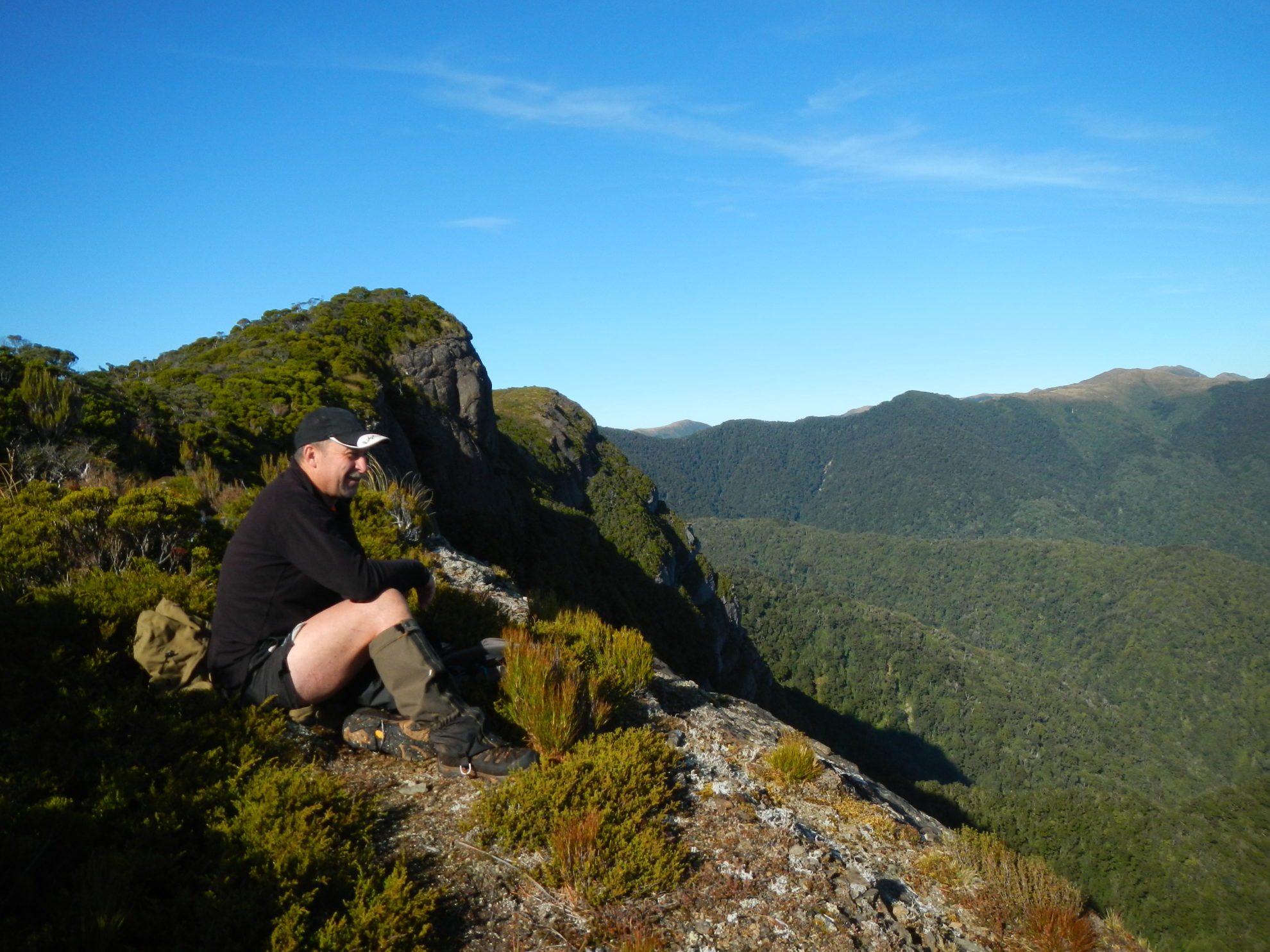
“When we built the track, we had discussions about every tree and rock,” says Nelson. “Do we have to take it out or can we go around it, or can we prune it just enough to fit the digger? In the old days, they would have gone straight through.
“So the Paparoa Track was an opportunity to bring three elements of track construction together. Let’s survey it well, let’s use machinery, but let’s fit it into the landscape. The big thing is we had contractors who wanted to listen. Those people were very skilled and took huge pride in what they did.”
The first task was to survey and design the track. There was no standard for a dual-use track, so a combination of the existing Great Walk and Grade 4 mountain bike standards was used. Both standards shared similar criteria, while the mountain bike standards also specified a maximum gradient of 6.5-degrees.
“Designing for this maxim gradient became the top priority for us. It dictated everything we did,” Nelson says.
He says it was a fine line to manage a safe bike speed for downhill, and get bikes uphill the easiest way possible, while at the same time creating an easy walking line. “We wanted a consistent grade, and we wanted to hide zigzags out across the hill because there’s nothing more frustrating for a walker than seeing long zigzags on the track ahead.”
Enter Hamish Seaton and his route-finding wizardry. “He’s an engineer, he’ll sit on his computer and study the lines, he can see the finished three dimensions of the track in his head and he has the ability to communicate all that to the digger operators so they understand,” says Nelson.
The man himself is happily surprised that he’s now making a career out of designing tracks. “Much of what I do is take data from LIDAR imaging (a kind of aerial 3D laser scanning of the terrain) and design the route on CAD or GIS software.
“You can get really accurate terrain models and pretty quickly work out where the track might be able to go,” he says. “Every hour on the computer can save days in the bush, and you can get the most desirable route with the lowest impact and least construction cost.”
Dual-use dilemmas and designs
The mantras ‘bikes wreck tracks’ and ‘walkers don’t feel safe sharing with bikes’ are often heard on dual-use tracks.
“Old tracks built for walking weren’t designed to handle bikes braking and skidding into corners and causing surface and water damage,” explains track designer Hamish Seaton. “Purpose-built dual-use tracks are made in a way that people don’t have to haul on the brakes and the water is well managed, and it definitely cuts down maintenance requirements.”
Safety factors can also be designed into the trail, he says. “The main things to think about are your sightlines, so we try to avoid leading into a sharp corner where you can’t see someone coming the other way.”
There are other, more subtle, things track designers can do. “If there does have to be a sharp corner then before that corner you make the track very flat, or even uphill, so people naturally slow down a bit and coast into it,” Seaton says. “When you think about a rider’s momentum, that also makes the track more enjoyable to ride.”
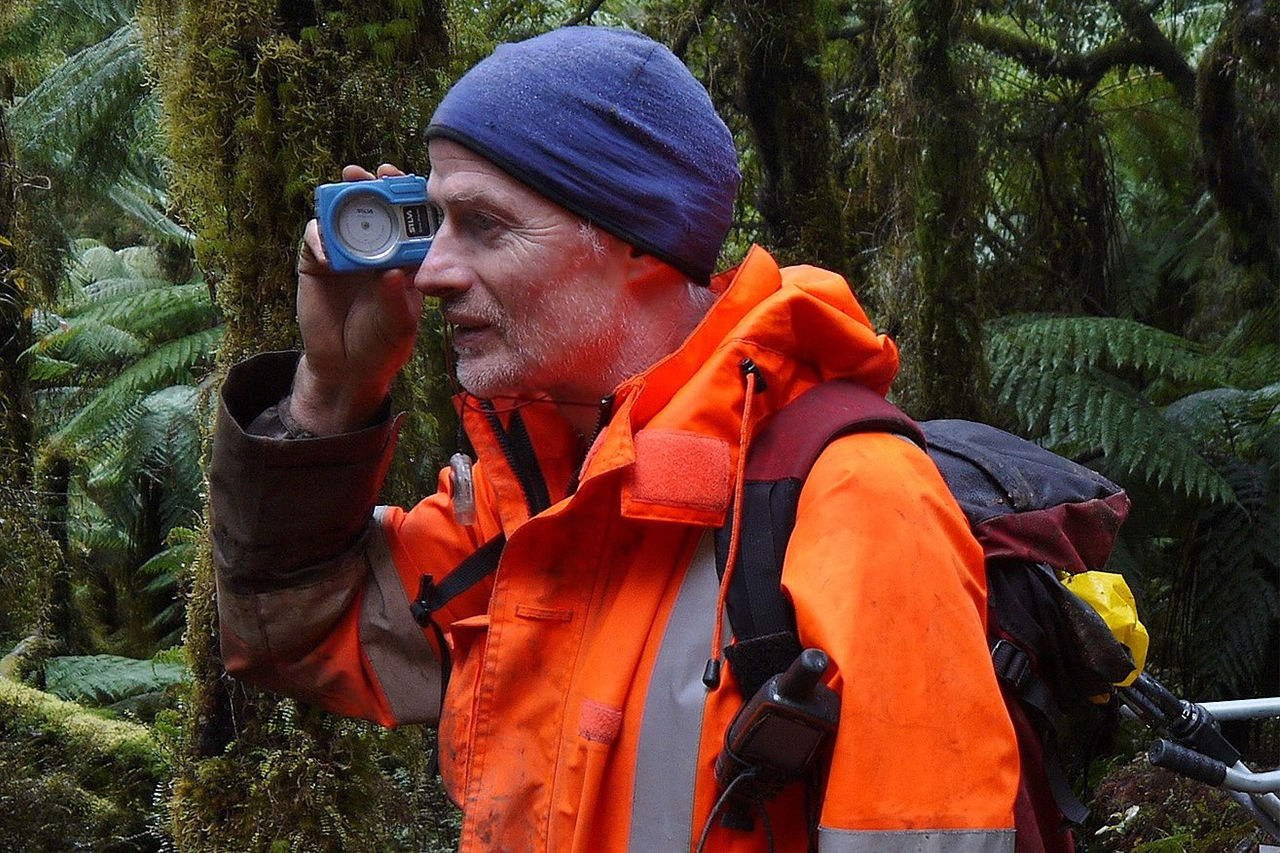
That said, there is still plenty of legwork and Seaton spent a fair bit of time on his hands and knees in the Paparoa bush.
“At least everything is loaded on my cell phone now, there are no more soggy pieces of paper to handle in the field,” he says.
Seaton recalls the track’s steep escarpment was a particular challenge. Finding a way onto the escarpment was proving difficult and that’s where his terrain modelling helped. “There were vertical bluffs with little bands where you could just squeeze a track through,” he says. “We also needed a few corners to keep the required grade so we looked for where we could put them, then worked out how to link them and at the same time minimise the amount of really steep rock we had to cut through.”
The ultimate goal was to seek the least invasive way, says Nelson. “No jarring scars of blasted tracks, no man-made structures in the landscape. With the Paparoa, taking in the design, construction, the environment, and old fashioned philosophy of track building, I believe we’ve created a benchmark others can step up to.
“The beauty for me is we are starting to come back to our roots, it’s like we’ve gone full circle back to grandad’s time.”