

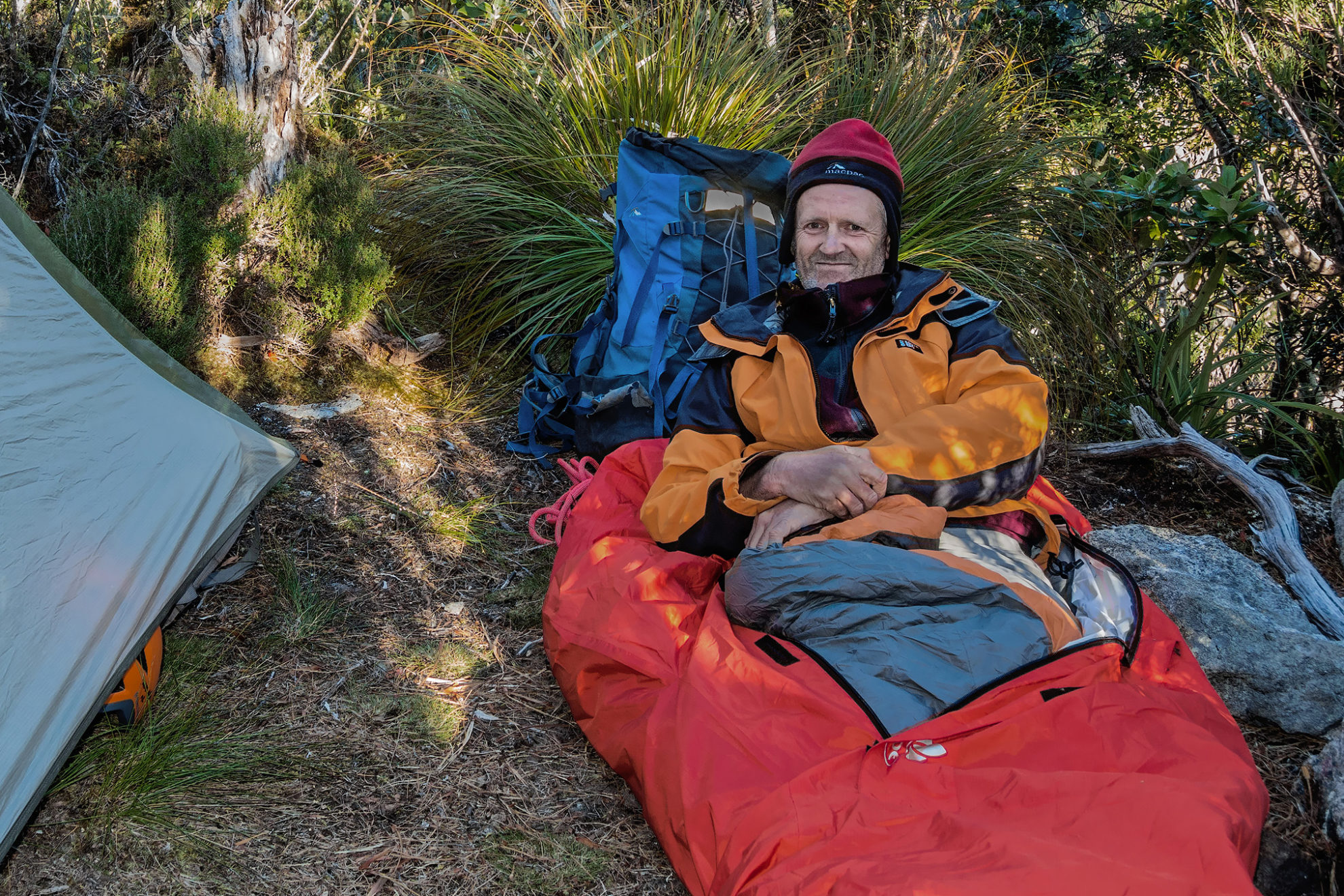
Bivvy benefits
But why would you not get a decent bivvy bag and what are the benefits of bivvying? Well, a bivvy bag is lighter than a tent. In fact, some of the flashest bivvy bags are effectively mini tents. But, they weigh less than 900g and take up less space in your pack.
My bivvy bag is kept at the bottom of my pack and gives me peace of mind. It’s a Plan B if I don’t quite make it to the intended hut before nightfall. I remember being caught in heavy cloud just north of Kahiwiroa (1320m) on the Tararua Range. Rather than risk making a wrong turn descending to Anderson Memorial Hut, I laid my bivvy bag on top of the springy tussock and slept there.
Bivvy bags also offer more flexibility when picking a sleeping spot. I’ve been on several trips where my companions have anguished about where best to park their tent while I’ve quickly found a spot suited to one body. Setting up my bivvy bag is easy when compared to a tent: simply roll it out and put the sleeping bag inside.
Then there’s the night sky. When unzipped to expose your face, a bivvy bag offers an unimpeded view from the comfort of your sleeping bag. I’ve gazed at the Milky Way from the top of many mountains and ridges all over the country. You never get tired of this. If you’re in a tent or hut, how often do you overcome pit-suction to go outside into the cold to take a look?
Downsides
Perhaps I’m making this bivvying caper sound too idyllic – and it is when the conditions are good. Add extreme cold or bad weather and I’d only recommend bivvying as a last resort, which means you can’t pitch a tent, reach a hut or find shelter under a huge rock or the forest.
On one trip, I bivvied behind a large boulder in a saddle between Mt Tongariro and North Crater. It was August, a spectacularly clear night and the coldest bivvy I’d ever done. My bag doesn’t have a face screen to allow easy breathing while still keeping out the breeze and cold. So when I fully zipped up, enclosing my head and face, I experienced a form of claustrophobia. While I wasn’t fearful, I hyperventilated. Condensation inside the bag soon became a discomfort. The only way to stop these afflictions is to unzip. The next morning when I tried to pick up the foam mattress I’d laid my bivvy bag on, it was frozen to the snow. That trusty mat had survived kea attacks on Bevan Col, but was now torn up pieces of foam.
Unlike a tent that has a fly and vestibule, a bivvy bag offers nowhere to shelter your pack, boots and other gear from the elements.
It isn’t just moisture or the cold that you need to keep at bay either. Bivvying on the saddle just west of Footstool on the route up Mitre Peak, above Milford Sound one January, was a torment due to the sandflies. The same thing happened at the base of Gillespie Pass in Otago. I’d learnt from the Mitre Peak experience to bring a fine silk sleeping bag liner, which I used to cover my face without restricting my breathing. Modern bivvy bag models have solved this problem by introducing mini-frames and mesh face screens.

Location suitability
The ideal situation to use a bivvy bag is during good weather and when reducing pack weight is important, such as on multi-day camping trips. If you invest in a more sophisticated model you’ll be able to use it comfortably beside tarns and rivers where sandflies gather; and be able to stay warmer and drier in less settled conditions.
As for rain, I’ve never put my Vaude to the test in really wet conditions. Even after a night with heavy dew, my sleeping bag starts to take in moisture. Newer, more sophisticated models claim to be fully waterproof and breathable. Many weigh less than 500g.
Bivvy bags are made from durable, hard-wearing materials but, as with pitching tents, care should be taken to avoid sharp stones, sticks or Spaniard grass that could puncture the bag and compromise its water resistance and your sleeping comfort. Using a sleeping mattress that fits inside or outside the bag can help prevent punctures by placing a cushioning layer between sharp objects and the bonier bits of you.
Well then, to bivvy or not to bivvy? For me, when the weather forecast is good and keeping pack weight down is important, bivving is a great option, especially on the tops on a clear night when I can peek at a few billion stars.
Peter Laurenson picks his four best bivvy sleeps (to date). All offer flat ground and stunning panoramic views for enjoying sunsets and sunrises.
1 South of Te Atuaoparapara, Ruahine Forest Park
“On one of the highest sections of the Ruahine Ranges, epic views of the Central Plateau volcanoes and there’s tarn water close by.”
2 Mitre/Pukeamoamo, Tararua Ranges
“The highest spot in the Tararua Ranges. There’s spongy tussock to sleep on and it offers relatively easy access.”
3 Ball Pass, Aoraki/Mt Cook National Park
“An iconic route and location facing Aoraki’s Caroline Face. There are small rock pools or snow melt for water.”
4 Gillespie Pass, Mt Aspiring NP
“A classic route through magnificent country. Snow melt for water.”
Want to travel lighter and faster? Pack one of these bivvy bags.
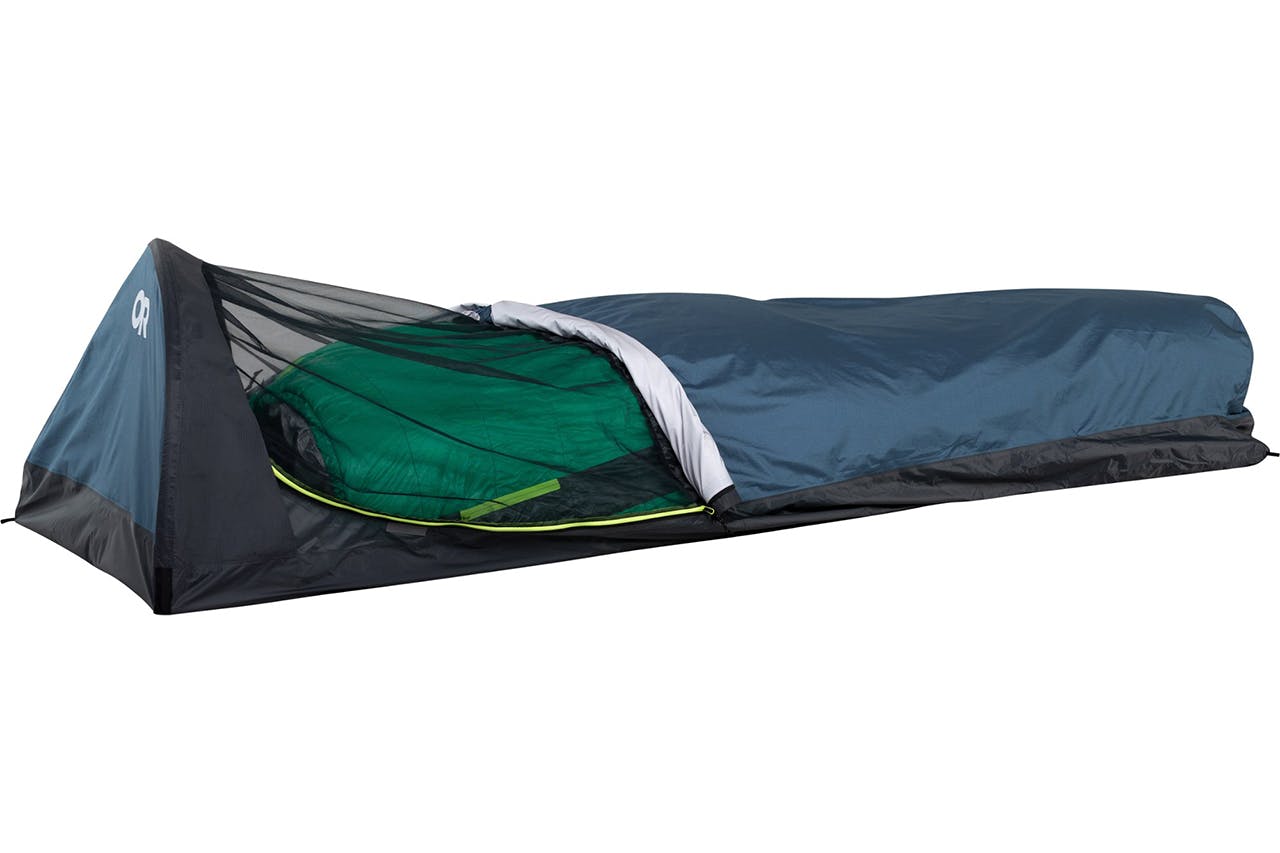
Outdoor Research Alpine AscentShell Bivy $599.99
Alpine bivvy with waterproof/breathable 3-layer AscentShell Pertex Shield Air Diamond upper, 40D TPU laminated floor, step-in opening, seam taped, mesh star-gazing and ventilation screen, one pole, two peg loops, one guyline loop. 528g. www.bivouac.co.nz
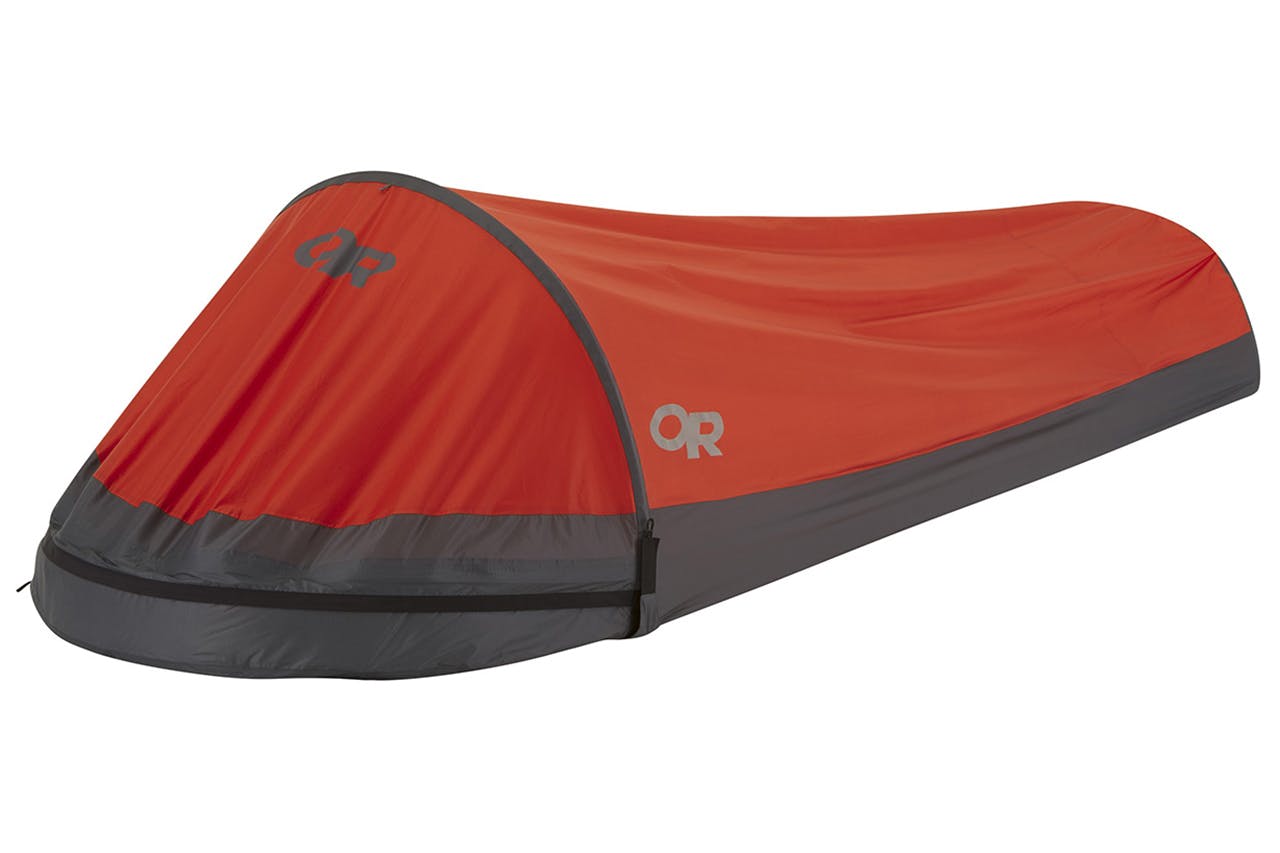
Outdoor Research Helium Bivy $299.99
Waterproof/breathable 2.5-layer Pertex Shield upper, 40D TPU laminated floor, clamshell opening, mesh ventilation and star-gazing screen, seam taped, one pole, two peg loops, one guyline loop. 459g. www.bivouac.co.nz

Trekmates Squall $299.99
Waterproof/breathable upper with 5000mm hydrostatic head and 10,000mm HH floor, head and foot poles, zippered opening with mesh panel, six pegs, sleeping mat fits inside. 980g. www.gearshop.co.nz

Sierra Designs Backcountry Bivy 3000 from $299
Waterproof/breathable 60D nylon with 3000mm hydrostatic head, u-shaped opening, fits mattresses up to 5cm thick, mesh star-gazing and ventilation panel, seam taped. Available mid-August. 390g (reg), 450g (large). www.furtherfaster.co.nz

Trekmates Storm $249.99
20D ripstop polyester upperwith waterproof PU coating, 150D base fabric with 10,000mm hydrostatic head, one pole, zippered opening with mesh panel, seven pegs, adjustable guyline. 900g. www.gearshop.co.nz

Rab Trailhead Bivi $249.95
Waterproof/breathable 40D ripstop fabric with a 10,000mm hydrostatic head, open face with mesh ventilation panel, seam taped, snap opening with stiffened peak and integrated rain gutter. 406g. www.outfitters.net.nz

SOL Escape Bivvy $119.99
Highly water-resistant and breathable, reflects 70% of body heat, waterproof seams, drawstring hood closure, side zip, puncture-resistant fabric in high-visibility orange colour. 241g. www.ampro.co.nz



