

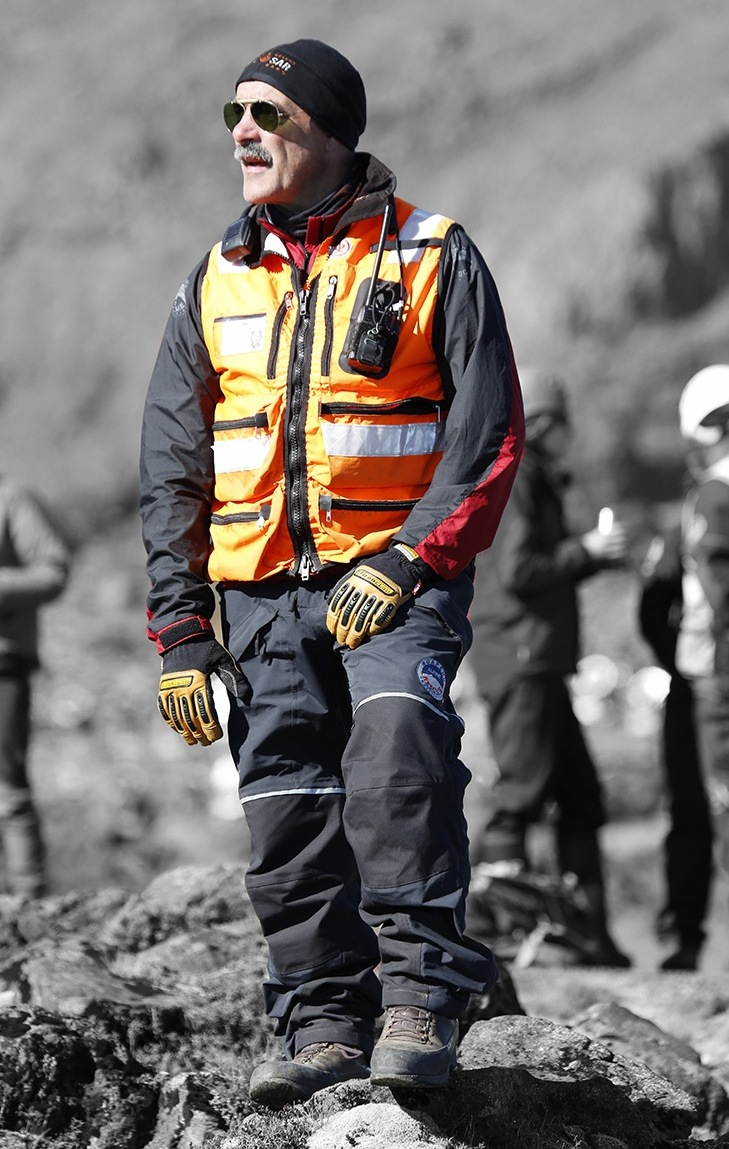
“If you can do the right thing – and quickly – you can usually get a good result.”
Paradoxical undressing is a behaviour sometimes experienced in the late stages of hypothermia.
As nerve endings become damaged by prolonged exposure, the patient can feel like they are overheating and remove clothing in spite of the cold.
Jones recalls a survivor who stripped during a blizzard because he thought he was hopping into bed.
“When you start finding clothing on a rescue, you know things aren’t usually going to end well,” he says.
‘Terminal burrowing’ can occur in the final stage of hypothermia, wherein the afflicted will hide in an enclosed space, often without their clothing, as though protecting themselves from the cold.
Treating hypothermia in the backcountry is difficult. On a search and rescue operation, rescuers will seal the patient in an airtight hypothermia bag with heat pads close to their main arteries until their extraction is possible.
The longer it takes to extract the patient, the greater the risk for the patient – and the rescue team.
Jones recalls a tough mission which saw three trapped hypothermic victims become six, and later nine, as members of the rescue team developed mild symptoms while awaiting extraction.
“It was looking quite bleak there for a while,” he says.
If trampers begin to experience symptoms of cold stress, immediate measures should be taken to ensure hypothermia does not develop.
Getting the patient warm and dry should be the top priority – whether this means changing out of wet clothes, layering up, or erecting a shelter.
Once the patient is dry and sheltered, carbs (warm if possible) will help the body to recover.
It is important to remember that insulated clothing and sleeping bags provide warmth by trapping body heat, and active heat must be applied to warm a cold body.
Without specific equipment, rehabilitation is not possible, and lingering ‘remedies’ – such as hopping into a sleeping bag with a patient – are outdated, and do not provide enough warmth energy to restore a medically hypothermic patient.
“It might be pleasant to share body heat if a person is in the early stages of cold stress, and it can make them feel psychologically better,” Dr Zachau says. “But the amount of heat delivered from another person’s body is nowhere near enough to re-warm a person who has become hypothermic and whose conscious level is impaired.
“Thermodynamic calculations have shown that you would need 300 naked, normothermic people in a sleeping bag to rewarm a hypothermic person.”
Adding hot water bottles may reduce further heat loss, but is also insufficient, Dr Zachau says. “The energy requirements to rewarm a person are very large and there is currently no portable device which is capable of doing so.
“A hypothermic person needs to get to the hospital as quickly as possible.”
As with any ailment, prevention is the best remedy and having a healthy respect for hypothermia is a good place to start.
Dr Zachau says Kiwis can be prone to subscribing to hypothermia misconceptions, such as: I can’t get hypothermia in the summer, I won’t get hypothermia because I’m fit, and, I’m just going out for a day tramp – I don’t need extra gear.
“Not being able to change into dry gear can be the difference between life and death,” she says.
Preparedness and adequate protection from the elements are critical in the backcountry, Jones adds.
“Sometimes I carry too much gear, but that doesn’t matter. If I don’t use it, someone else will,” he says.
Windchill is a big killer, and packing an extra windbreaker never goes amiss.
He also recommends packing decent head insulation, such as a beanie or balaclava, to prevent heat loss from the head and brain stem.
“Thermally, a baseball cap is just not going to do it. Fleece or synthetic materials work really well,” he says.
The aim is to be “comfortably warm”, McDavitt says.
“Try not to wear too much. When you heat up, you’ll want to strip off, and then the sweat will cool you down.”
Cotton is a deceptively dangerous fabric to wear when tramping, as it can absorb up to 2700 per cent of its own weight in moisture.
“Cotton kills because it keeps you wet and therefore cold, whereas merino or polar fleece doesn’t absorb water well and allows you to dry out much more quickly,” Dr Zachau says.
Peter Wilson recalls experiencing the dangers of cotton as a teenager during a tramping trip in the Marlborough Sounds.
“We had three hypothermic trampers, who got it by not changing into polypropylene underwear when they should have. They remained in cotton, perhaps out of modesty, when the rest of us changed,” he says.
“Our mistake was that we didn’t notice until later. The weather turned southerly and it began to snow. We first noticed the hypothermia as the three women began to stumble, with blue lips. They were soaked to the bone.”
The party immediately made camp in a two-person bivvy to rewarm the patients, but the experience was “very scary”, Wilson says.
As a proportion of outdoor fatalities, hypothermia is on the decline – perhaps due to improved emergency communication, higher quality clothing and education.
Despite this, any tramper – regardless of gear and experience – can still be caught out by a failed river crossing or weather bomb, so it pays to know the enemy.
Learn the signs, don’t ignore the symptoms, and pack enough for all weather, no matter the forecast.
How to spot hypothermia
Slurred or stuttering speech is often the first noticeable sign of hypothermia onset, accompanied by a loss of motor control, or clumsiness, wherein simple tasks like unzipping a backpack may become difficult.
Stumbling and a bad temper also occur and may be easier signs to pick up on if you’re keeping an eye on a patient.
Hypothermia can sneak up on trampers and make them resistant to help or reason. It is, therefore, best combated by tramping in groups, and solo trampers must ensure extra care to stay prepared and vigilant.
The stages of hypothermia
Cold stress: The stage preceding hypothermia, characterised by reduced body temperature (35-37℃), mild shivering and stiff fingers. Treat with warm sugary drinks, food, shelter and clothing layers.
Mild hypothermia: If cold stress develops into hypothermia, emergency services should be contacted. Symptoms may include confusion or personality changes, impaired motor functions, uncontrollable shivering, and a core temperature of 32-35℃. Treat as above, and add active heat such as heat pads and hot water bottles.
Moderate hypothermia (conscious): Core temperature likely 30-32℃, physical ability is impaired, and shivering has likely stopped. The patient should be kept horizontal and still, and choking hazards exist so treatment is nil by mouth. Active heat must be added, as patient has stopped producing body heat. Hospitalisation is essential.
Moderate hypothermia (unconscious): Core temperature drops below 30℃, and patient loses consciousness. Cardiac arrest risk is high, and patient should not be moved unnecessarily. Hospitalisation is essential for survival as the energy requirements to reheat the patient are very high.
Watch out for young ones
It is often marvelled that kids don’t feel the cold, but children have a greater risk than adults of becoming hypothermic, Dr Malin Zachau says.
“They tend to have a lower fat mass, meaning less insulation, and lower muscle mass, which means less capacity for producing heat, and lower metabolic reserves – or less glycogen stored in their liver – to utilise for muscle warming movement,” she says.
UPDATE: This story prompted numerous letters and a story from a reader who had dealt with hypothermia on several occassions. You can read ‘With hypothermia, caution is the better part of valour‘ in the July 2019 issue.



