
(Listen to this interview.)
Jay Lichter combines macro photography and fascinating facts to reveal The Secret Life of Fungi.
What is it about fungi that fascinates you, and how did this fascination start?
Everything! They’re such a cool and underappreciated group of organisms. I worked as a gardener and was already a bit of a plant nerd when I came across an anemone stinkhorn, which produces a smell similar to rotting flesh. The ingenuity of the fungal kingdom really became apparent to me after I started learning about species like that.
Tell us about the fungus on your book cover that went viral on Instagram
It got almost half a million likes, skyrocketing my Instagram overnight. The fungus is a Mycena roseoflava, it’s beautiful and pink and only 2mm tall. I managed to get this really nice close-up photo of it against a black backdrop and I included a scale shot of my finger as well, which I think highlighted to people that there is so much incredible beauty that’s invisible to the naked eye. I felt like I did my part to share the joy of fungi with the rest of the world. It was quite surreal.
How do you take the photos?
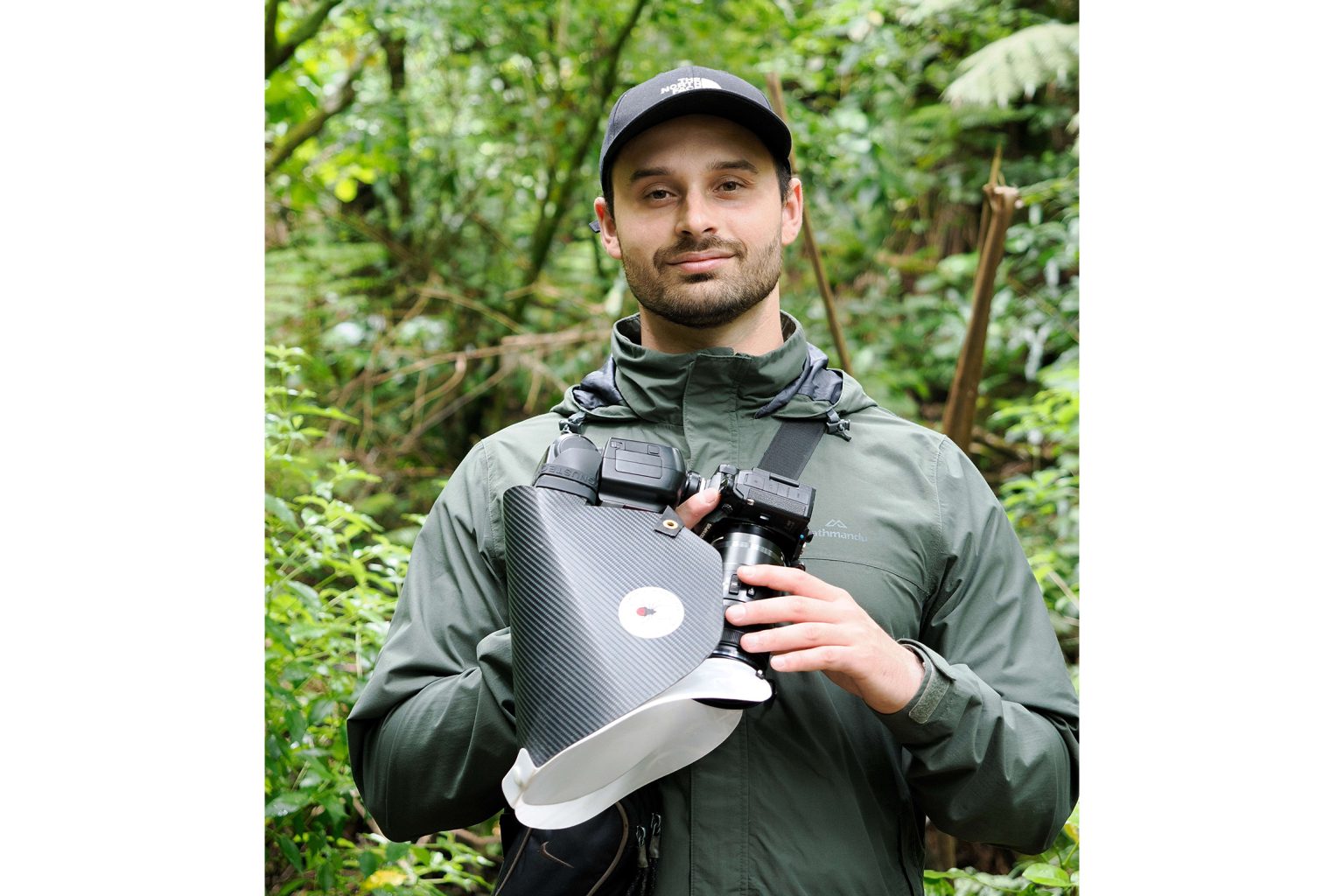
I use the OM System, an OM1 Mark II for the body. The most important part is the macro lens, which allows me to achieve the super high levels of magnification required to get a nice sharp image of something that is only one or two millimetres in size. I also use a custom-built diffuser to soften the flash. Each image is actually a collection of 50 to 150 images. I use a process called focus stacking, where the focal plane shifts back incrementally. Depending on how big the subject is, it could be by a fraction of a millimetre each time. Afterwards, I use a programme called Helicon Focus, which allows me to stack all of those images together. It extracts the sharp point from each image, which eventually combines to form one nice sharp image. It’s quite a laborious, lengthy process to get one photo.
How do you know what you’re looking at when you’re searching for fungi that are so small?
That is part of the fun, finding out. Identifying stuff that is really tiny is difficult because a lot of the time the immature fruiting bodies actually look quite different to the larger mature fruiting bodies. But, luckily for me, often there are larger ones nearby that I can use as a reference point. I also use iNaturalist. I upload my observations and experts in the field chime in. Having a second opinion is hugely helpful, but eventually you get to know what you’re looking at. You can identify shared traits across various different genuses, which helps to narrow it down.
What are the chances of walkers being able to find fungi like this?
Very, very high. Fungi are everywhere, but you need to slow down so as not to walk past them. You need to be quite intentional. Once you stop and start looking on this different, very small scale, they do begin to show themselves. Autumn and early winter are the best times. All you need really for fungi is rain and something for them to eat – their substrate – whether that’s rotting wood or soil or moss, they’re not super picky. A little bit of moisture and something to eat and they will be there.
The Secret Life of Fungi is available in the Wilderness bookstore. Subscribers get a 10% discount.