
(Listen to this interview.)
Peta Carey’s The Hollows Boys tells the story of helicopter deer recovery in Fiordland through the lives of three brothers, Gary, Mark and Kim Hollows. It reveals the true cost of an era fuelled by adrenalin and fast money – and beset by accidents and fatalities.
Kim Hollows asked me to write his story. I said, actually, it’s the story of the three of you. It took me a while to make the decision to pursue it. I knew it was a good one but also tricky to write – because there’s a lot of stories that you have to handle very carefully and be mindful of those who were left behind. Also, every project takes a good few years out of my life. I wanted to be sure the Hollows boys were committed, and that we would complete the project once we’d started.
What difference did it make, knowing Mark and Kim? Is this a story you could have told otherwise?
I first met them in Fiordland when I was 17 or 18. I’ve known them for over 40 years, Kim in particular. For the last 25 years I’ve been working out of Fiordland, covering other stories, and have got to know a lot of the other characters – Dick Deaker, Sir Richard Hayes. I think knowing Kim and Mark made all the difference. I’ve always been on the fringes, so I had an understanding most people didn’t. And as a woman I wasn’t going to retell the same ‘boy’s own adventure’ story. I knew there was a more profound and probably bleaker legacy than had been represented in other books.
The story is referred to as a legacy of loss. What impact has this had on the Hollows family and the wider community?
I think any family with an immediate loss knows what grief feels like. There is a lot of it in the book. Did they become inured to it? Possibly, but it still had an effect. There are a couple of losses in the book that are particularly heartfelt. I think it was cumulative. Perhaps for some of them it resulted in what we now call PTSD … too many hard times, too many traumatic times, too many terrifying times. There is definitely that legacy among some of those who worked in the industry.
And still they kept returning to the work.
One, it was surviving. And, particularly for Kim, it was an addiction to the adrenalin. It was good fun. It was incredibly exhilarating, and there was an edge to it that you wouldn’t normally get in life.
What role did luck play in who got to come home?
That’s kind of the underlying theme of the whole book. Was it fate or was it the roll of the dice? I leave that for the reader to decide, and I don’t think we can ever determine that one. I think luck meant that they gained experience they wouldn’t have otherwise had: they would’ve died. Mark Hollows, when he first got his licence, had barely 50 hours in a helicopter. From those early accidents he gained a huge amount of experience. So, every time there was a near miss, they learned – to the point that they became extraordinary helicopter pilots.
The deer numbers in Fiordland today are close to what they were in the 1960s. Was it all in vain?
Let’s not pretend they went out there as part of a conservation effort. That was simply a corollary of an incredible industry. They were chasing the dollar – the money was huge, particularly when they got into live capture. But it was a wonderful gift to the park. The only way you’re going to control the deer population is with helicopters and it’s a ridiculous cost.
What does Fiordland mean to you?
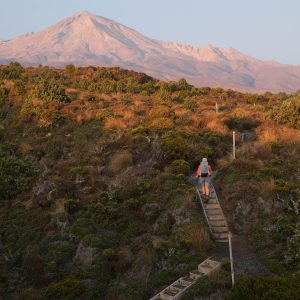
Everything. I think it’s probably one of the most beautiful places in the world. Simply that. It is an extraordinary wilderness, and I’ve been very fortunate to have meandered and voyaged and walked – and helicoptered – through most of it.
– The Hollows Boys is available on the Wilderness store. Subscribers get a 10% discount.