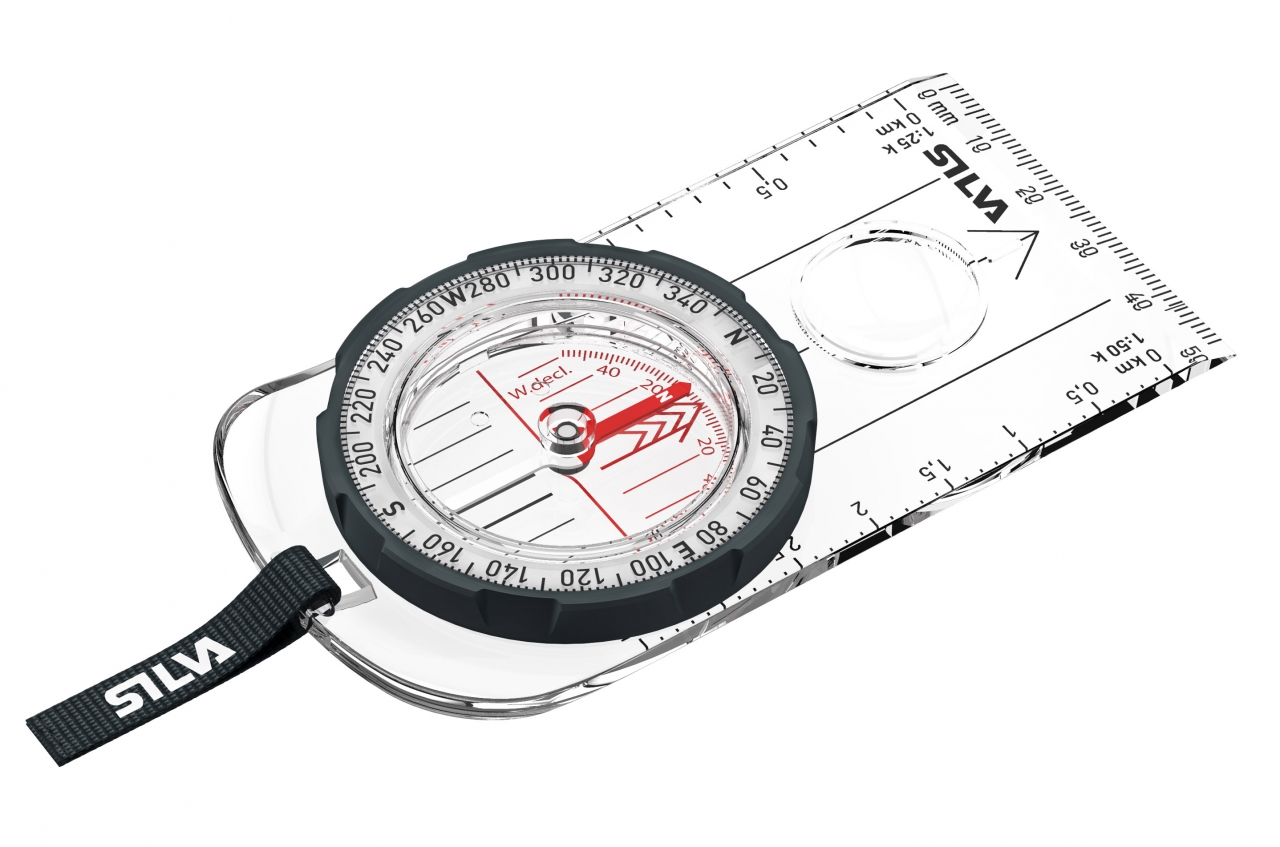
Compasses come in many shapes and forms and while all compasses have needles, not all needles are the same.
Compass needles are balanced to align and swing with the Earth’s magnetic field, but this field varies subtly across the globe so compasses balanced for New Zealand’s magnetic zone (a southern hemisphere compass) will not swing freely in Europe or North America. Similarly, a European compass will not swing freely outside greater Europe.
Needles aside, all other compass features are optional and can include the following:
Scale Bars will help you to confirm map distances. A good compass should have at least two scale bars.
Straight edges are useful when taking bearings where you line up the straight edge of the compass on the map in your intended direction of travel. At least one straight edge should be a minimum of 70mm in length; any less will not help you.
Rotating bezels should only be used when taking bearings. Once you have aligned the compass straight-edge with your direction of travel, rotate the bezel to align with magnetic north on the map. From here, following a bearing is as simple as keeping the needle pointing north.
Magnifiers are used most when approaching a destination. As you get closer, reading the finer detail of the map will be necessary to complete the approach.
Lanyards can be wrapped around your wrist to keep the compass handy. Compasses not affixed to the user are often lost!
Stabiliser disks are found in high-end compasses like the Silva Jet Spectra ($200) and keep the needle steady when travelling at speed.
A rotating bezel is useful when taking bearings, but not essential. Thumb compasses are an orienteering specialty and are specifically designed to keep you travelling on bearing; all you have to do is travel in the direction you face and keep the needle aligned to magnetic north on your map.

34 years of inspiring New Zealanders to explore the outdoors. Don’t miss out — subscribe today.

Questions? Contact us