The weka is well known to trampers for its thieving ways. Lesser known is the important conservation role it plays.
The feisty weka is well known to trampers as the mischievous rail that snatches shiny objects and food, from car keys to biscuits!
But while this backcountry ‘bad-boy’ may be a campsite kleptomaniac, that’s not the whole story. It also plays an important ecological role. Researchers have found the weka is an important disperser of large seeds such as tawa, hīnau and miro – which may help explain why they poop out their own body weight every day!
The ever-adaptable weka is also an avian ‘jack of all trades’, combining the cheeky nature of the kea with the nocturnal calling of kiwi, the tree climbing of kākā and the feistiness of the kārearea.
Weka live in a wide variety of habitats, from the coast to above the treeline and including wetlands, subalpine tussocklands, rough pasture, shrublands and both native and plantation forests.
And being an amiable scallywag, it also has friends in high places. Kiwi musician Don McGlashan and former Governor-General Anand Satyanand have both backed the weka in Forest & Bird’s annual Bird of the Year poll, and although it has not yet won the coveted title, it polled third in 2018 and may yet snatch the prize!
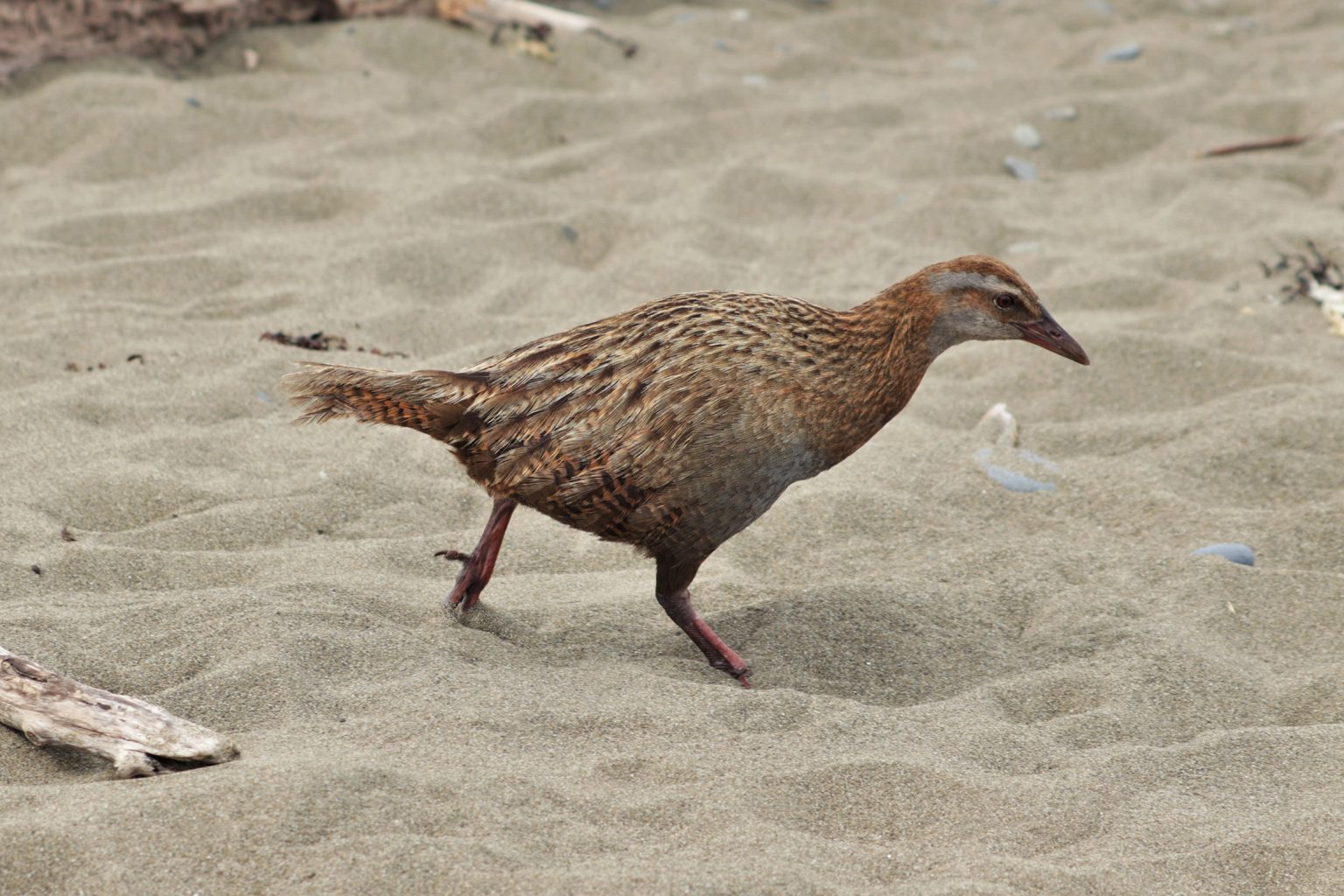
The weka is quite big for an ‘underbird’, about the size of a hen (50–60cm, 430g–1.4kg) with sturdy reddish to grey legs, a robust reddish to greyish bill and red eyes.
Most of its feathers are brown with black markings, with some regional variation among the four subspecies. Western, buff and Stewart Island weka have a grey to brown-grey breast with a brown breast-band, a grey to pink bill, and brown to pink legs; North Island weka are usually grey-breasted with grey bills and brownish legs. They make their rapidly repeated, raucous ascending coo-eet calls mainly at dawn and just after sunset.
Like its cousin the pūkeko, the flightless weka is in the rail family. The name rail is anglicised from the French râle or rasle, to groan, and relates to their harsh calls. The te reo name, weka, is similar to an eastern Polynesian Mā`ohi name for the extinct Tahiti rail, a flightless species with a red bill and red legs that resembled the weka. The Tahiti rail was known as te ve`a on the island of Meheti`a, east of Tahiti, and this seems to be the origin of the name ‘weka’.
Despite its brazen nature, the weka is unable to fend off introduced predators such as feral cats, ferrets and stoats, and is in trouble in some parts of the country.
The North Island weka declined dramatically in the twentieth century and by the 1990s only about 1000 were left, confined to East Cape. Following targeted conservation work, the population is now estimated at 20,000 birds in the hills between Gisborne and Ōpōtiki, and west to Whakatāne. There is also a growing reintroduced population on the Russell peninsula in Northland, and translocated populations exist on Kawau, Waiheke and Rotoroa islands.
The strongholds for the more abundant western weka are in the regions of Marlborough, north-west Nelson, Westland and Fiordland. The Stewart Island weka is the most threatened, being sparsely distributed on Rakiura, but there is a restoration site near Halfmoon Bay and they are doing well on pest-free Ulva Island.
Before the buff weka became extinct in the eastern South Island, a few were introduced to the Chatham Islands in the early 1900s. The absence of stoats, ferrets and weasels there means the weka is now abundant on the Chathams. While it is illegal to hunt weka on the New Zealand mainland, they are legally hunted and eaten on the Chathams. I tried roast weka there once and found it tastes like slightly beefy chicken!
Weka are not fussy eaters. They mainly eat forest fruits but will also dine out on invertebrates, small mammals, the chicks of ground- or burrow-nesting birds, and even roadkill.
Next time you go tramping in weka country, be sure to stow your valuables securely. Weka have been known to snatch car keys, iPhones, wallets and even a wedding ring left on a beach towel!
– Michael Szabo is the author of Native Birds of Aotearoa and Wild Wellington, and editor of Birds New Zealand magazine.