You’re squatting on the lawn with your friend, indulging in a classic childhood pastime. You snip the bright yellow flower off at its stem, hold it under your friend’s chin and ask, “Do you like butter?” The summer sun is reflected upward by the smooth petals, creating a dazzling yellow light and equivalent delight: “Yes!”
Well-known in folklore, the mirror-like quality of Ranunculus flowers serves a key purpose in nature by attracting pollinators. Certainly, there is more to buttercups than meets the eye. The central rosette of leaves often sends out hidden runners, each of which can form a new rosette. Ranunculus means ‘little frog’ in Latin, referring to a penchant for wet or boggy places. Many such water-loving species produce small, dry fruits with a spongy layer that allows them to float, aiding dispersal in fresh water.
There are over 40 native Ranunculus species gracing our favourite walking spots. However, the exact number of native buttercup species is no settled matter. The genus poses serious challenges to scientists and conservationists alike – both in Aotearoa and abroad.
Which buttercup is which?
Taxonomists, tasked with classifying living organisms, are simultaneously fed up with and fascinated by Ranunculus. Researchers have even gone so far as to call them ‘Gordian knots’ (near-impossible problems to solve).
This is because buttercups are notorious for (a) randomly doubling their chromosome numbers to create new entities, (b) having sex all over the show, or (c) not having sex at all. Unlike animals, which usually have clear reproductive barriers between species, these factors can blur the boundaries between plant species.
Unfettered hybridisation among buttercups can create tangled evolutionary histories that are extremely difficult to unravel. Many species can also reproduce asexually, either by growing vegetative clones (with those medusa-like runners), or by producing seed without fertilisation – an extraordinary feat known as apomixis. Some buttercups combine these tactics with a more conventional sexlife, favouring a ‘once in a while’ approach. Gordian knots, indeed.
We’re often led to believe that ‘species’ is a fixed concept, when in fact designating species is like trying to draw a line in the sand – one that is at imminent risk of being washed away.
Conservation in Aotearoa often focuses on ‘species’ as the unit of rescue. But what do you do when it’s difficult to file organisms neatly in boxes? How can we point to a lovely buttercup bloom and name it with confidence?
Native buttercups have accrued many Māori names, depending on their form and habitat: waoriki, mārūrū, kōpukapuka, korikori, or kawariki, to name a few. Such diversity reflects their widespread presence across the motu. Learning to recognise distinctive species can begin to help us attune to more unusual forms. As walkers, our observations are valuable. For example, we can log our sightings on inaturalist.org, so that researchers can start to paint a picture of what’s going on with our flora.
The big, the small, and the vulnerable
Get to know the following distinctive buttercups as a starting point.
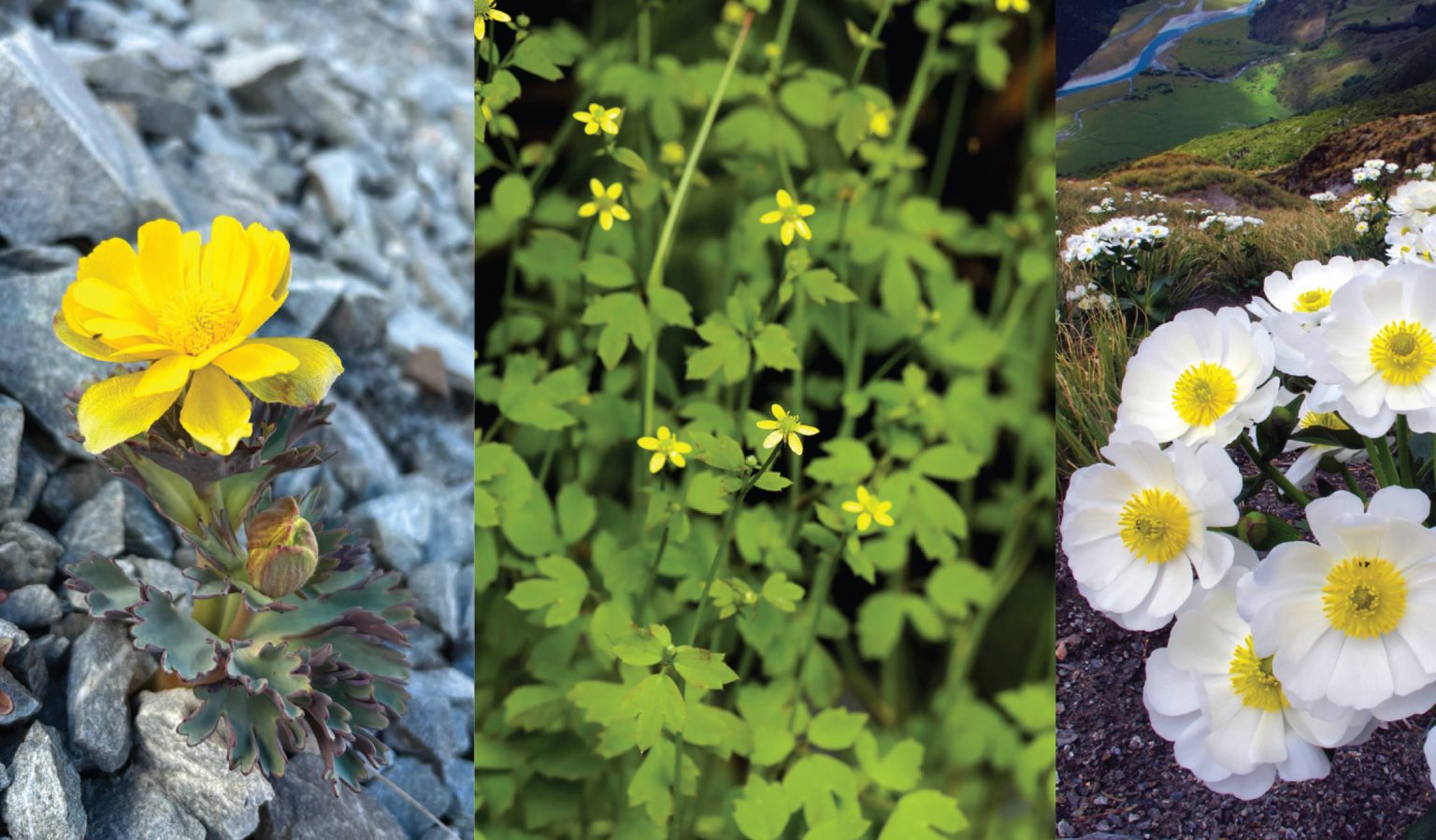
The big: Giant buttercup (Ranunculus lyallii). You can’t miss this brash buttercup when walking in the Southern Alps in summer. With large white flowers and lily-pad leaves, it is the jewel in the walker’s flower-crown. While clean-cut in its looks, it is a genetically diverse species. Found near or above the bushline; herbfields and creeksides; Te Waipounamu and Rakiura.
The small: Mārūrū (Ranunculus reflexus). You have a good chance of seeing this modest beauty on your local bush walk. With hairy three-pronged leaves and dainty flowers, it hugs the trackside in damp dells. Found from sea-level to uplands throughout Aotearoa.
Photos above supplied by: Lixin Zhou, Matt Berger and Nick Dennis/iNaturalist
The vulnerable: Haast’s buttercup (Ranunculus haastii). This scree specialist sends down sturdy roots over a metre long to anchor it on moving slopes. With succulent blueish leaves, this at-risk species is hard to spot except when in radiant flower. Look out for other scree plants while you’re at it. Found on mountain screes of Te Waipounamu east of the Main Divide.
Take a moment to look out for and appreciate our native Ranunculus on your next hīkoi. And if you’re feeling nostalgic, perhaps even lower your chin over a bright buttercup flower … are you still fond of butter?