(Listen to Hazel read her story with a follow-up Q&A about the trip with our editor.)
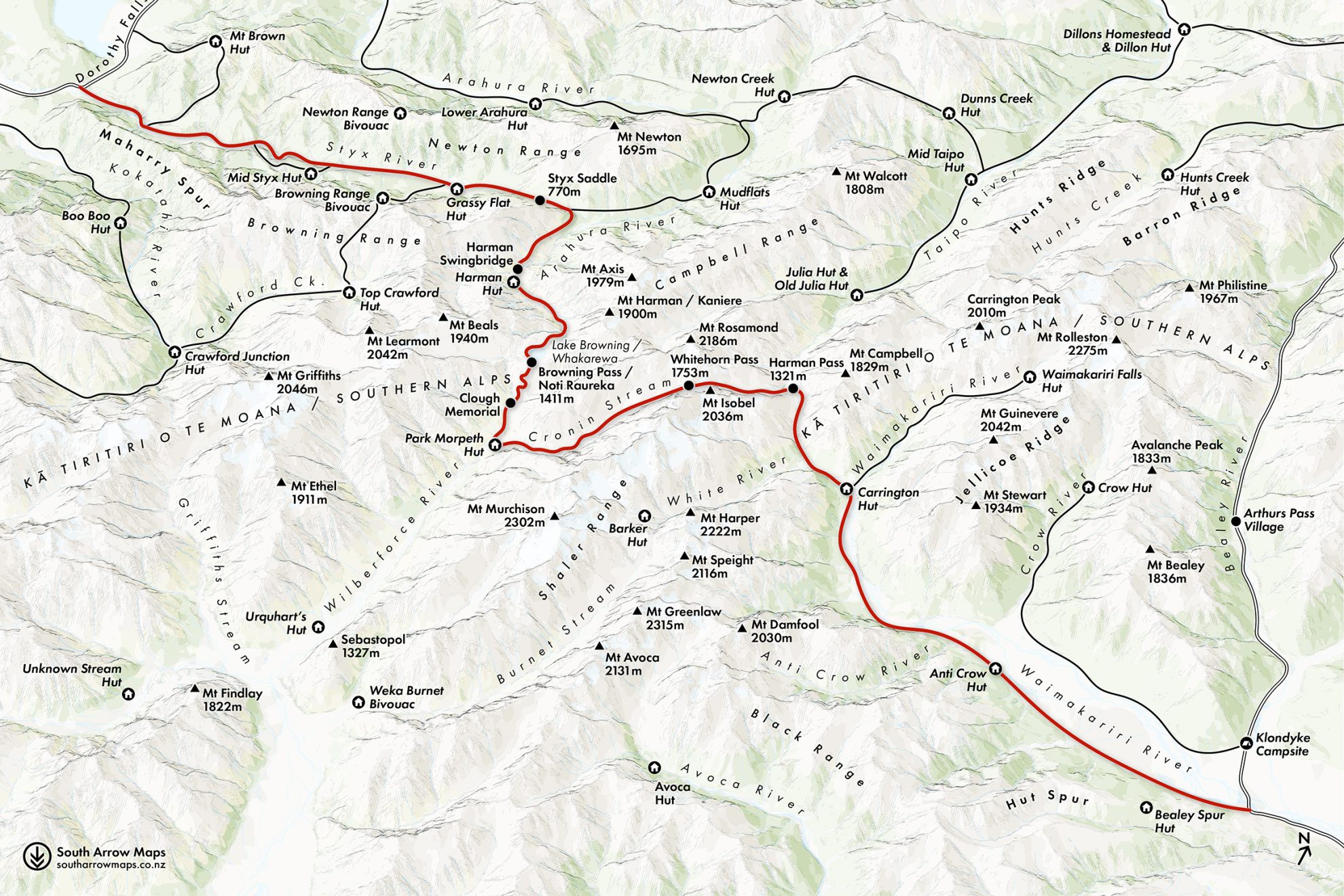
I was warned not to attempt the Three Passes route solo, and for 10 years I listened. But after too many false starts – bad weather, work deadlines, lack of tramping buddies – I gave up waiting and went anyway.
The warnings were based on the steepness of the climb to Browning Pass, a notch leading to a round lake. Both are named after John S. Browning, who crossed the pass with Richard Harman and others in 1865. The men drew lots for the honour of the lake’s name. Browning, the smallest man in the party, drew the biggest lot and claimed the prize.
The ascent is indeed steep, and Browning himself had a mishap here. Charging ahead of the rest of the party, he slipped on ice, slid 120m but somehow escaped unharmed.
The track was once intended as a dray road between east and west. The explorers reported that although it was walkable, it was rough and steep – especially towards the top. With a flourish of typical colonial optimism, they concluded: “There is nothing to prevent a road being cut up it in a zig-zag direction with long sidlings.” Dreams are free.
But they’d jumped the gun in naming the pass and lake. The route was already well known to tāngata whenua; a wāhine toa, Raureka, was the first to cross there, solo, with a supply of pounamu from the West Coast. Early Pākehā historians labelled her a ‘madwoman’, thanks to a poor translation by writer James Cowan. In truth, she was tenacious and brave, and happily, her name lives on: the pass is now Browning Pass/Noti Raureka.
In 1931 the first European women crossed the pass. Mrs M. Wallace, Miss Phyllis Sheriff and Miss Vera Marshall tramped from west to east with four men and a guide. On the descent they found the shingle face below the pass was dangerously unstable. Roped together, they half-slid, half-scrambled down, desperate not to trigger a collapse. After camping beside Wilberforce River they exited down-valley and did not complete the full Three Passes trip.

Five years later two young female trampers put the pass in their crosshairs. Joan Singleton from Tararua Tramping Club and Mary Thorpe from Canterbury College Tramping Club became the first women to complete Three Passes ‘without male assistance’. Despite the lateness of the season, heavy rain as they walked up Waimakariri River and a rule forbidding women from staying at Carrington Hut (then a Canterbury Mountaineering Club hut), they finished ‘without incident’.
After Carrington Hut, Joan and Mary overnighted at Park Morpeth Hut, then camped in the Kokatahi Valley, and walked out to Hokitika.
Mary fades from the record there, but Joan added a few more feathers to her mountaineering cap. The year before she had been part of a group of Tararua Tramping Club climbers – 10 men and five women – doing several first ascents in the headwaters of Rakaia River. Joan was rubbing shoulders with some key names in the history of women’s tramping and climbing, such as Mildred Huggins, Jean Shallcrass and Betty Lorimer.
That year she also climbed Mt Rolleston with John Pascoe and H.M. Sweney – a 25-hour expedition in August, remarkable for the era. Described as a marathon effort, it was reminiscent of Betsy Blunden’s iconic first ascent of Mt Oates with John Pascoe and Brian Barrer in 1931.
I tramped, alone, up the Waimakariri River bed on a sunny Thursday before Easter, with the aim of beating any holiday rush. At Carrington Hut I smacked my fair share of sandflies, ate a dehy dinner and bunked down early, anticipating a long day on the morrow.
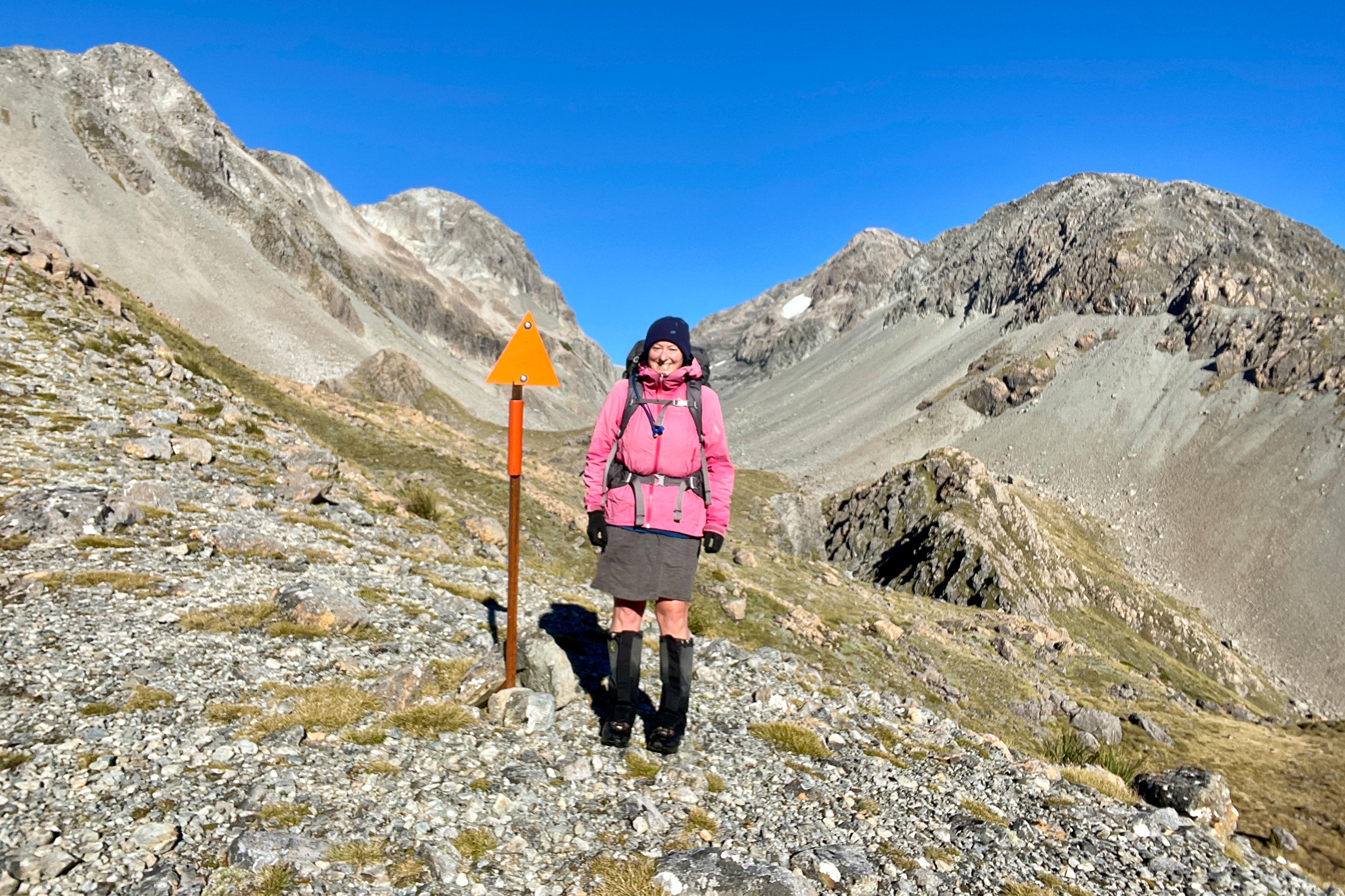
I’d done Harman Pass before with my mate, Mike, but we’d turned off down Mary Creek and gone out the Taipo. Trepidation rose as soon as I left Carrington Hut, but like Joan and Mary before me, I reached Harman Pass ‘without incident’.
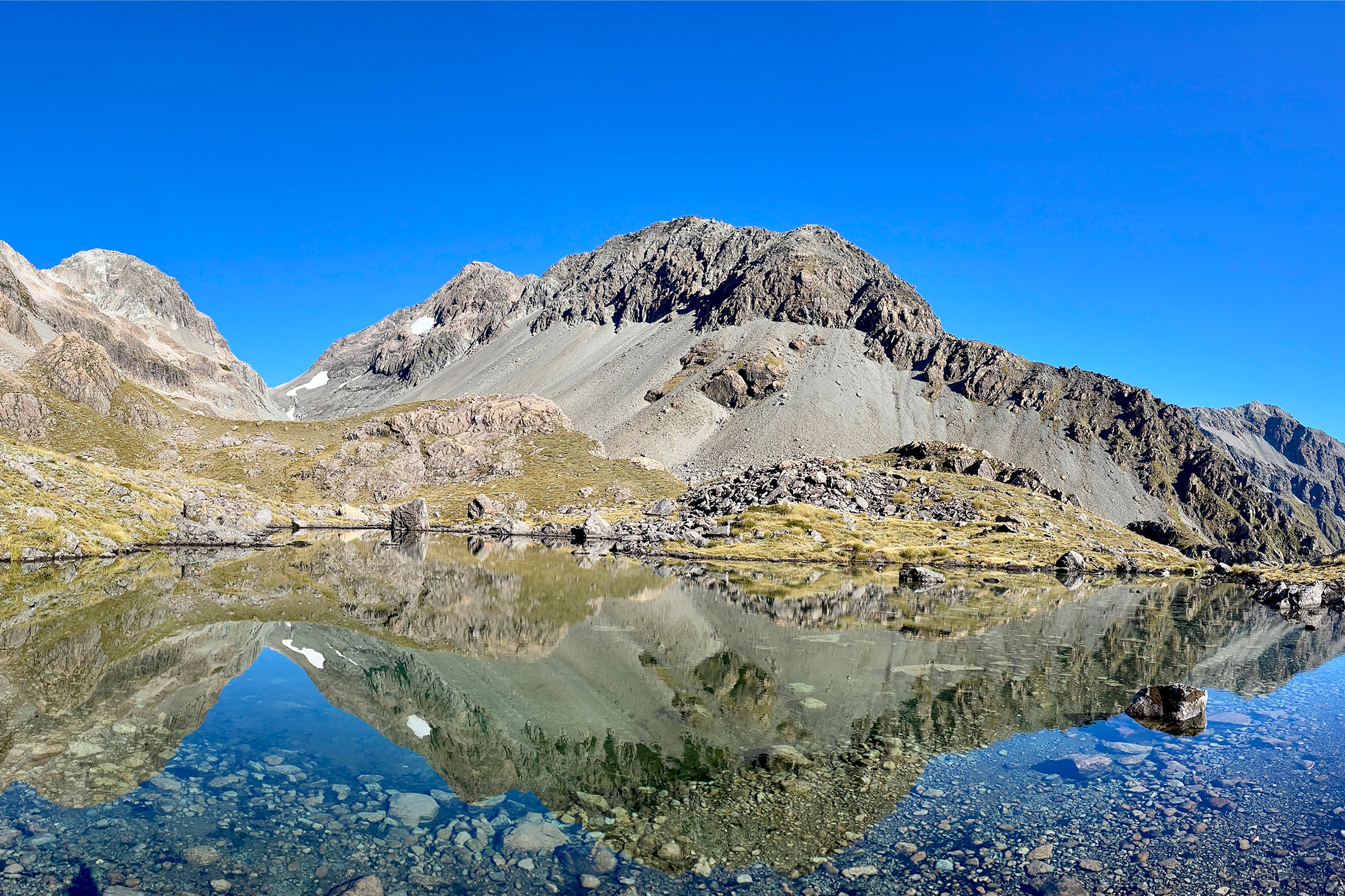
Ariels Tarns, startling in their clarity, gleamed like fragments of the sky fallen to earth. I picked my way towards the V-shaped horizon of Whitehorn Pass. Named for Alfred Whitehorn, who surveyed the Styx and Kokatahi rivers in 1906, the glacier there has been shrinking steadily; in 2019, it reportedly collapsed entirely for the first time.
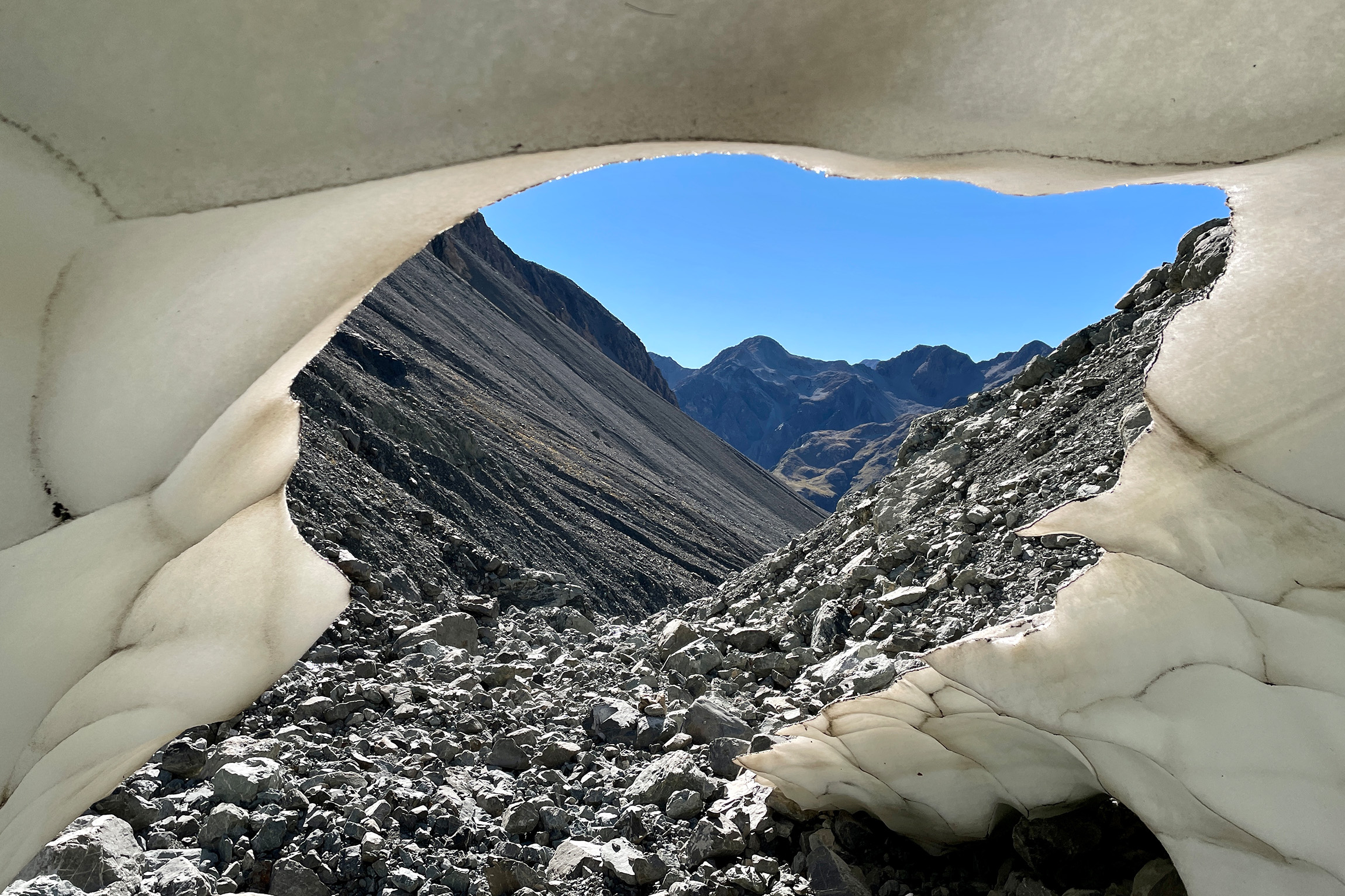
Getting onto the ice of the Whitehorn was a trick in itself. It was still early in the day and the ice remained slick, so I used my lightweight ice axe to cut steps. Immediately below my steps was an ice cave from which a small stream issued, and to slide and fall off the end of the ice would have spelled a PLB activation. After 20 minutes of hot work I found myself on a flatter section that was covered with a blessed few centimetres of softening snow, and began to trudge more confidently upwards.
Once over Whitehorn Pass I descended with some relief into Cronin Stream, with Mt Rosamond and Rosamond Ridge towering above, watching over me. These features were named after Rosamond Harper, who was as close as you can get to historic climbing royalty. Her grandmother, Joanna Harper, was the first (known) woman to walk on the glaciers of Mt Cook in 1873 and considered it a grand adventure. Her father, A.P. Harper, was founder of New Zealand Alpine Club and encouraged her in her climbing pursuits, such that in December 1934 Rosamond teamed up with Betsy Blunden and Lella Davidson to do the first all-woman, unguided ascent of a major peak, Mt Sefton. In 1935 Betsy and Rosamond did a winter climb of Mt Rolleston. By themselves.
I thought about them as I marched down the Cronin, an endless, rock-strewn valley. I scanned constantly for the side track that would take me around a gorge and down to Park Morpeth Hut, named for James Park and John Morpeth, two teenage trampers who drowned crossing a tributary of Wilberforce River in 1929.
At Park Morpeth Hut I collapsed in my sleeping bag, ate more dehy and leafed through the hut book. A Canterbury Mountaineering Club member had recorded his travel time in the book (a time I thought to be rather impressive) and beside it someone had scrawled: ‘Nobody cares, mountain man’. Even in the backcountry, hierarchies persist.
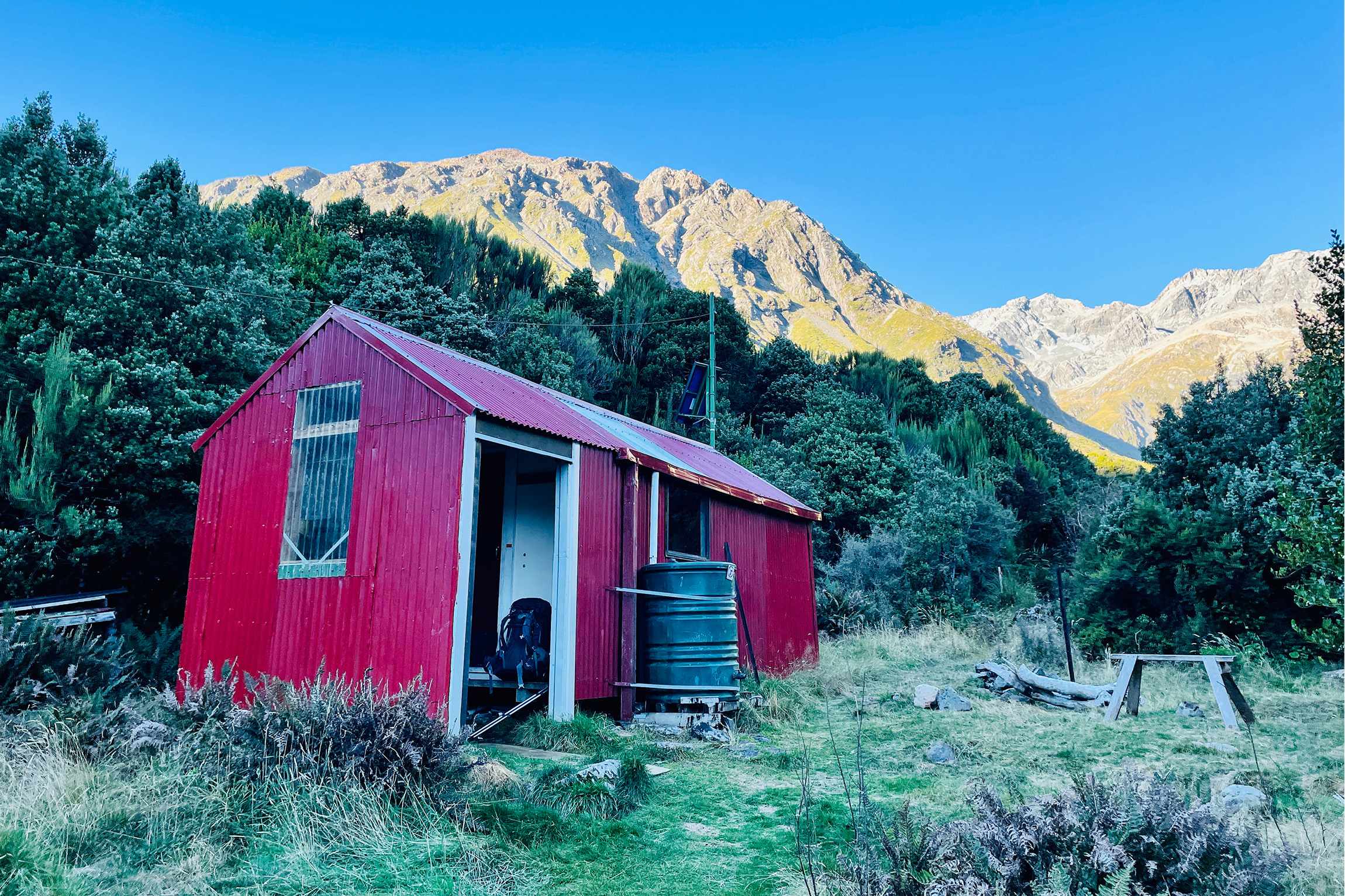
The next morning was the day I might die, climbing Browning Pass/Noti Raureka alone; the coroner would make pithy remarks about my lack of judgement and utter absence of skill. Earlier words of encouragement from my friend, Wayne, echoed in my head: “You’ll be fine, mate, just take it quietly.”
I touched the Clough memorial at the base of the pass as a mark of respect for Allan Clough, a 15-year-old enthusiast who drowned in the Wilberforce in 1956. (There’s a lot of death on this trip.)
DOC says two hours to gain the pass, and I took three. I usually beat DOC times, but that day I wanted each step to be completely solid. With Wayne’s words looping in my mind, I inched up the zig-zags towards the pass. I made a rule: I would not look down, up or around, until my feet were firmly on the flat of the pass.
A friend once told me how his girlfriend lost her mojo here and cried. At least if I cried, nobody would witness it – even the coroner would never know.
“There is no down,” I told myself. “There is only up.”
The zig-zags, distinct from a distance, were overgrown, fading in and out of the slope. I lost the track once but regained it by heading straight up until my boots found it again. I placed my poles with precision and at times gripped the tussock with sweaty palms.
In reality, Browning Pass/Noti Raureka isn’t much worse or steeper than what Joan Singleton would have cut her teeth on in the Tararua or Kaweka ranges. But it is consistently true: to fall could be fatal. You wouldn’t slide and stop – you’d bounce and cartwheel. Browning was lucky to survive.
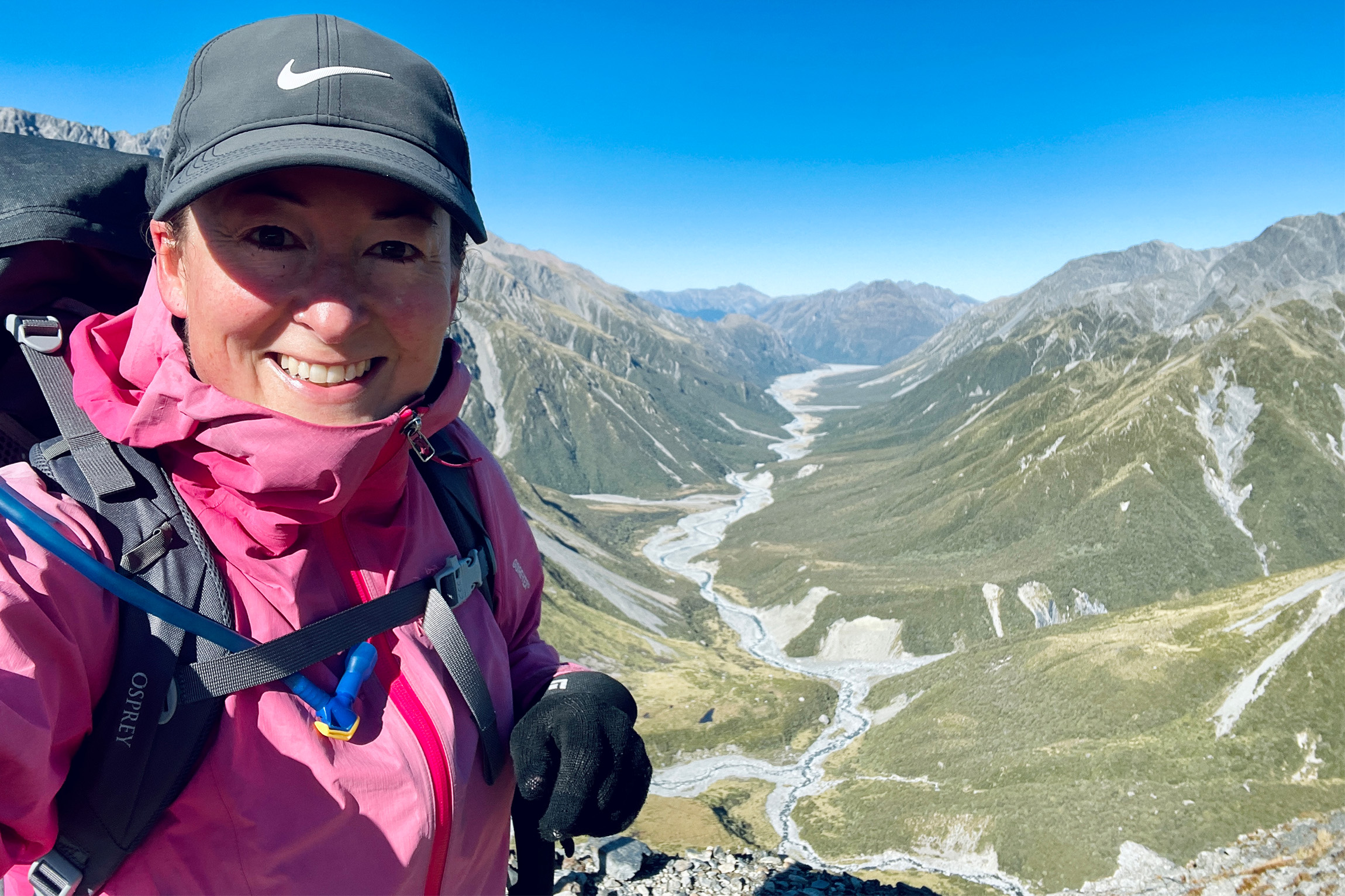
The top section appeared, almost under my nose, as though conjured up by concentration, and the track veered left into bluffs. I made my steps ever more careful, picking out small ledges for my feet.
The DOC notes say: ‘Once you gain the pass, relax.’ I wanted to, but at the top, relief vanished with the wind. Gusts whipped over the ridge, clouds billowed from the west and my eyes streamed. I snapped some photos, unseeing, and hurried around the lake’s edge, head down against the gale.
I spent the next two nights at Harman Hut as I knew a day of wild weather would be blowing through. I did not anticipate anybody coming over the pass in such bad weather, but the hut became a train station of soaked, cheerful trampers.
Later, I exited via the Arahura River valley, lush and green, the kind of valley that feels like recovery. As I wombled out on the easy former pack track, I thought not only about my own mortality but also about Joan Singleton,Mary Thorpe, Rosamond Harper and Betsy Blunden, the historic, tough ladies who’d walked before me. And Raureka, the crazy wahine who wasn’t crazy at all.
Raureka had walked it solo too.
Joan and Mary later crossed Whitcombe Pass with another woman, Miss Nurse. It was another female first: unguided, women only.
Little remains of Joan’s history beyond a few newspaper lines and one enduring quote in a Christchurch newspaper: “Miss Singleton, who is an experienced climber, considers that Canterbury people – especially girls – are not sufficiently alive to the attractive climbs and tramps that are available in their ranges.”
Ninety years on, her words haven’t lost their edge.
– Hazel’s fifth book, about early women climbers of Aoraki Mount Cook, will be published in late 2026.