

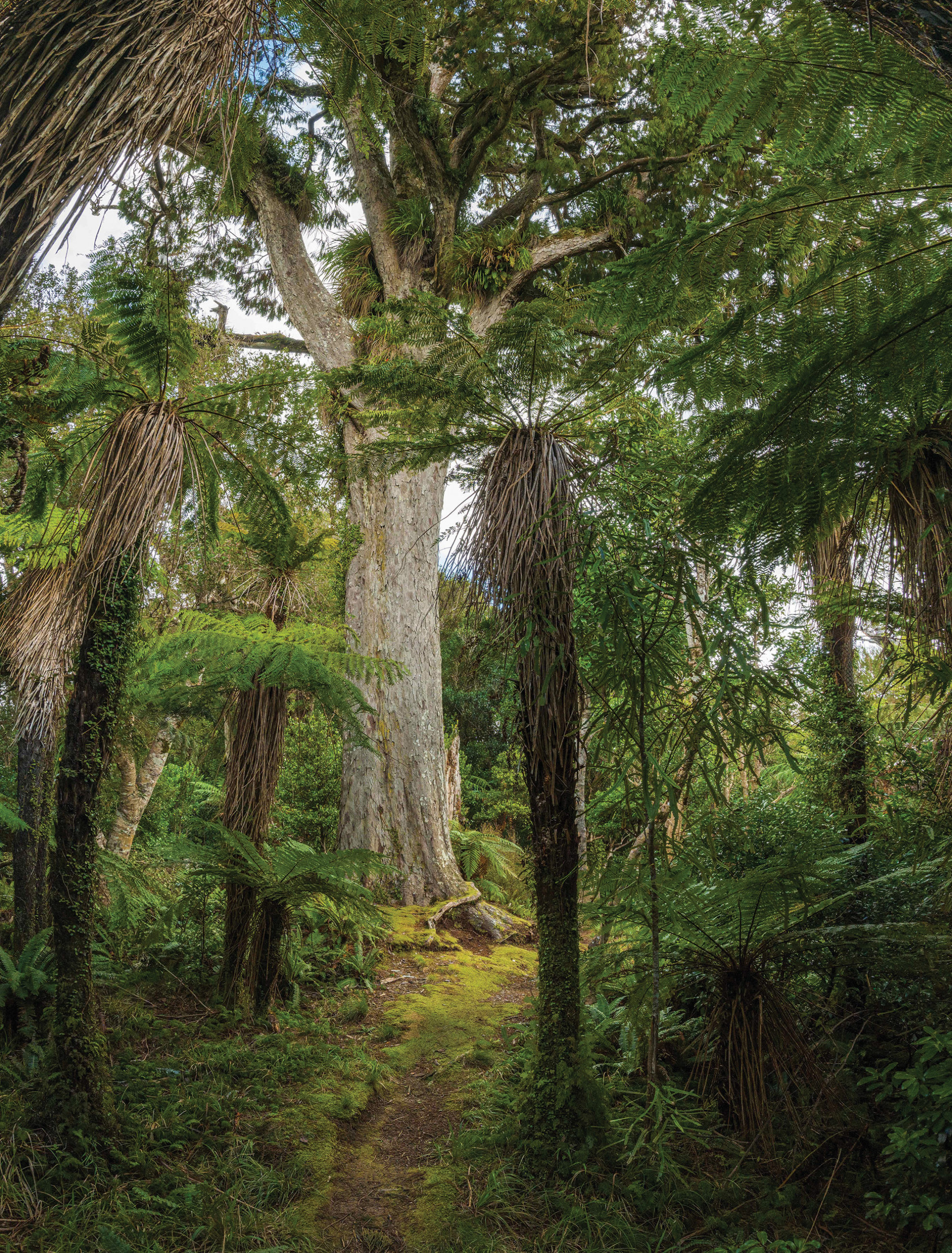
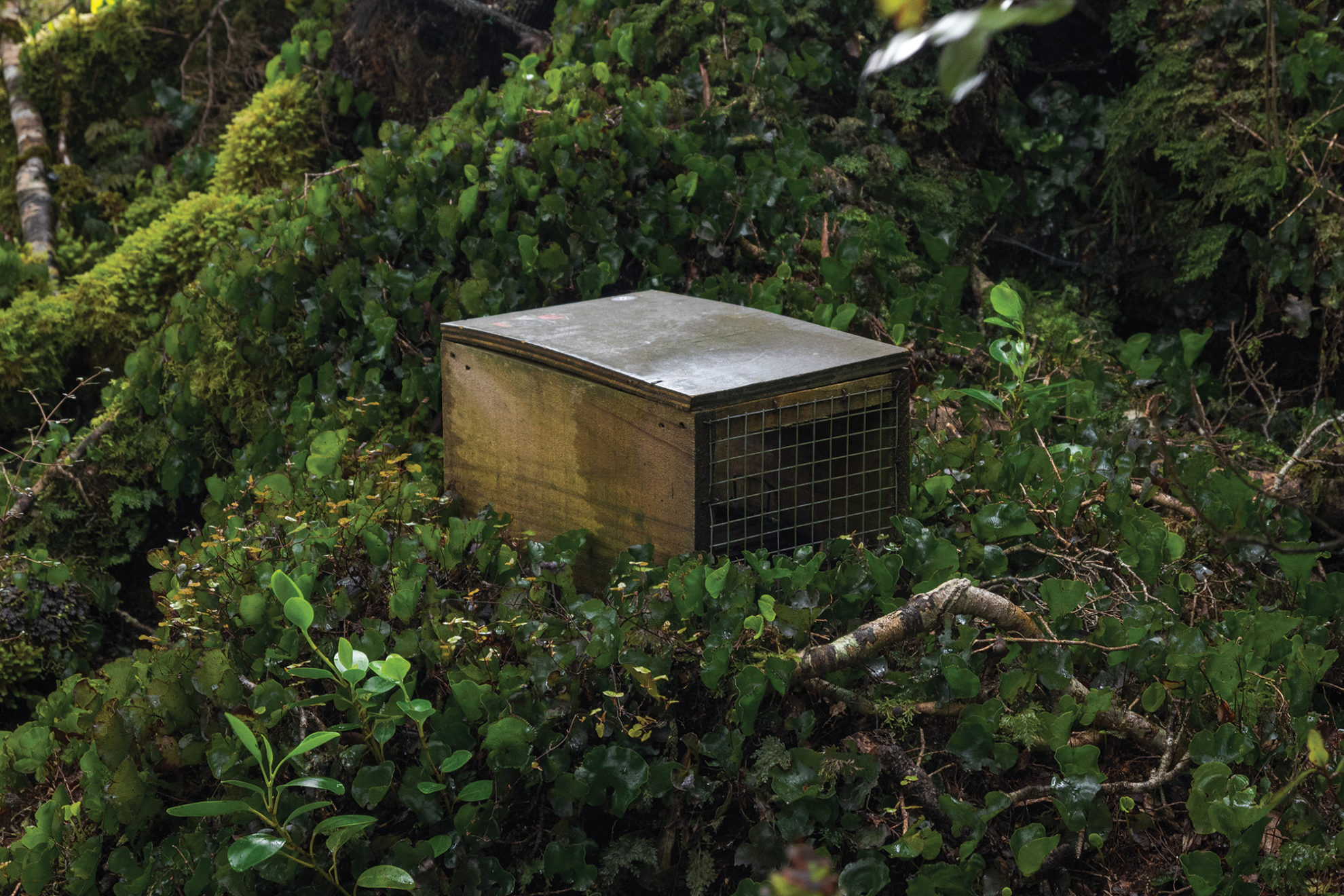
‘My’ trapline, known as MO42–MO57, consists of fifteen DOC200 traps inside various-sized wooden boxes. From the Catchpool car park, the line is reached by walking the popular Ōrongorongo Track as far as the McKerrow Track signpost. Then it’s a climb up the leading bush spur that culminates in the forested summit of McKerrow (706m).
The traps begin about halfway up, starting with MO57. They’re spaced about 100m apart and are marked by pink triangles. The last one, MO42, lies near the McKerrow summit, and to complete a tidy triangle, the line descends the Clay Ridge and Graces Stream tracks back to the car park. It takes between four and six hours, depending on energy levels and how many dead pests are in the traps.
The unpleasant smell of rotting flesh usually alerts you to a kill, mostly dead ship rats with their long scaly tails sticking out of the wire netting. Unscrew the lid, foot on the trap box, pull up the spring-loaded plate with a tool in one hand and pull out the dead pest with the other. Fling the carcass away then reset the trap. Replace the bait – either with a fresh egg or dehydrated squares of rabbit meat known as Erayz.
Occasionally there’s the satisfaction of catching a serial killer: a stoat. They are extraordinary animals with sleek brown fur, white bellies and a black tip on the tail. Recently I made the mistake of pulling a dead stoat through the netting, which must have scraped over its scent glands, releasing an awful stench. The stinky secretion persisted even after I scrubbed my hands with soap and water.
As a tramper, I usually want to discover new places. So, wouldn’t walking the same track become repetitive or tiresome? Yes, on the surface. Same track, same traps, same job, 16km through enclosed forest of almost unrelenting green. And there’s no view from the McKerrow summit.
But on another level, interest lies in the detail, the small differences that each trip offers, getting attuned to the nuances of the track in different weather, different seasons. Over dozens of trips the forest has slowly revealed its complexity and diversity to me, and now I’m surprised by the degree of affection I feel for this track.
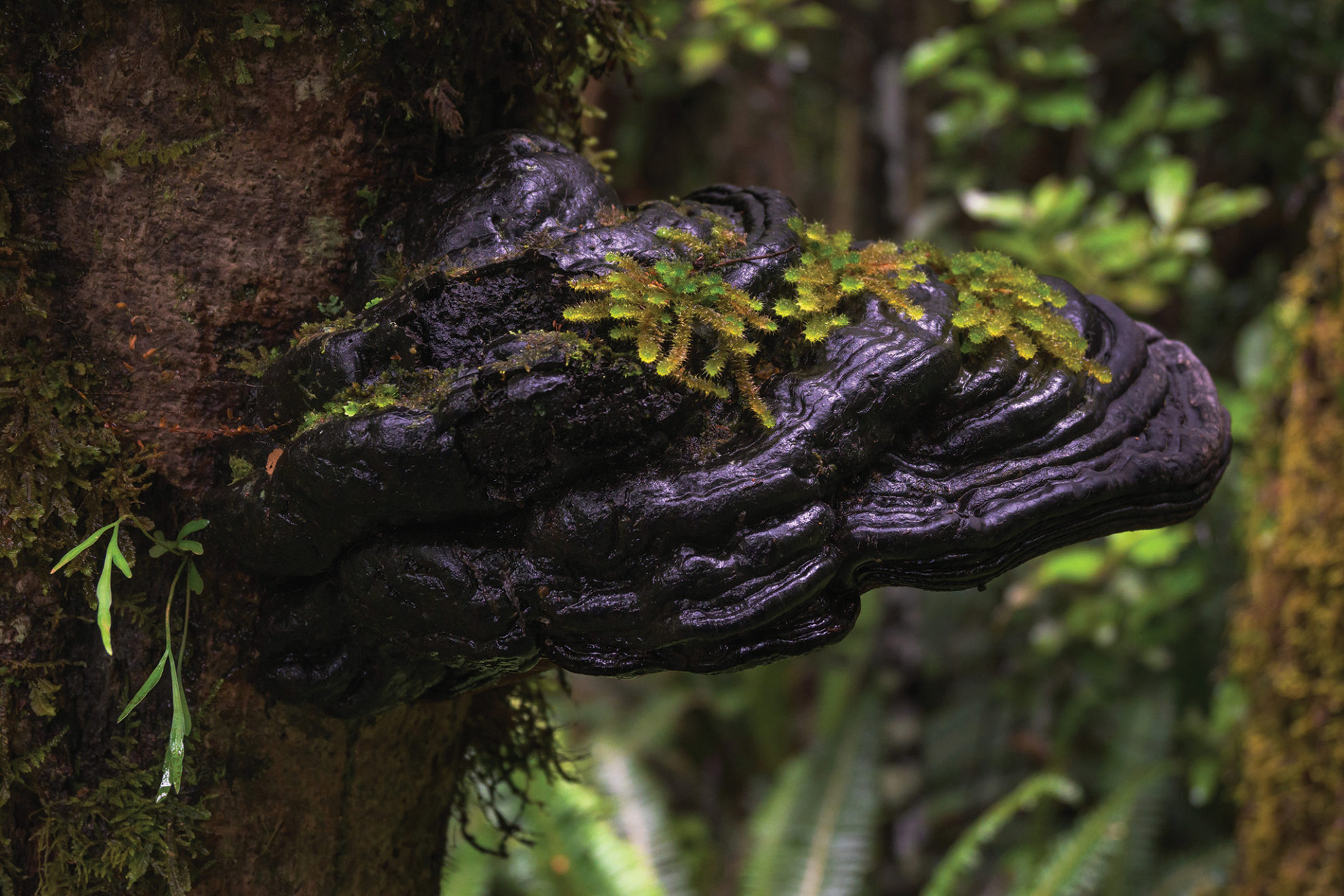
The broken canopy where large trees have fallen in one place, the altitude where the tree ferns give out and the stunted mossy silver beech takes over. The carpets of kidney ferns, the sprouting orchids that protrude from tree trunks, and the bracket fungi that are almost as hard as the dead wood they feed upon. The broad, bold rimu on the Clay Ridge Track and the sylvan shelter of Graces Stream, lined with grand stands of red beech forest, the track littered with fallen leaves.
I’ve also come to know which birds are common and which are rarer visitors. The high-pitched, almost imperceptible calls of titipounamu (rifleman), the trilling of riroriro (grey warbler), the heavy flapping of a kererū, the happy chittering of a flock of tauhou (silvereye), and occasionally the predatory kek-kek-kek of a kārearea, which almost immediately results in alarm calls from the startled passerines.
My friend Kathy Ombler often joins me and we’ve developed our own rituals. Like the egg-smashing challenge. Fresh egg in the trap box, old egg out.
“Okay,” says Kathy. “Try and hit that tree.” She points to a tree about 15m away. I hurl the old egg at the trunk and usually miss, sometimes comically badly. We keep score. When the target is missed, the thrower suffers ridicule: “Pathetic!”
A short way down Clay Ridge Track is a wall of stunted silver beech trees, their white trunks blotched with lichen and moss. Nearby, dead tree stumps protrude from low and shrubby vegetation, dominated by dracophyllum, red matipo and kāmahi.
I don’t know what caused this break in the forest, but it may have been a fire – perhaps started by a lightning strike – which razed the vegetation some decades ago. Beech is slow to re-establish, so the shrubby plants enjoy their turn in the sun. Wellington’s famous winds probably also hamper the larger trees from re-establishing.
This is our lunch-stop viewpoint. Here, when it’s sunny, Kathy and I sit to enjoy the outlook over Wellington Harbour and the more distant Kaikōura Ranges. We compare and sometimes share lunches. Kathy pours us coffee from her thermos and we linger. At times of inclemency, however, we brace against the cold wind, watch clouds scud past and scoff our lunches before a hasty departure.
Checking the traps is one small gesture, part of the effort of thousands of volunteers working on conservation projects around the country. All are striving towards Predator Free 2050, first suggested in 2012 by distinguished scientist Sir Paul Callaghan shortly before his death from cancer.
Some people question the possibility of achieving this audacious goal, now less than 30 years away. But for many the date is irrelevant. Simply aiming for the goal means untold advantages for native species, like the kiwi in the Remutaka Range. And as I have come to appreciate, the benefits for volunteers are almost equally profound.
Without the task of checking the traps, I wouldn’t have come to know the forest in this way. Familiarity has bolstered my knowledge, given me a satisfying sense of purpose.
In short, I’m learning to see the trees in the wood.



