


The benched track follows the Arahura all the way to Styx Saddle. It’s a friendly gradient, suitable for most fitness levels.
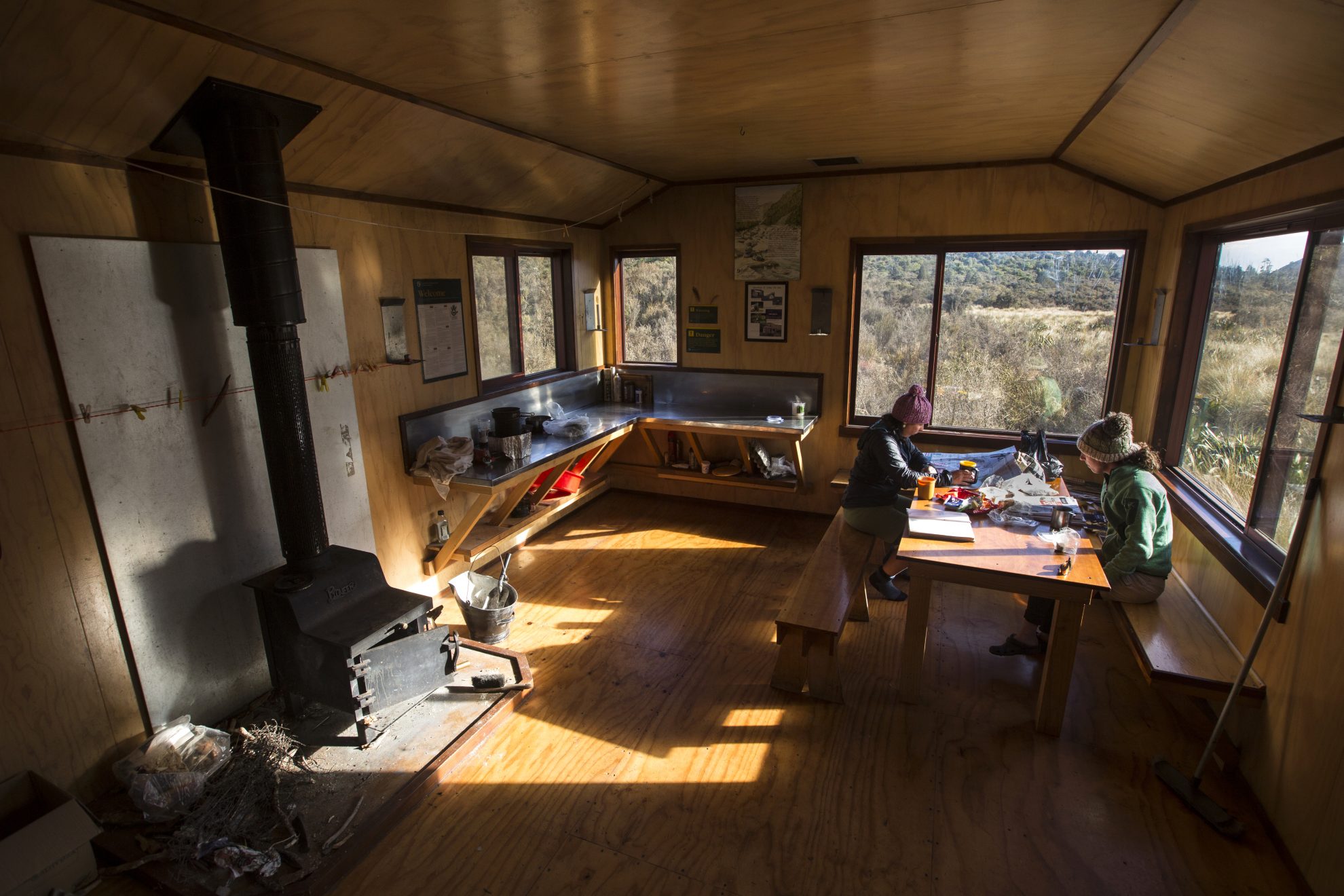
Mudflats Hut is visible from across the river as it ’s approached. As we neared the hut, Neil swore he could see smoke coming out of the chimney and, sure enough, we soon saw two people soaking up the last rays of winter sunshine on the deck.
I always hope to get a hut to ourselves, but each time I’ve shared a backcountry hut with strangers I’ve had a nice experience and this time was no exception. The close quarters means you have to interact and get to know the other people. Ken and Al were a colourful pair of trappers who shared their homemade, mouthwatering, hot chips with us.
They had based themselves in the upper Arahura-Styx area for a few days to check and re-bait their lines of stoat traps. They monitored 700 double-ended traps in the region as part of a whio/blue duck protection scheme. “We’re after stoats primarily, but rats are also a real problem,” Ken told us. “Yesterday, coming up the Styx, every second trap had a rat in it.”
The aim is to create a safe, predator-free corridor along the Arahura and Styx river beds to take pressure off the whio whose numbers locally, they said, are on the rise. We told them we had seen rat tails hanging out of at least half of the trap boxes on our way up the valley, so the guys knew they had a long day ahead of them. When they left before dawn the next morning, they kindly put a log on the fire for us.
Whio are endemic to New Zealand, but with a declining population of between 2000 and 3000, they are listed as a threatened, nationally vulnerable species and are at risk of extinction. DOC, with partners, is working hard to save these special birds which live only in clean, fast-flowing mountain rivers. The main risk to whio is habitat loss, human disturbance (through tourism and recreation) and stoats and other predators which kill vulnerable eggs and chicks. A captive breeding and rearing programme at the Isaac Conservation and Wildlife Trust in Christchurch plays a vital role in their survival, and whio from here have been released in the upper Arahura and Styx rivers.
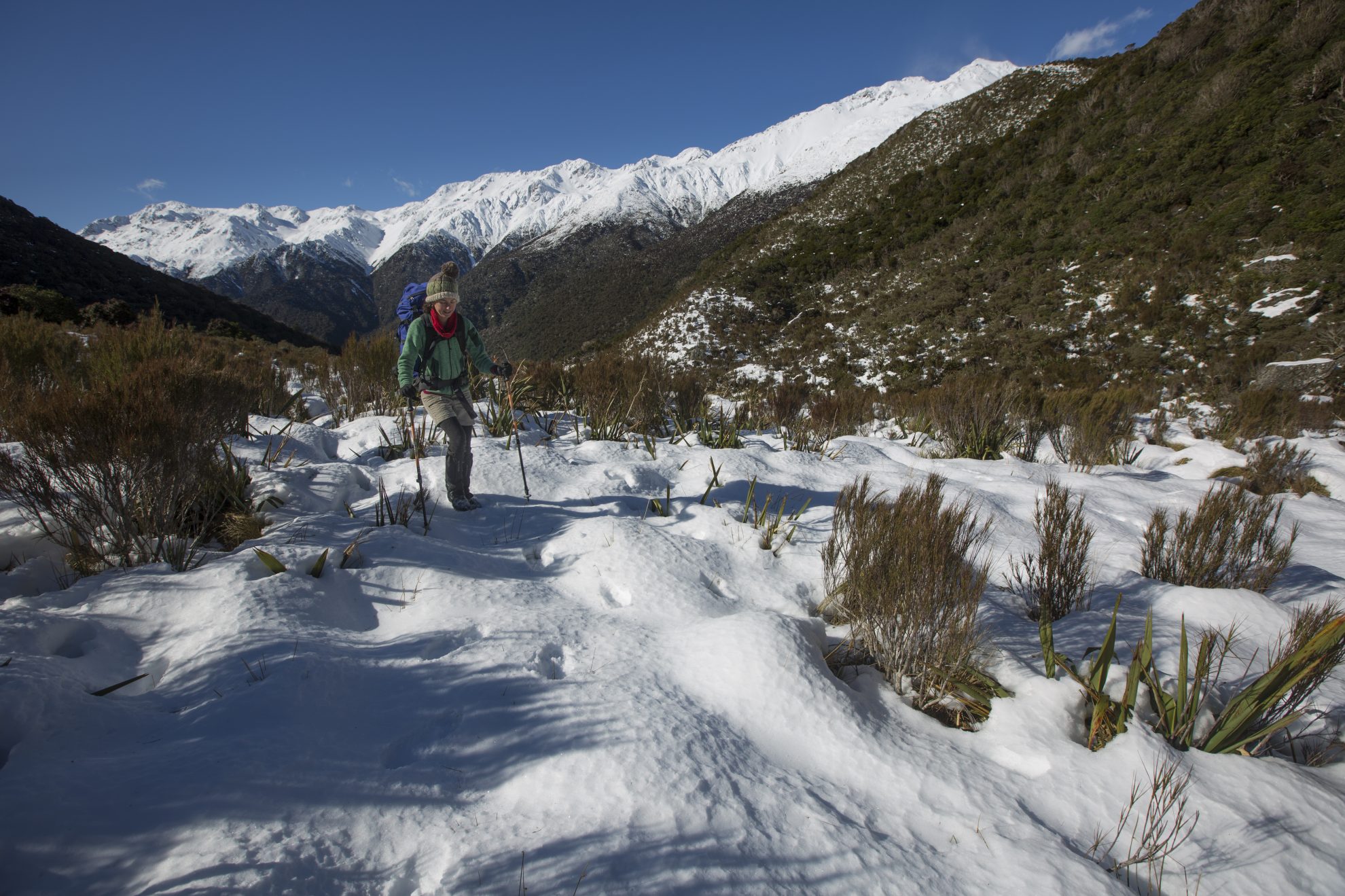
Styx Saddle is a lovely low pass. The miners’ track leads to the eastern end before splitting off in several directions. Turning south takes trampers toward Harmon Hut and Browning Pass – one of the easiest passes breaching the Southern Alps south of Arthur’s Pass – to link up with the Three Passes route – but we turned west and headed into the Styx River.
At the saddle, the golden tussock was covered in snow. It looked and felt like walking on bubble wrap. Progress involved using the buried tussock like stepping stones hopping from one to the next – some were frozen and held our weight; others weren’t and we plunged through the crust.
Civilisation can be seen from Styx Saddle. Farmland unfolds in the valley, and while the upper Arahura feels like true backcountry, the Styx is a gateway into the front country.
Grassy Flat Hut is new (in hut-years) with modern features – it was built just 12 years ago to replace an old, poorly-insulated Forest Service hut that had already been upgraded several times. This is the third hut on the site; the first was built sometime in the 1920s or 30s when the rising popularity of tramping and hunting saw a revival of the nearly lost gold miners’ tracks from the late 1800s.
Grassy Flat was deserted and it was nice to spread out and relax, but almost felt too quiet without the lively conversation of the night before. I couldn’t help but feel a little sad about heading back to the real world. I’d rather be right here in the backcountry where life is simple and the complications and worries are stripped away.
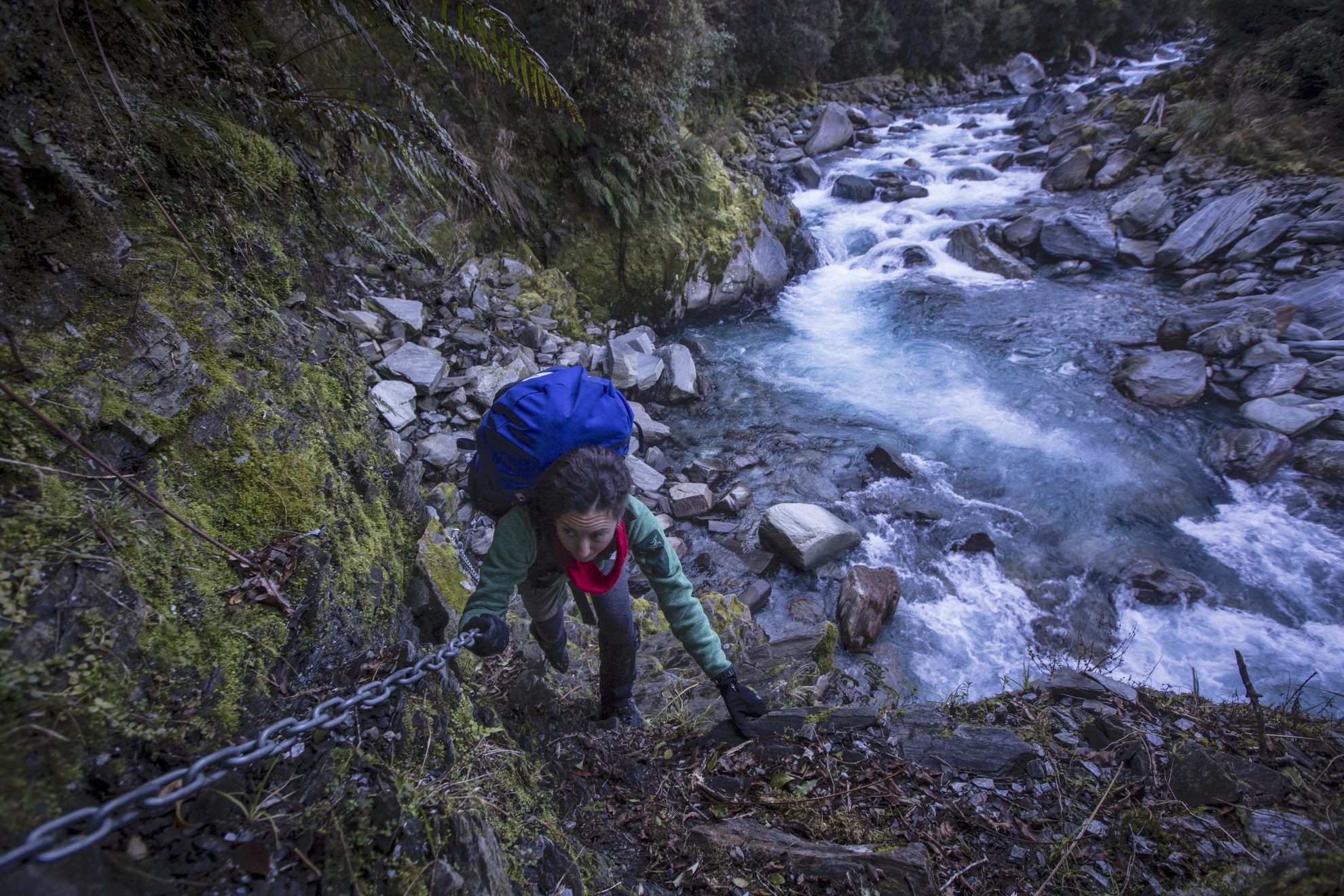
But sooner or later, every trip has to end and, with a heavy frost on the ground, we started our last morning with an icy river crossing and followed a mostly-lovely track to the road end. There are a few places where the track had slipped away and now requires a rock scramble to get past, but despite that, the final day was a cruiser.
There are tougher trips in the area, like the Kokatahi-Toaroha loop, but if you enjoy benched tracks and well-insulated, well-spaced huts, the Arahura-Styx circuit is just the ticket. It’s a relaxed affair and a doable trip in winter when higher routes, like the Three Passes, become difficult.


