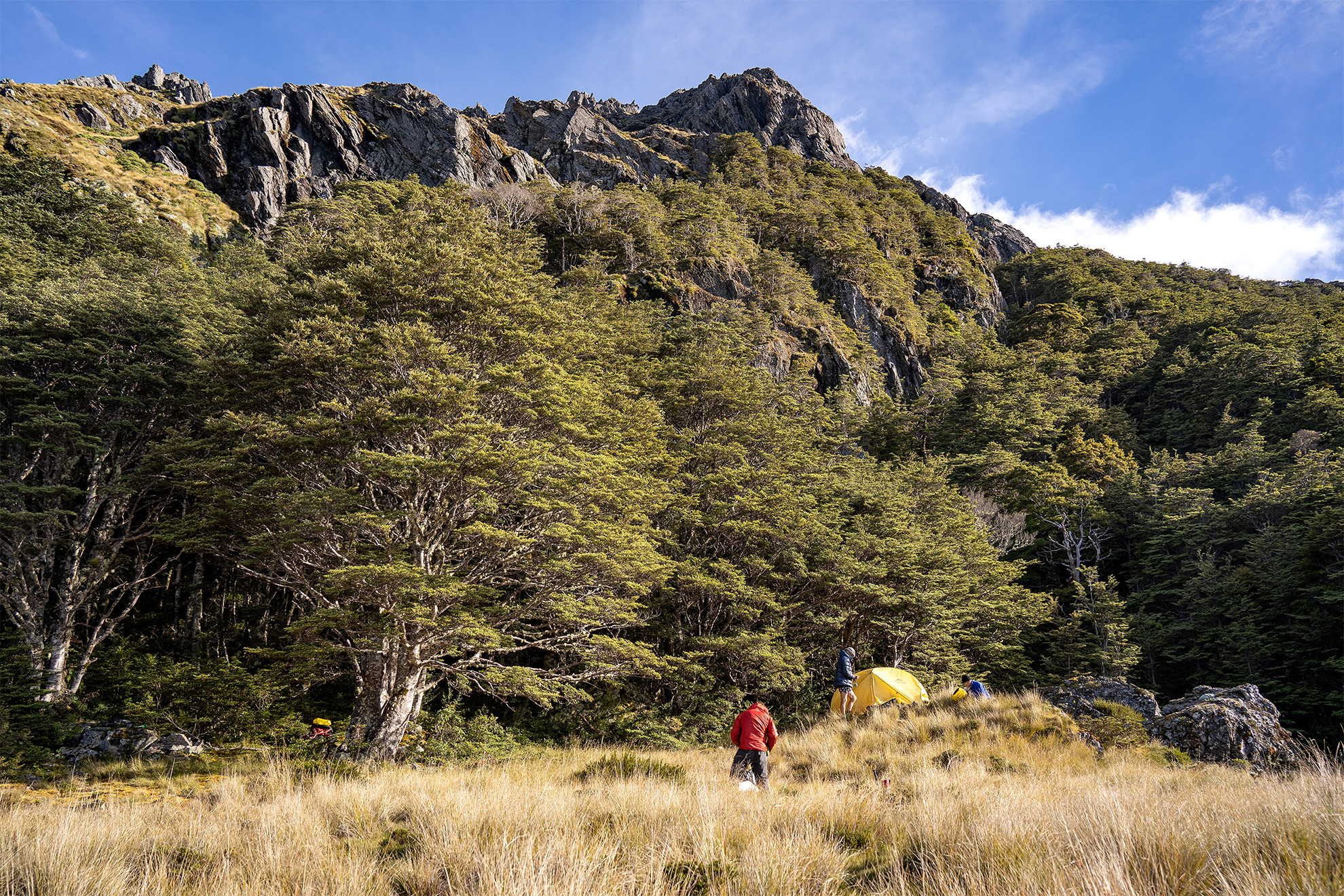
Now we were bashing through thick, regenerating bush and progress slowed to a snail’s pace. The irony was not lost on me when we encountered many discarded Powelliphanta shells. Jim led us on a compass bearing down a valley wall where we slipped and slid to Cedar Saddle, losing altitude quickly. By 3pm, too late to reach the next waterhole, we set up an unscheduled camp beneath towering mountain cedar, flowering red rāta, and a serenade of delightful birdsong. It proved the right decision. Jim fetched water from a tiny stream and we had time to enjoy this bush setting, rest and reflect on our journey.
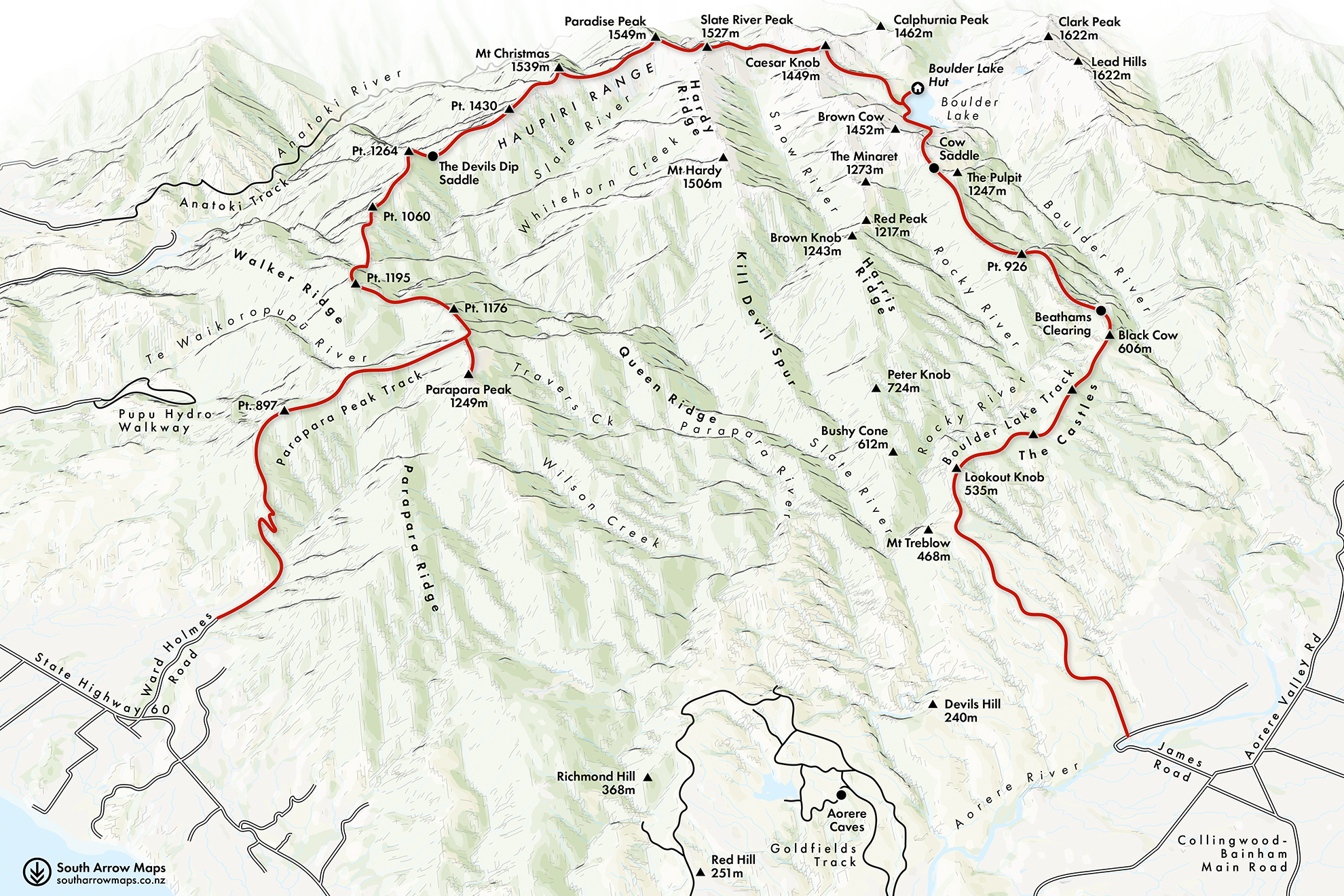
The dawn chorus roused us early. The gruelling 350m climb out of Cedar Saddle took its toll as we inched our way through stunted scrub and scratchy mānuka, our skin torn and bleeding. After four hours we found a large cairn made of white quartz. From there we dropped sharply down a spur to The Devils Dip, a bush saddle draped in a thousand shades of green and with good camping potential. We boiled the billy and chatted with robins, pīwakawaka, korimako and tūī, all of whom approached with Eden-like innocence.
The next climb was a little easier as the spur route had been recently cut. Three hours and we were on the Haupiri Range with a grandstand view of Golden Bay. A pair of kea made a passing visit and two pipits frolicked on shattered shale. A pair of aging men made phone calls to their wives.
Soon we had Mt Christmas in our sights, 2km along a grassy ridgeline punctuated with numerous knobs. The sun hung low in the western sky, and Jim kindly carried our packs ahead to enable us to cover the remaining 5km before nightfall.
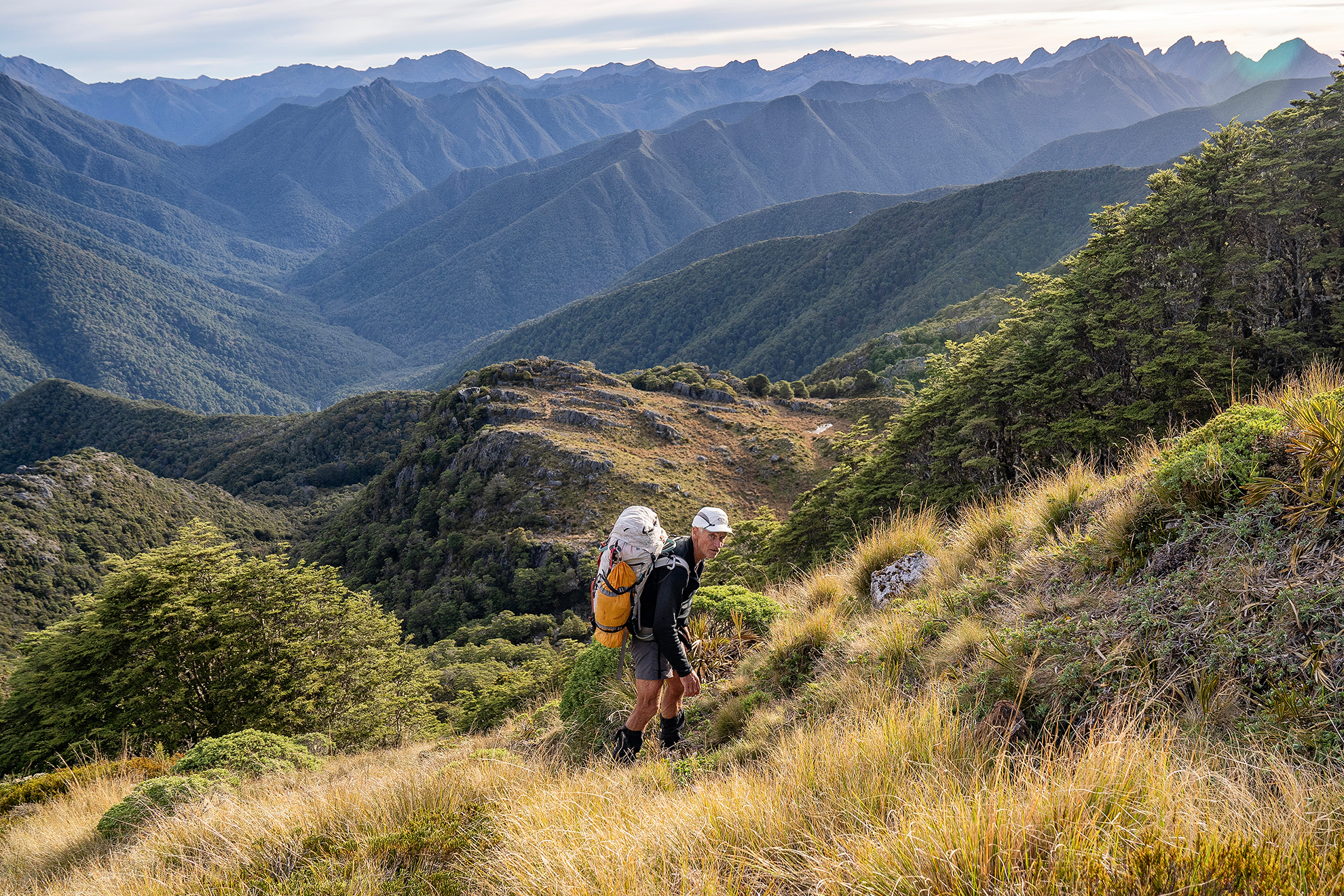
My three companions gave me their last drops of water. This was truly a team effort.
The scramble up Mt Christmas (1539m) was straightforward; the taxing descent down unstable scree was not. The sloping apex of Paradise Peak (1549m) loomed close as we clambered up snowgrass terraces to the summit. Jim led us through a series of narrow ledges to safer ground.
From here we could see the Dragons Teeth and could identify waypoints such as Kakapo Peak and Drunken Sailors in the gathering of muscular mountains.
We arrived at a col beneath the pyramid of Slate River Peak, an upward thrusting wall of shadows. In half an hour we descended a grassy slope and rock slide to the tarns of Paradise Basin. A weka screeched as we made camp at the edge of this beautiful clearing. After 12 hours’ travel, I was spent.
We woke at sunrise to goats bleating nearby and shared a brew to celebrate being in Paradise. The stream was cold and clear and we filled every receptacle before returning to the ridgeline, threading through beech trees and climbing a tongue of tussock.
I rested on a saddle and watched my mates disappear around the northern flank of Slate River Peak (1527m). They returned an hour later, jubilant from their summit bid.
Further west we could see the lie of the land. A bare ridgeline arced in a dress circle along to Brown Cow, cradling the catchment of Snow River below. I found refreshment in these headwaters. How reviving is the liquid luxury of a mountain cascade!
We punched through a bush saddle. Remnants of wire netting reminded us that this was once a woolly highway. It was a tedious plod up gentle tussock slopes to Caesar Knob (1449m) where our baby boomers again phoned their partners. This I silently questioned. Can we not break free from our reliance on mobile devices for one week of quiet wilderness?
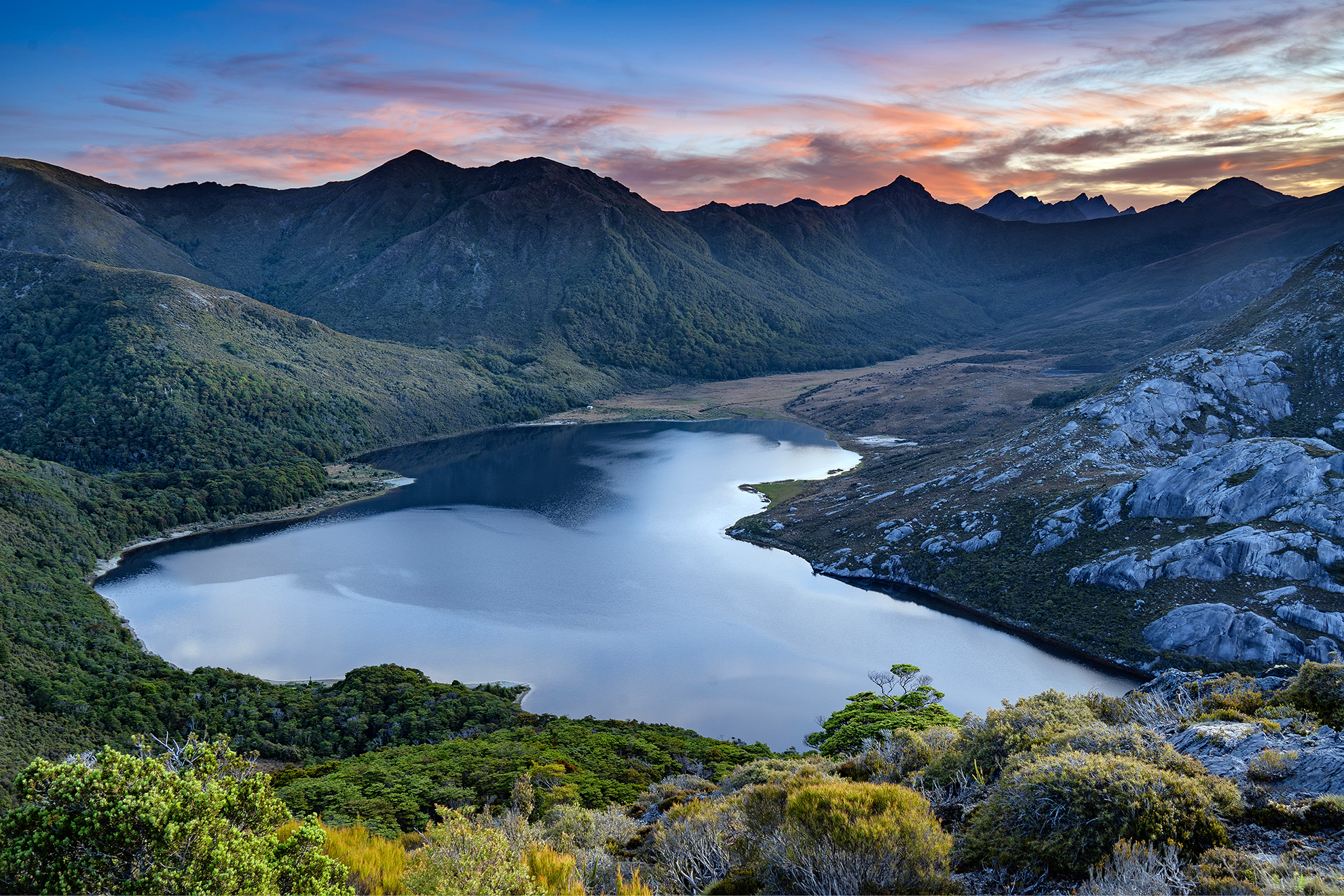
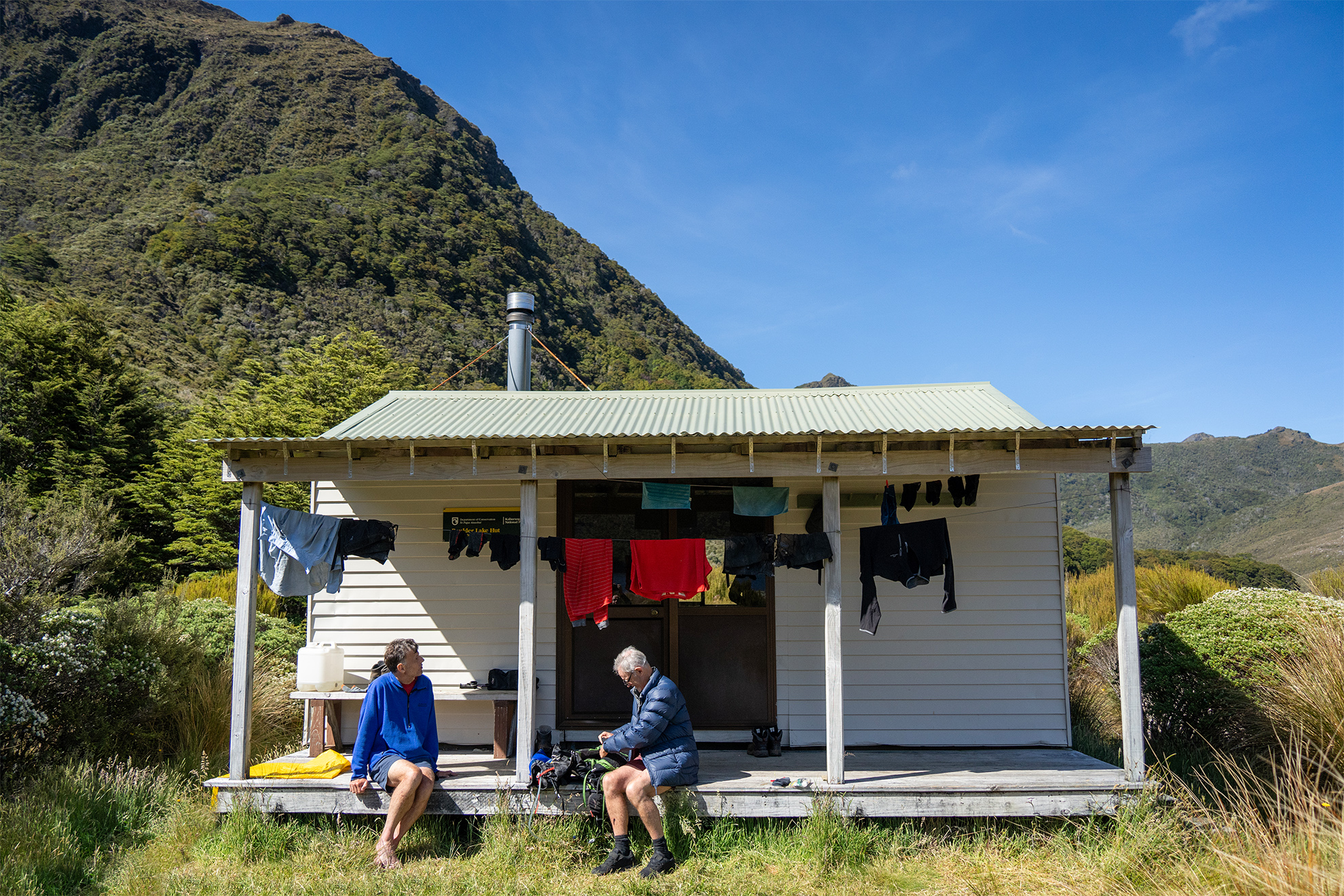
Locating the abrupt route down to Boulder Lake was easy. The zig-zag down ball-bearing scree was not, and at the end of a finger-like spur we were bluffed. Unable to find the old stock route, we had to crash through glades of mānuka. We fell into hidden bogs. Finally, we reached the lakeside track just a stone’s throw from the hut. My hiking pole was broken; my pack’s buckle was broken; my fleece jacket’s zip was broken; I felt broken, in need of a drink, a wash and sleep.
After limping along the track to the Suspicion Creek waterfall, I lowered my sun-baked body into the ultimate natural spa pool. Divine! Another taste of paradise.
Day five was a rest day. They’re the best days. In the evening Jim and I strolled around the lake. We left the track at Kiwi Creek following deer hoofprints through patches of scrub to where the lake outflow plummeted 64m into a hidden ravine. There were remains of a man-made dam and bits of No. 8 wire. The three-metre-high dam was completed in 1899 and doubled the lake’s storage capacity; the water was fed through 8km of fluming to a gold claim below. The enterprise failed spectacularly, and in 1920 Sid Flowers blew up the dam to reclaim his family’s grazing flats around the shoreline. During the Depression years a new influx of miners shot his sheep for sport, so the man quit. The annual Boulder Lake muster was no more. The burnt hillsides of Haupiri Station were abandoned and returned to their natural state.
While Jim returned to the hut, I climbed a prominent hill north of the lake and pitched my tiny tent. I made a brew and waited for the magic hour to capture the panorama and soak up the deep purples, oranges and reds of dusk.
I was up at daybreak, photographing the lake, enjoying the play of light and shadow on the Lead Hills. Distant peaks emerged into the horizon’s jagged shape. A squadron of kea soared high above. One straggler struggled to maintain airspeed, lagging behind the other birds, crying out to his companions. He had my empathy.
I rejoined my three friends and we readied ourselves for a long, hot, dry day.
We walked up a rocky track over a high shoulder on Brown Cow (1452m) before dropping down scree slopes marked with poles. It was good to be moving fast on a marked track, although we sought refuge from the harsh sun. Through Cow Saddle, we sidled below The Pulpit, past Beathams Clearing and Black Cow.
At The Castles, a limestone rock formation, were a dozen deep crevasses that required care to leap over, then we joined a farm road to Lookout Knob. From here is an expansive view of Aorere Valley before the trail swings north. It was a relentlessly nice avenue through tī tree, and we made steady progress downhill.
After nine hours and 22km we reached the trackhead. Around the corner was a sandy beach beside the inviting waters of the Aorere River, the perfect tonic for tired souls and battered bodies.
Upon reflection, this traverse along the lonely tops of the Haupiri Range was a gift. Despite the brutal bush-bashing, the 50km of rugged terrain and the lack of water, we were treated to mountain grandeur, delightful birdsong and moments of quiet solitude. From our low point at The Devil’s Dip, we recovered at Mt Christmas and finally found Paradise – a fitting allegorical sequence of geographical landmarks that mirrored our journey into the wild heart of northern Kahurangi.