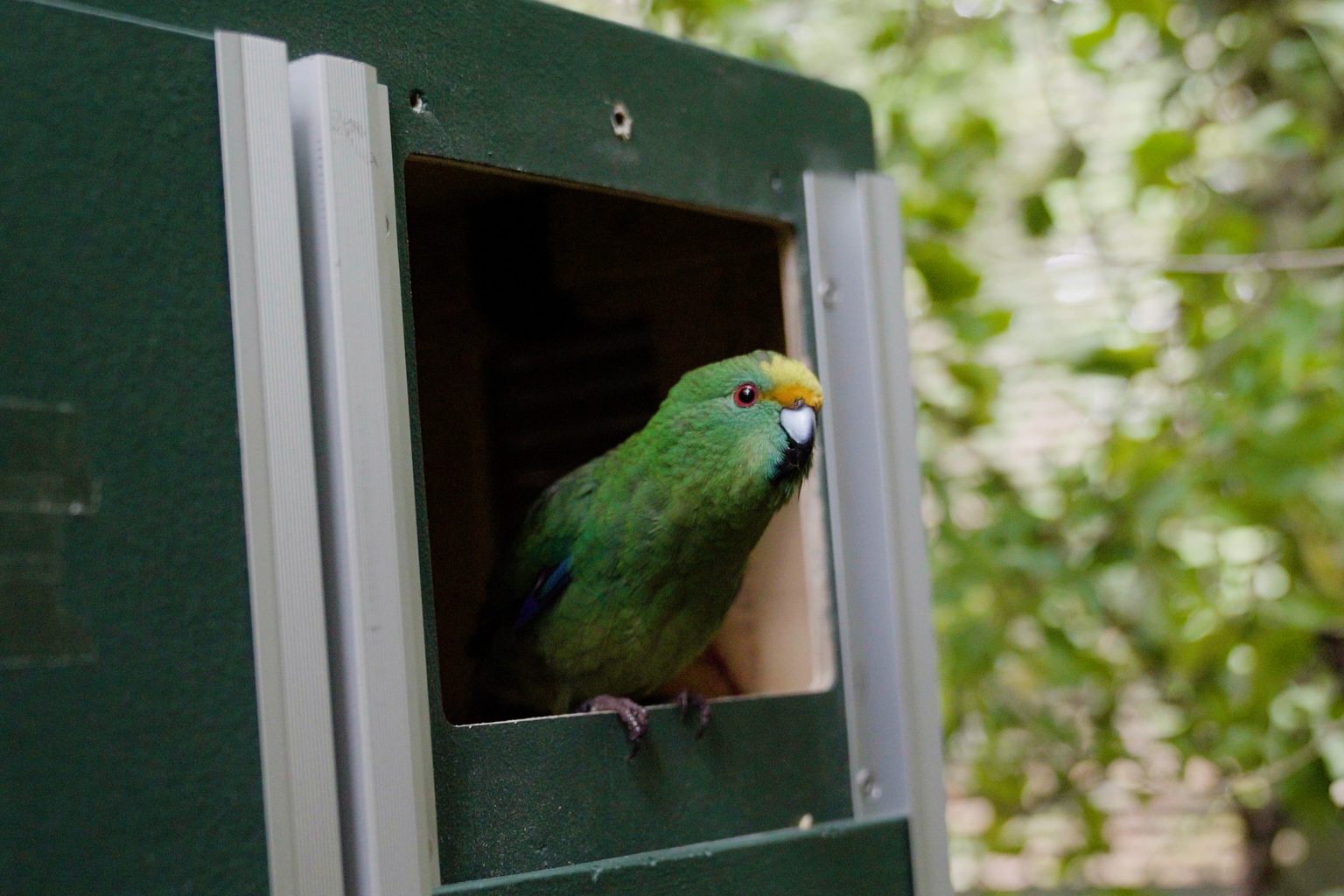
Twice declared extinct, the kākāriki karaka is taking tentative steps towards recovery.
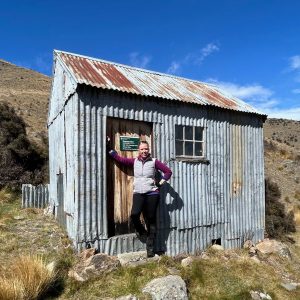
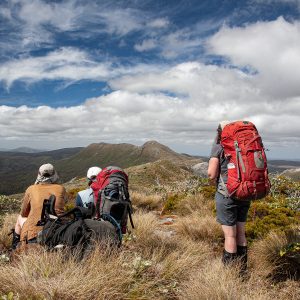
If you’re walking the Harper Pass Route, keep your eyes and ears open because you never know, a kākāriki karaka or orange-fronted parakeet could happen by. It is New Zealand’s rarest mainland forest bird, so the odds are low, but nevertheless a sighting was reported a few years ago near Kiwi Hut in the Taramakau. A DOC survey in the upper Hurunui (North Branch) in 2021 located a few birds, distinguishable by a tiny orange stripe between their eyes, near the old Cameron Hut.
The kākāriki karaka’s recovery story is akin to that of Fiordland’s takahē, thought to be extinct until its discovery in the Murchison Mountains in 1948. Kākāriki karaka have twice been declared extinct, in 1919 and 1965, then were rediscovered in the 1980s in very small numbers in inland Canterbury beech forests. Habitat loss and introduced predators have been their nemesis. Because they nest and roost in holes in trees, they are particularly vulnerable to rats, stoats and cats, and their numbers can fluctuate rapidly.
Today, only about 450 kākāriki karaka remain in the wild and their conservation status is threatened – nationally critical. For many years kākāriki karaka recovery work and predator control focused on areas neighbouring the Harper Pass Route, the Hurunui South Branch, Lake Sumner Forest Park and the Hawdon Valley in Arthur’s Pass National Park. But rat and stoat plagues still proved challenging, so translocations to create safe, alternative populations were made in 2011 to predator-free Ōwairua Blumine Island in the Marlborough Sounds, and in 2021 to Brook Waimārama Sanctuary in Nelson. In 2022 kākāriki karaka were reintroduced to the Hawdon Valley where the population had declined due to predation.
Establishing new populations and supporting existing populations of kākāriki karaka now relies on captive breeding. Since 2003 DOC has worked with partners such as the Isaac Conservation and Wildlife Trust and Orana Wildlife Park. Using eggs gathered in the wild (to maintain genetic diversity), hundreds of kākāriki karaka have been bred in captivity and released into the wild.
The story continues to evolve. In 2024 the Te Ara Mōrehu: Kākāriki Karaka Recovery Strategy formalised the partnership between DOC and Te Rūnunga o Ngāi Tahu. According to the Ngāi Tahu Claims Settlement Act 1998, kākāriki karaka are acknowledged as a traditional taonga species, central to the identity and wellbeing of Ngāi Tahu. The strategy enables taonga species experts to work alongside DOC to bring mātauranga Māori (Māori knowledge) and values to their conservation work and decision making.
Key to this new strategy is its vision: that kākāriki karaka will be thriving independently in the wild, with 10 self-sustaining populations in the Ngāi Tahu tawikā (region), in the next 20 years.
Things have moved fast. In 2025, 80 kākāriki karaka were released on predator-free Pukenui/Anchor Island in Fiordland, with the aim of establishing a new wild population.
Local iwi representatives welcomed the birds to the island with karakia and waiata. Ngāi Tahu is on a journey with this manu, says Te Rūnunga o Ngāi Tahu representative Yvette Couch-Lewis. “For me, it is a very emotional process seeing them being released into the wild. There is a sense of amnesia associated with engaging with this manu because we haven’t had the opportunity in generations to observe them in their natural habitat.”
The predator-free beech and rimu forest on Pukenui should be a great site for kākāriki karaka to flourish, says Wayne Beggs, DOC kākāriki karaka operations manager.
Meanwhile, Beggs and his team also remain focused on the Hurunui and Hawdon valleys. “We monitor and control rats, stoats, possums and feral cats intensively to keep numbers to low levels. Monitoring is undertaken year-round, and even more intensively during beech mast years when rat plagues might occur.”