Harwoods Hole, Abel Tasman National Park / easy
Marble blocks litter the track to Harwoods Hole like the carcasses of long dead, strange and forgotten animals.
Sharp ribs still protrude and holes have worn through the slippery rocks, where once a stream had eaten its way through the marble mountain, known as Takaka Hill.
In places, the rocks tumble densely around the track which follows a dry stream bed, whose waters have long since disappeared to caves and channels tunnelled through the hill, deep below us.
With a heavy 2.5-year-old loaded into my backpack, I clambered carefully over the marble, polished to a slippery shine in places.
Eventually we reached a jumble of boulders and stunted trees which marked the edge of Harwoods Hole.
The hole plunges 176m straight down to an underground river. Standing among the boulders I could feel its almost magnetic pull, but it is not possible to see into the spectacular depths of New Zealand’s deepest vertical shaft.
The cliffs surrounding the hole seemed to lean in towards us. Signs warned of the extreme danger and the fact there are no barriers around the 50m-wide hole. There is no way I was going to let out the toddler settled comfortably in my backpack, and thankfully she seemed happy to let mum do all the walking.
For experienced cavers, Harwoods Hole delivers a spectacularly long rope descent down the water-enlarged, but now dry, sinkhole. Further in, it connects with the romantic-sounding Starlight Cave, dropping to depths 357m below the top of the hole, before emerging further down the hill at Starlight entrance.
DOC warns that for small, experienced groups it takes at least nine hours to enter and traverse the caves, which are a chilly six to eight degrees, even on the hottest summer day. The site has been the scene of a number of rescue operations.
Swallowing my disappointment at not being able to actually see the hole, I headed up to the nearby Gorge Creek lookout, where the efforts of the walk were amply rewarded.
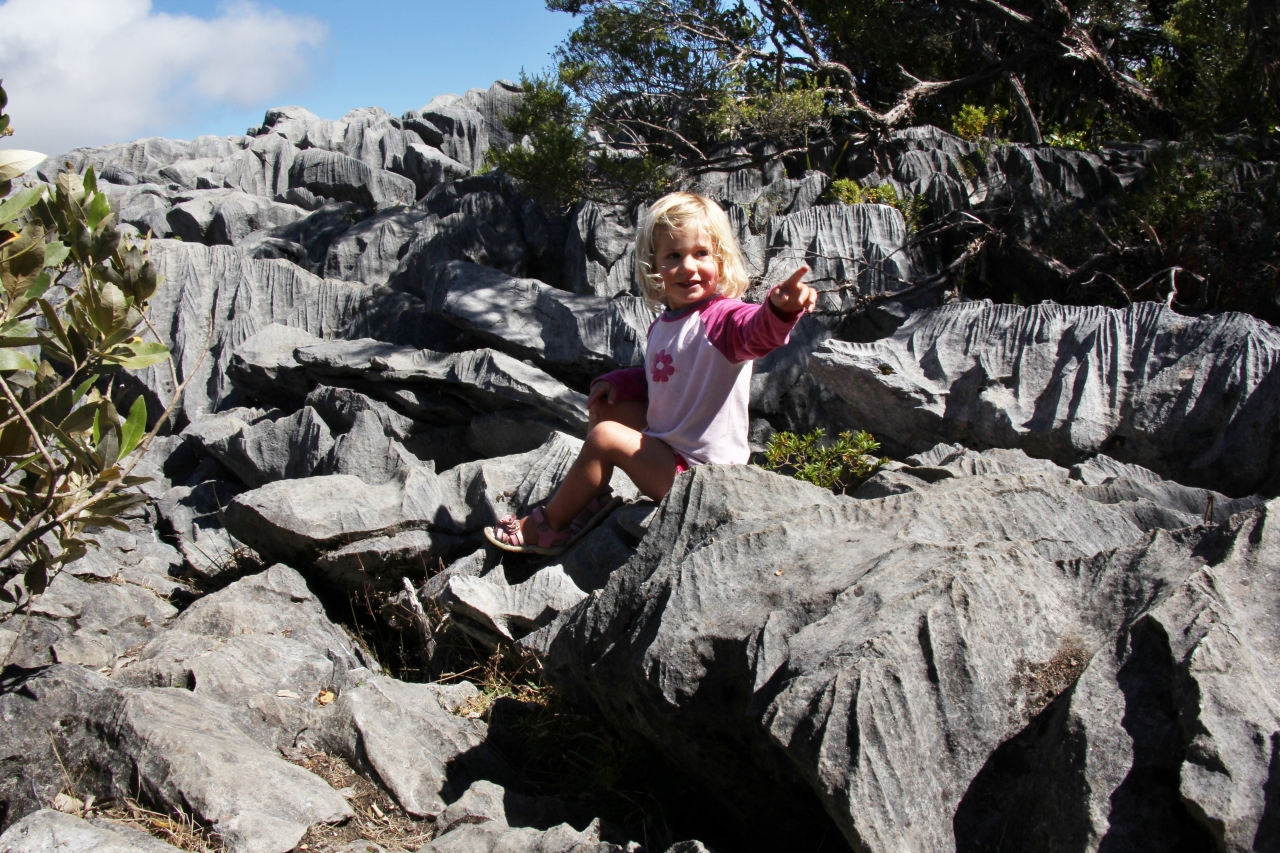
The track tops out onto a maze of fluted rocks which leads to views over Takaka Valley. The rock formations, known in geographical terms as a karst landscape, are stunning and we found a sunny spot well back from the cliff edge to enjoy our lunch.
Somewhat reluctantly I packed up to head out, and once down the steep side track I let my toddler down to walk and play among the marble formations. She busied herself poking sticks through holes, running her hand across spiny ridges and picking up empty snail shells.
Before long we had left the old stream bed behind us and were back in the open beech forest which hummed, and almost vibrated, with wasps.
Along the way, black pools, which indicate the location of old sink holes, beckoned, but the buzzing wasps encouraged a fast walk back to the car.