

Something’s afoot
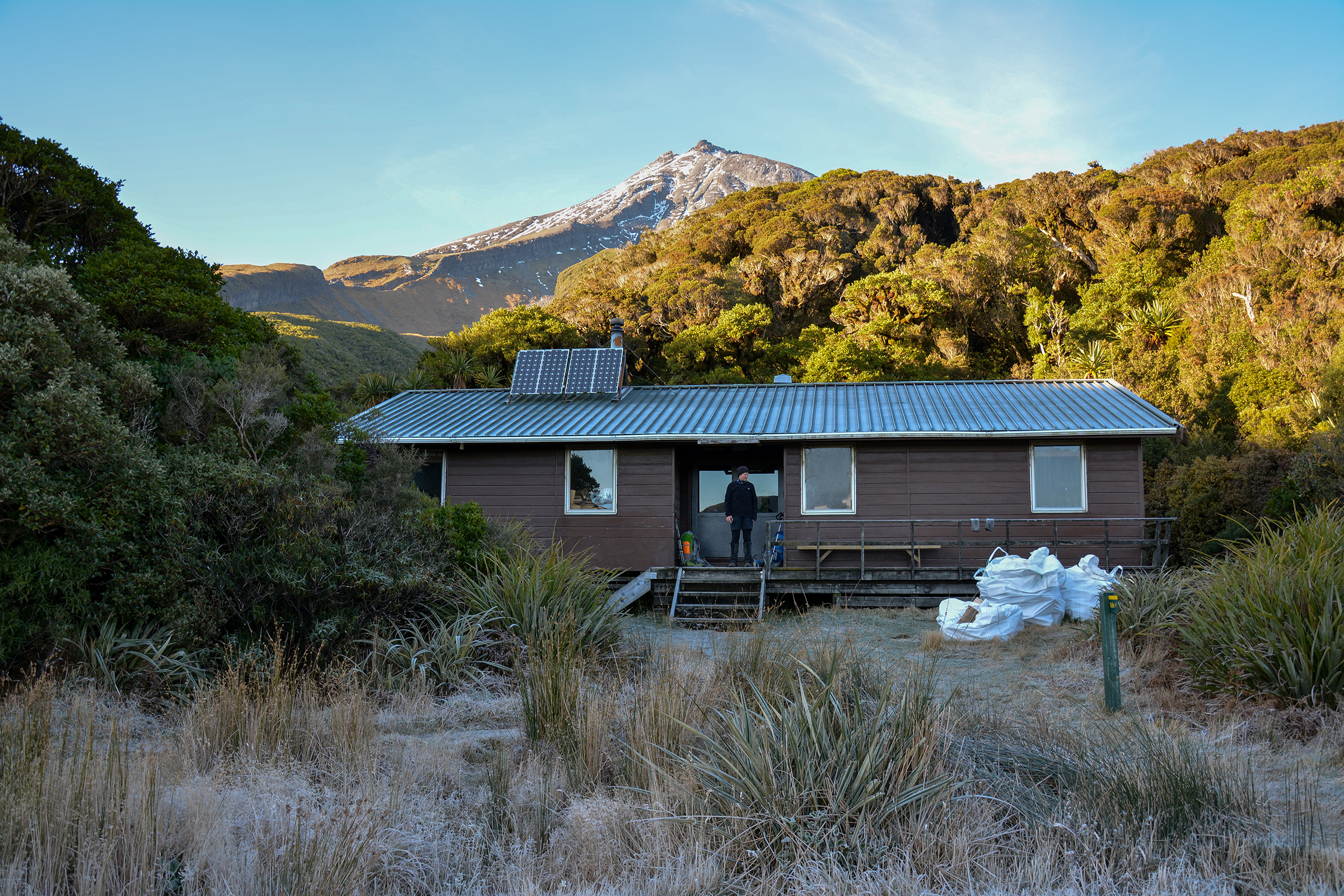
Our second day dawned with a frost, clear skies and sunshine emerging centimetre by centimetre to eventually defrost our merino-clad bodies as we warmed up aching muscles with a slow plod down to Bells Falls, a side trip on the track from Holly Hut to Waiaua Gorge Hut. A piece of blue tape was tied to scrub on my left, the only one I saw on this track, but I initially wrote it off as a trap line.
Jean photographed Bells Falls and I thought a lot about how the Reverend would have fared in this spot. The falls are in a V shape, violently carved out of the rock, spilling down and punching into the pool. This is the headwaters of the Stony River, true to its name, littered with boulders and rocks to break anyone travelling down it – by choice or otherwise.
“I guess there wouldn’t be much left of a body after it’s gone over the falls and down the river,” I said to Jean, who told me bodies can stay in one piece after an initial impact but once the bones are broken, there’s not much to hold it together. It’s possible the Reverend fell to pieces fairly quickly if he got bumped over the falls and washed down the Stony River in torrential rain.
Just over a year after the Reverend’s disappearance, a group of men from the Taranaki County Council working in the Stony River found a tweed jacket, then a boot – with a human foot inside, clad in a sock. It was assumed to be Murray as no-one else had been reported missing on the mountain since his disappearance – and he had been wearing a dark tweed suit on the climb.
“A foot would stay in the boot quite easily,” Jean said. “The boot sort of holds it in there.”
I was still thinking about the Reverend and his last journey as we turned off the Stony River Track and came to a track junction where the Puniho Track (straight up) meets the Kapoaiaia Track (across the mountain). I’d done the Kapoaiaia Track eight years ago and what memory I had of it was prompting me to suggest going via Kahui Hut. And anyway, I hadn’t bagged that hut yet. (The Kapoaiaia Track ostensibly maintains the same contour line as it cuts across the mountain’s flanks, but it scrambles down and out of endless stream beds.) A warning sign cemented our decision.
At around 960m, the track takes a sharp, 90-degree right turn, often a sign that another track used to intersect with that and you’re standing at the T junction. Peering into the scrub, a ‘Danger’ sign well hidden amongst the greenery confirmed my suspicions. Another piece of blue tape highlighted the connection, and checking an old map (as late as 1989, but the junction also features in the Lonely Planet guide from 2006) confirmed that an upper mountain track used to run from Holly Flat, skirting the Little Pyramid and linking up to the Kahui Track.
It’s possible the Reverend fell to pieces
if he went over the falls and down the Stony River
Searchers found evidence that the Reverend had picked up this track in his wanderings in the days after going missing. I wonder if he was plagued with a sense of impending doom.
Things change over the years, of course, not just tracks but also huts; we pass the concrete remains of the old Oaonui Hut before reaching Waiaua Gorge Hut, where we chatted in the firelight with two locals.
My dehy dinner is brown rice, vegetables and an un-dehydratable sachet of flavoured tuna. I decided I could go without the tuna.
Crumbling cliff carcasses
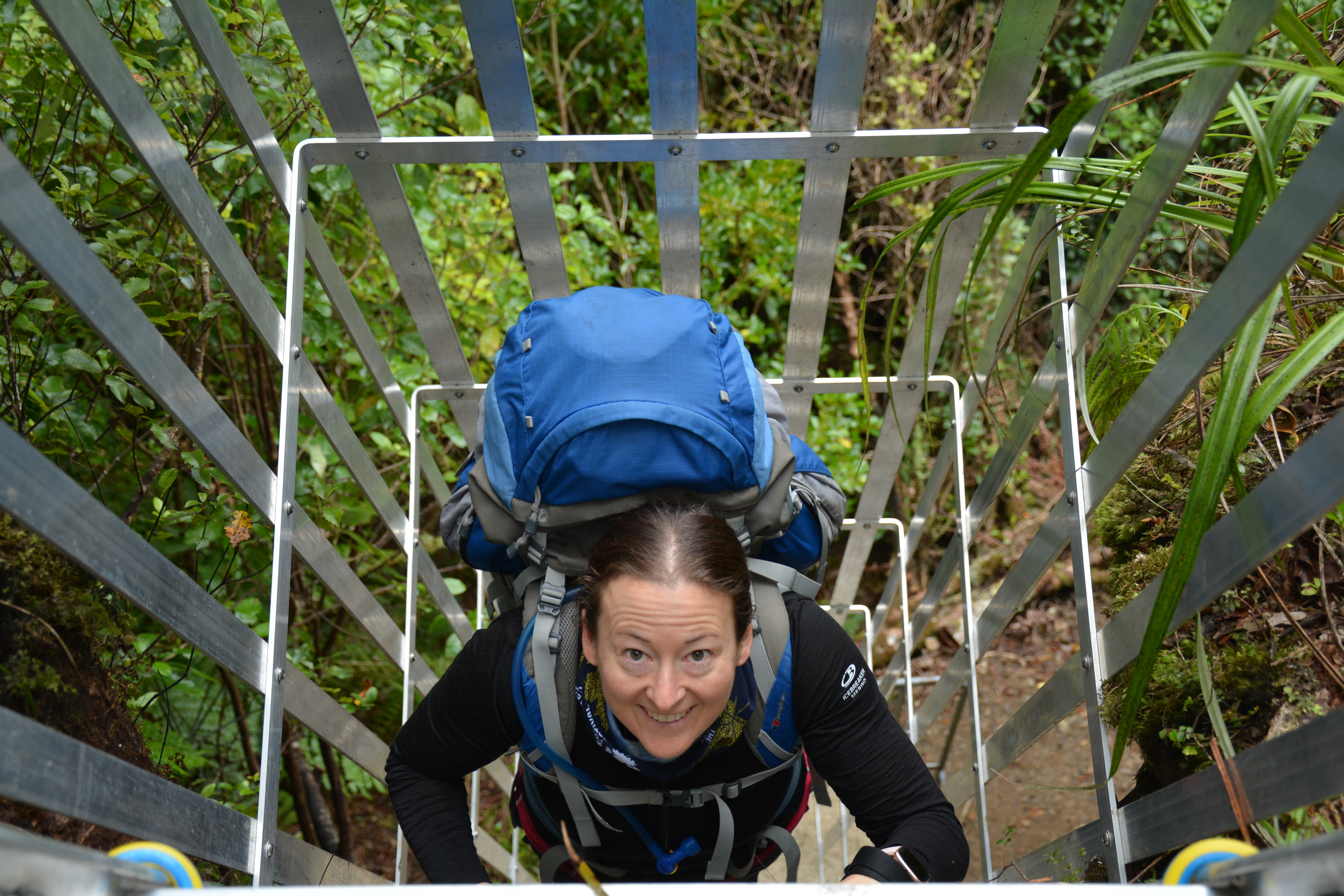
I was grateful for a warmer, frost-free start the next morning. The mountain was capped with cloud and mist, which soon burned off but made for a moody atmosphere. We opted for the upper track, the Brames Falls Track, which climbs steadily then sharply towards a set of cliffs at around 1300m.
I’d done the Around the Mountain Circuit once before – intending to do it alone, two friends decided to join me, and I recall having a come-to-Jesus moment at these cliffs, thankful I wasn’t rolling solo in such foreboding terrain. The occasional piece of rock sits on the track as the cliffs and mountain shed its skin, and we moved swiftly along.
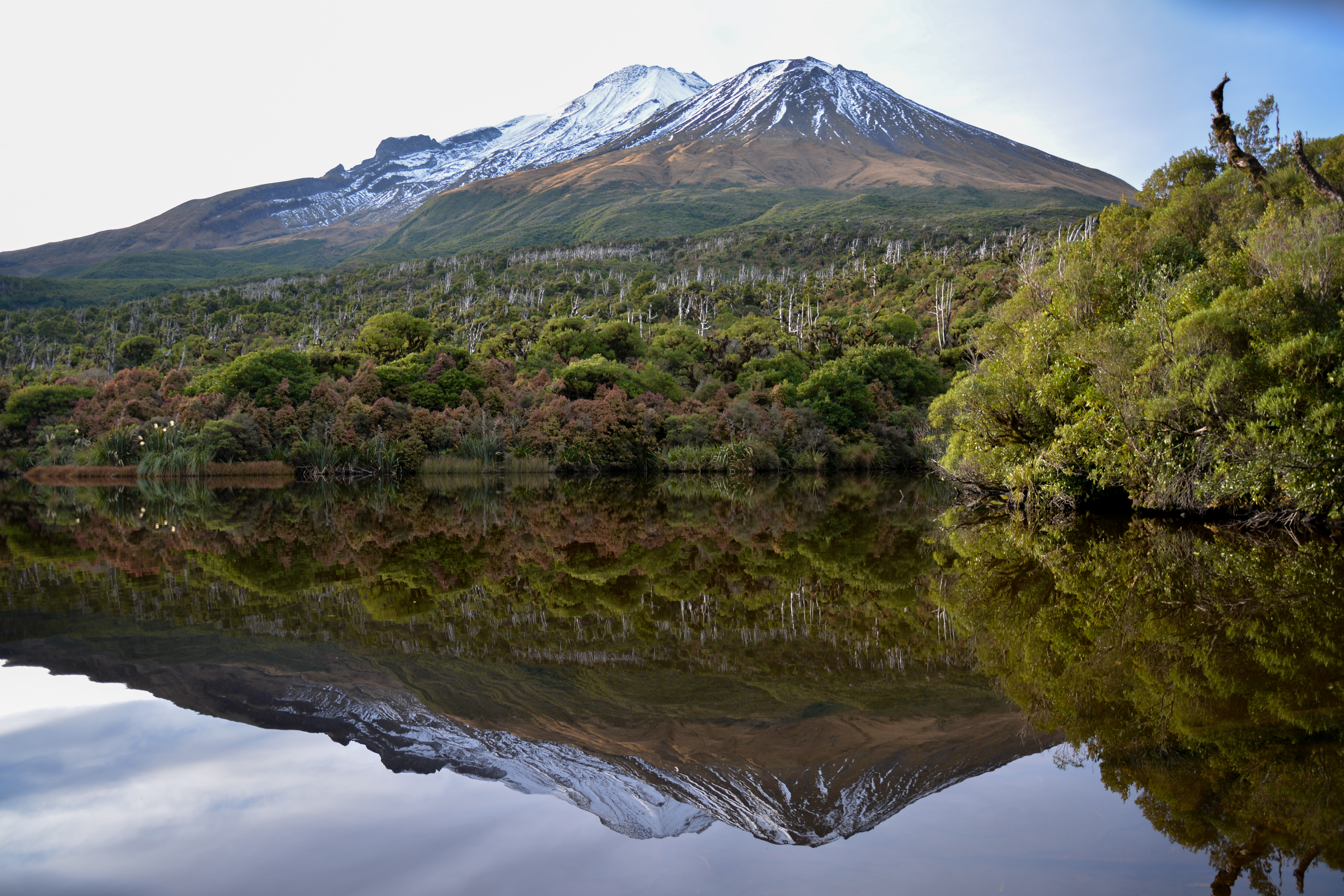
In and out of eroded gullies and down, down to Lake Dive Hut for night three. Lake Dive is named after Bradshaw Dive, an MP for the Reform Party and mountaineer, who claimed he spotted the lake on a summit trip. His companions reckoned it was a mirage, but it was later confirmed. The lake is cold and I’m reliably informed that the bottom is muddy. It’s May, we’ve had frost, and I’m not that keen to find out. It does, however, give a reflection photo opportunity to rival the usual Pouakai Tarn snap from the other side. The western and southern sides are less known, less trodden – and given how rugged and unforgiving the terrain is, I’m not surprised.
Dehy dinner is another serve of brown rice, veges and tuna, and I conclude firmly that the tuna is too much, especially given I have four lines of white chocolate to finish off and I just need the bare bones, really. We chat to hut occupants, retire from the fire, and mentally prepare ourselves for the final push out via the lower track. The forecast looks like it will turn, but perhaps not until the afternoon.
It doesn’t happen, of course. After three days of good weather that lulled us into a false sense of windless, cloudless security, Taranaki serves up a dish of un-dehydrated rain and wind, as if to say, don’t let the door hit you in the arse on your way out. Taranaki, with a sting in its tail, simply has to have the last word.
A survivalist and author
The Reverend was particularly interested in nutrition – namely, how much food you should eat to keep your body in perfect health. His idea was that the barest margin of sustenance was desirable, and he reckoned people could endure severe physical hardships for up to seven days without food.
Murray was writing a ‘work’ on the topic and his trip up the mountain was intended to be part of a series of experiments on the ability of a man to survive without food. His companions on the day rejected the idea that his sudden mad break from the rest of the party was premeditated, but agreed that the enforced hardships he would endure from having to survive on the mountain would give him plenty of material to test his theories.
“He was incredibly arrogant, wasn’t he?” Jean remarked to me, and I couldn’t help but agree. I reckon he did it on purpose.
We finish the trip wet but triumphant and as far as aversion therapy goes, it seems to have worked. I’ve spent a couple of days thinking about a summit trip and perhaps an overnight trip to Syme Hut to bag Fanthams Peak. The mountain is shrouded in mystery, stories to be told, secrets to be unlocked.
Other human remains were discovered on Taranaki during the search for Murray. Three skeletons were found in a cave on the western face of the mountain. But that’s a story, and a trip, for another time.



