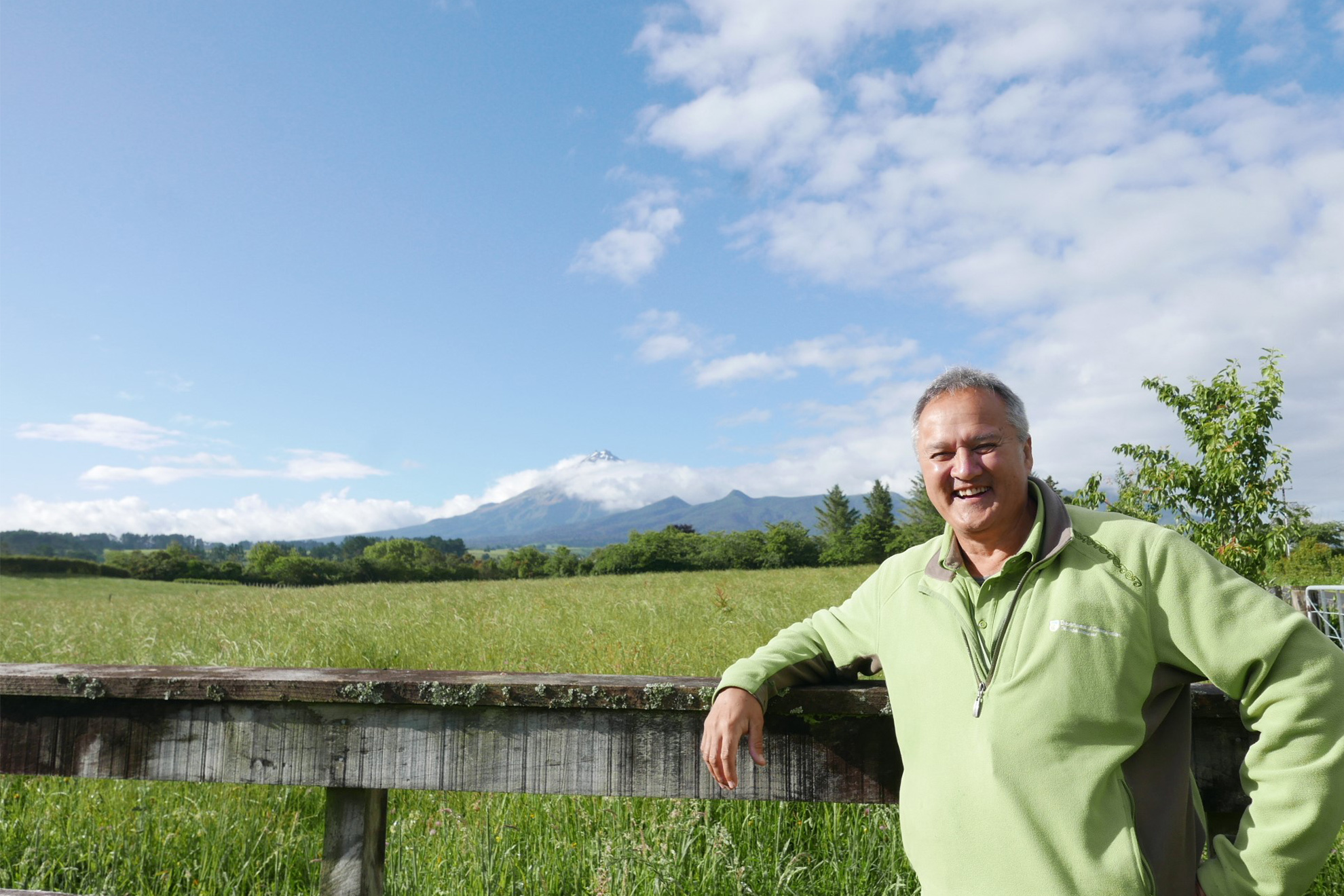
The Taranaki settlement has addressed massive grievances, says Rogers.
“After the wars of the 1800s, Taranaki iwi suffered the largest of all tribal land confiscations, including that of our revered ancestor, Taranaki Maunga,” he says.
Wearing both his Crown (DOC) and iwi hats, Rogers was uniquely placed for the settlement negotiations.
His iwi involvement began when he was just 16, with Ngāti Mutunga. “My maternal grandfather did a lot of work to identify the issues around the loss of our lands. When he died my mother took over that work, then I picked it up.
“For 15 years I was consumed by the treaty negotiations throughout Taranaki and used all my annual leave to attend hui. I was involved in four of the eight different iwi settlements, and through my work with the Crown had the benefit of sitting on both sides of the table.
“My main role was to look at all the lands iwi had interests in, and what was now happening on that land. It was incredibly rewarding but challenging. At one point I was on 11 different Māori groups and had a heart attack. I’ve stepped back now, although as a past chair of the local marae I still get called into Ngāti Ruanui.”
Rogers shows no outward animosity about past wrongs. “We’ve got to be able to close those grievances. We can’t have another generation living in that bitterness; we need to put a mark in the ground and move forward. Don’t forget it. But move forward.”
Meanwhile, there are new challenges facing park management – notably a new breed of visitor, says Rogers.
“The bulk of our park visitors now are short-stop travellers at the road ends. The three/four day tramp is history; a long trip for them is probably an overnighter. I don’t think they appreciate the park the way we’d like them to. They want that ‘wow’ experience – clean toilets, car parking and a café.”
The response has been to develop the Taranaki Crossing. This has entailed a major track upgrade from Dawson Falls, in the south, across the eastern Taranaki slopes to link with the Pouākai Crossing and Mangorei Road, in the north. It has been funded by the Provincial Growth Fund.
That funding was a blessing, says Rogers. “Ever since I’ve been in the park we’ve had more assets than resources to look after them, and we’ve always had to consider priorities.
“The reality is the northern and eastern areas are where the bulk of our use is, so most resources are going there. On the other side of the maunga we get fewer than 500 people going around each year, and about half of them come in to the huts from the road ends.”
In April DOC announced the closure of the Bells Falls to Kahui Hut section of the Round the Mountain Track due to severe storm damage and erosion. The closure will be reviewed next summer.
DOC will, however, replace Lake Dive Hut, which burned down in 2020, says Rogers.
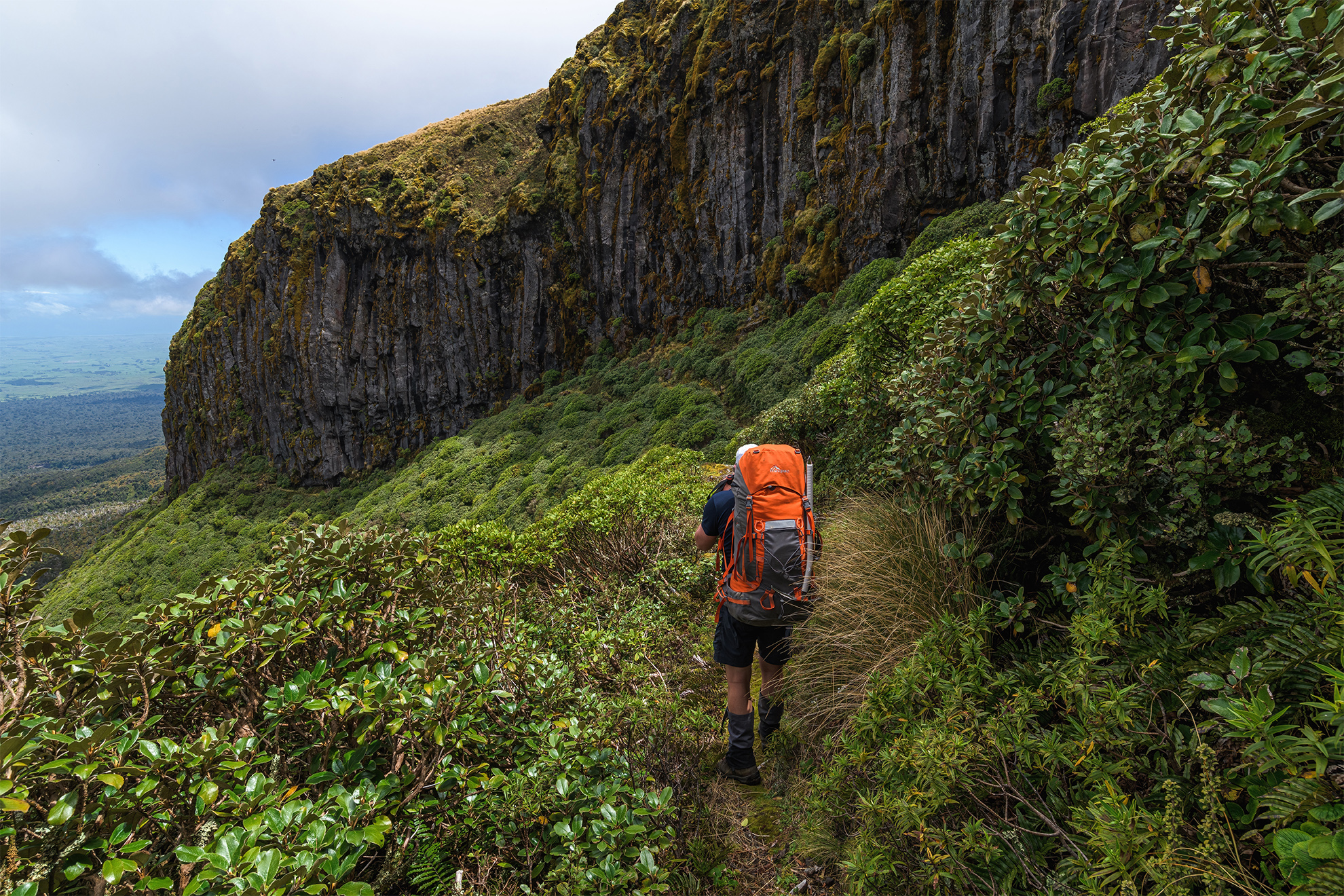
“It was a local gem. It made a nice circuit from Dawson Falls, and since the hut burned down many people have been camping at the site.”
Protecting the natural values around Pouākai Tarn, the fragile wetland area that is now a social media drawcard for the tarn’s reflected views of Taranaki Maunga, continues to present challenges. Pre-Covid, annual visitor numbers there went from 3000 people to 30,000 within five years.
“We could see the impacts on the whole area. People camped up there for days to get their photos because they also wanted to be there for the sunrise and sunset,” says Rogers.
The Covid pause was welcome but is now over.
“The biggest issue now is waste from the hut toilets. Our helicopter budget is used up taking out waste and yet we are looking at putting more toilets up there. We have plans for a new, 38-bunk hut (the present hut has 16 bunks). That was part of the funding package and is currently in the design process.”
The new hut raises questions for Rogers. “Should we be encouraging even more people? In fact, could we move away from having any huts in this park? Nothing is very far from a road end,” he muses.
“Provincial Growth funding is about regional economics, attracting people and their money to Taranaki. But is this something we should be doing in our conservation role? Personally, I would have been very happy with the same size hut.”
The visitor environment has changed, he says. “Our population has changed and a lot of park users now are not outdoor people like the traditional Kiwi tramper. Many have a lot to learn. We also have overseas visitors who get caught out. They don’t understand what rainfall of seven to ten metres a year looks like. Yet they are here and are as entitled as anyone to participate in and benefit from the park.
“We want people to gain appreciation for this place and have enjoyable, memorable and safe experiences, so we put out a lot of information about safety. Some Kiwi trampers think this is overdone but we have to do it.
“Taranaki Maunga is dynamic. We’re trying to manage risks to people; we cannot manage the mountain.”
Rogers feels close to retirement. Whether or not he’s working on the maunga, chances are you’ll find him up there in the subalpine zone. When I ask if he has a favourite spot on the maunga, he smiles.
“Anywhere in the herb fields above the shrub line. I love the smell of the herbs, the khaki colours, the carpet matting, and I love it when the plants are flowering. I could sit up there all day.”