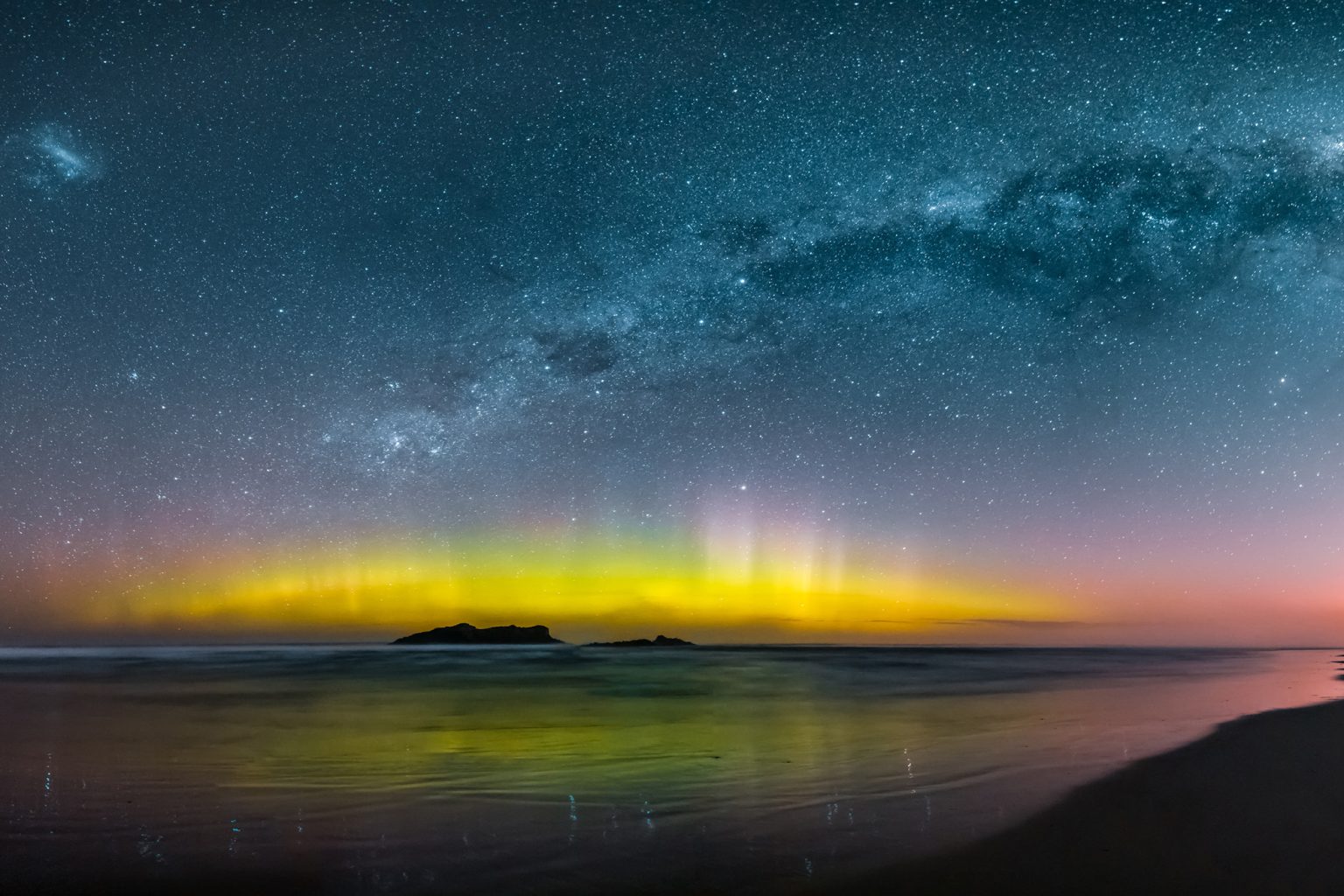
Winter offers a longer, crisper night sky for witnessing a celestial wonder. By Paul Le Comte
The New Zealand wilderness often has a soundtrack to accompany the magnificence: crashing waves on a rugged coastline, melodic birdsong in native bush or the wind in tussocks. There are also times when a symphonic soundtrack would be appropriate but there is only silence. That is when you witness an aurora in the night sky.
Those who have had the good fortune (or dedication) to view Tahu-nui-ā-Rangi Aurora Australis in the southern skies will know exactly what I mean.
We are particularly lucky to be able to view Tahu-nui-ā-Rangi all year round in New Zealand (unlike in the Arctic, where the sun can be present 24 hours a day at certain times of the year) and the long, crisp winter nights are a particularly good time to view it.
An aurora is caused by a variety of solar storms ranging from massive flares to weak ‘openings’ in the solar atmosphere. Sometimes these storms (literally space weather) race towards earth; the resulting solar wind is packed with electrically charged particles that interact with our protective magnetosphere. This interaction of charged particles with the different gas molecules in the upper atmosphere creates the colourful lights. The greens are generally created by excited oxygen particles, while the pinks, yellow/orange and reds come from excited nitrogen particles.
Aurora, like all storms, are measured in intensity. New Zealand has the advantage of being close to the magnetic south pole. A typical G1 aurora (caused by a minor storm) will be weak and visible from the far south only. A strong G3 or severe G4 aurora may be visible across most of the South Island and much of the lower North Island (and sometimes even further north). ‘Peak aurora’ occurs during Solar Maximum in the 11-year solar cycle. The next solar cycle is expected to peak in July 2025.
Having hiked to your favourite viewing spot, you might be disappointed to find that what you see in the sky above you is washed out and almost white in nature. Your camera has the advantage of long exposures that collect the light information that our eyes can’t see. But if you let your eyes adjust for long enough, you will see that light dancing around. It is unbelievable to witness.
During a strong aurora the colours of the rainbow appear in the night sky visible to the naked eye. (That’s when involuntary yelps of joy sneak out; it happens to the best of us.)
Whether you are on a beach in Rakiura, among the tussocks of the Southern Alps, roadside on Otago Peninsula or on the rocky south coast of Wellington; whether you are snapping away with your camera or just gazing south; and whether it is the first or the hundredth time you have seen an aurora, let the soundtrack in your mind accompany those magnificent dancing lights in front of you.
34 years of inspiring New Zealanders to explore the outdoors. Don’t miss out — subscribe today.

Questions? Contact us