One year later, they both went through a tough period of depression. They decided it was time to change their lives. They wanted out: out of the city, out of their jobs, and into the outdoors.
“We started looking around at alternative ways to live so we didn’t have to be on the treadmill everyday – going to work to pay rent and power bills,” Cleverley says. “We looked at different options, and the one that really appealed to us was travelling around New Zealand, being together as much as we possibly could, and living off-grid.”
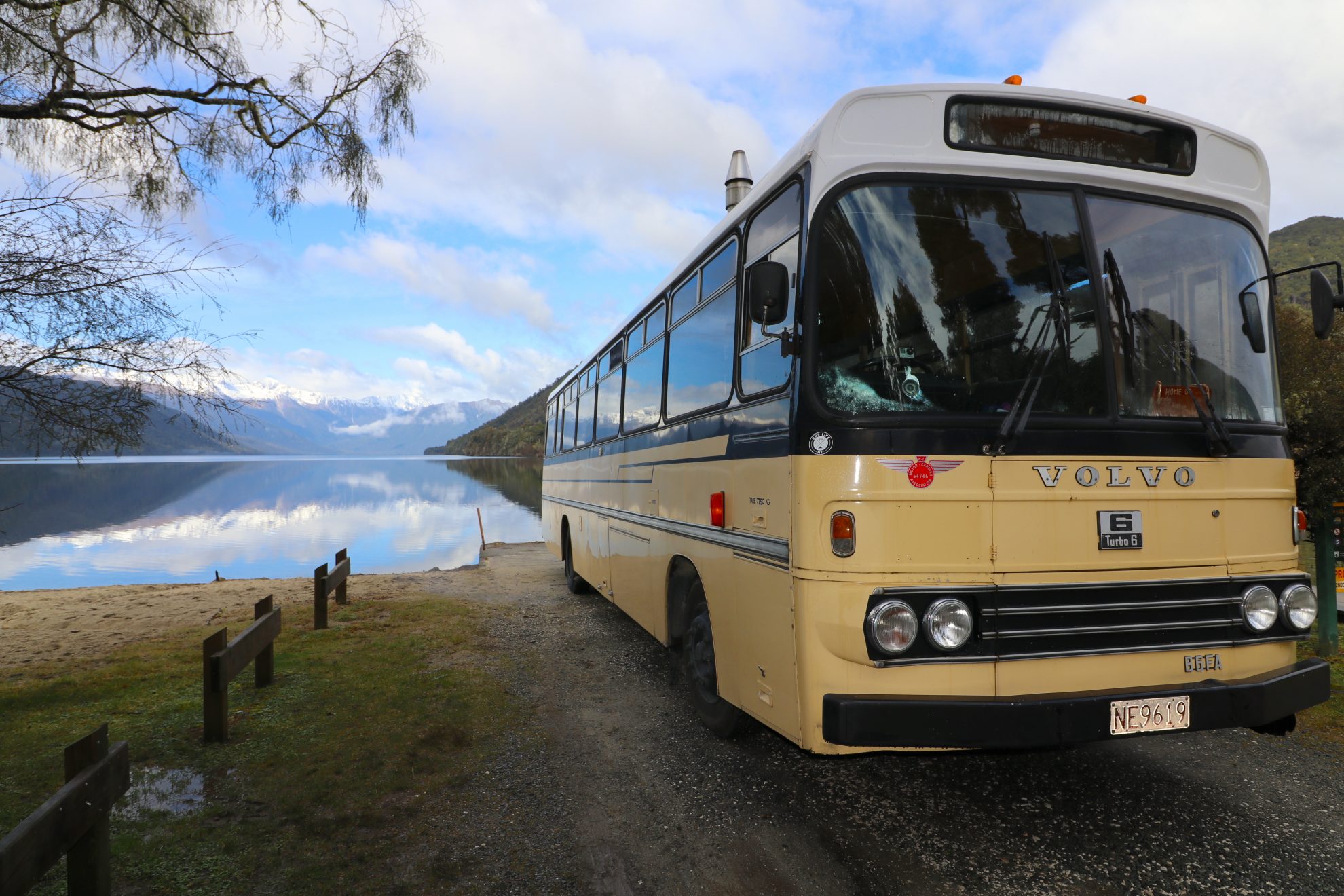
They met some people living and travelling in a converted bus. After taking a quick tour, they’d found their answer. Just two months later, they’d bought a Volvo bus and got to work converting it into their tiny home.
Cleverley isn’t a carpenter. Before this project he’d never built anything in his life. So he did what most of us would do and turned to the Internet for help. One year and hundreds of YouTube video tutorials later, they were ready to move in.
“We wanted it to feel like a mix between a hunting cabin and a DOC hut,” Cleverley says. “Just real Kiwi.”
The walls are lined with plywood, and there’s a wood burning stove surrounded by corrugated iron. It’s fully self-contained, with a solar system powerful enough to run their full-sized refrigerator. They have a composting toilet, hot showers, and a fully functioning kitchen. Their kids sleep in bunk beds in the hallway across from the shower and bath, and the master bedroom is at the back of the bus, with massive windows allowing them to soak up the view.
When Wilderness spoke to Cleverley, the family was parked next to Lake Dunstan in Cromwell. They’d been there a week, soaking up the warm early summer weather and exploring the surrounds. Cleverley says it hasn’t been difficult to find places to park, as long as he does a bit of research before rolling into an area. He says it’s been helpful to read up on local council bylaws to understand where he can park the bus, and for how long.
Freedom camping – or camping on public land that isn’t recognised as a campground or holiday park – has become a significant issue in some places, with some areas restricting overnight access due to unruly campers and the unsightly mess they leave behind.
However, self-contained vehicles have looser restrictions. For a vehicle to be designated as self-contained, you need to be able to live in it for three days without getting more water or dumping waste. It must have a toilet, fresh water storage, wastewater storage, and a rubbish bin with a lid. Several councils won’t allow any freedom camping unless the vehicle is self-contained. Few freedom campers will have all the luxuries that Cleverley and his family enjoy in their bus, but it’s a relatively simple process to gain self-contained status.
Cleverley and Mackintosh aren’t bound by jobs anymore; they create income with their Bus Life NZ brand. Each week, they film and edit one or two YouTube videos about what it’s like to live in a bus and they make money from the subscriptions. Right now, they’re up to 35,000 subscribers. They earn enough through their videos and merchandise to fully support their simple, yet very free, lifestyle.
“You get your time back,” Cleverley explains. “You don’t need to meet these everyday costs, so you get a lot of time to spend with your family. And, you get to live in some really awesome places. I love being outdoors and in the bush, or beside a lake or the ocean, so just the connection you get with the outdoors is so much better. My backyard is all of New Zealand.”
He describes their kids as “barefoot, free-range”; they spend nearly all of their time outdoors. Jake is now school-aged, so the couple began homeschooling him this year.
“They don’t have to trudge off to school each day and sit in a classroom. They’re with us. They’re out exploring and learning,” he says, adding that Jake has developed a passion for nature.
Cleverly says the nomadic lifestyle seems to be catching on; as their online following grows, he says they get more and more messages from people who say they’re inspired to do the same.
“I can see it becoming a bigger and stronger community, purely because this is just such a better way to live, rather than trudging through life trying to pay a mortgage that might take you 30 years to pay off. People just don’t want that anymore. That Kiwi dream has shifted.”
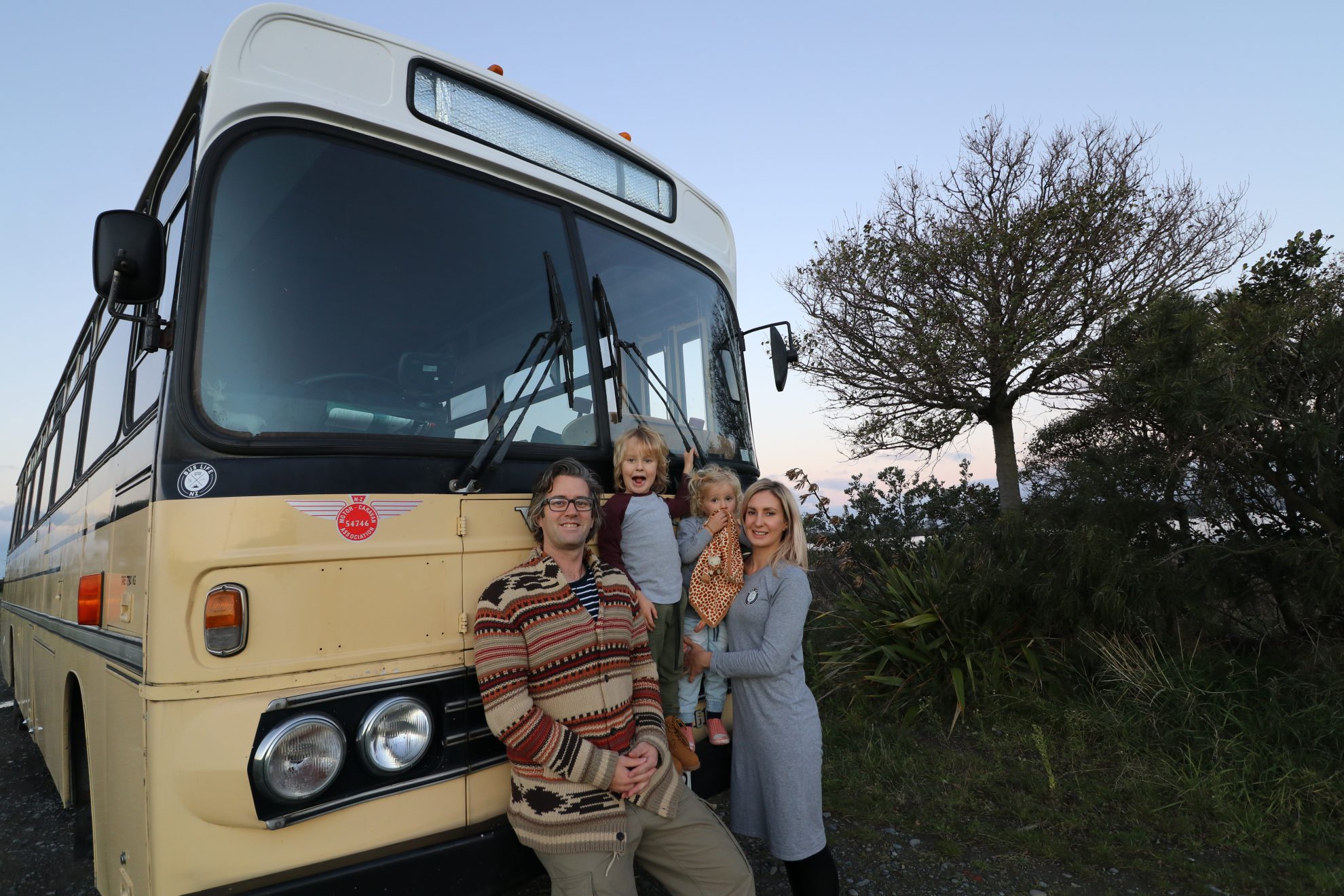
The bus cost $10,000, and after all the conversions, it came out to $35,000. Compare that to the $1 million price tag of an average Auckland house, and it’s a no-brainer says Cleverley.
“We consider ourselves very lucky to have thought of doing this in our 30s. I think as housing becomes more unaffordable, people will start to look for alternatives. Whether it’s a bus, a van, a tiny home or a yurt, there’s going to be quite a demand for it.”
The family’s routine is pretty open these days; if they’re enjoying where they are, they’ll stay a week or so. If the weather turns, they’ll move on. It’s free-form, go-with-the-flow living for them, and it seems to suit just fine.
“We’ll go into town today, get some groceries. Maybe take out the paddleboard later. I feel like a millionaire,” Cleverley says.
Johnny Johnston, 31, is a full-time van-dweller and electrician with an unquenchable thirst for surfing. Hailing from the Hawke’s Bay, his transition to van life happened two years ago. As a contractor, he often travels for work, sometimes for months at a time. Paying rent while he was away seemed silly, and he decided he’d try out an alternative lifestyle.
So, he bought a van.
Johnston’s home is a 2008 Ford Transit. He spent two months kitting it out himself, from the woodworking to the interior decorating.
“Because I knew I’d be living in it full time, I wanted it as luxurious as possible,” he explains. His kitchen is modest but tasteful, with bright wooden cupboards and a compact sink/stove unit. He even has a small solar-powered fridge.
His bed doubles as a seating area, with a removable pole that turns the centre bed panel into a table during the day. The surfboards hang above the bed, opposite a small shelf for his personal items. It’s cosy, but more importantly, his van allows him complete freedom to chase waves all over the country.
As with other van-dwellers, he’s often checking the app Campermate to find free parking places for the night. But sometimes he barters with campground owners, offering to do some work.
“I don’t just go to a campsite and pay full price. I ask them if they need any electrical work done and see if we can come to an arrangement for staying the night. I’ve done it in a few places and it’s been received really well,” Johnston says. “I do a little work and I stay places for free for a long time.”
The freedom to explore has been the best part of the past two years, but he says van life does have its downsides; primarily, he misses having a home base.
“I’ve seen more of New Zealand in the last year and a half while living in the van than I had in the previous 10 years,” Johnston says. “There are so many places in the South Island I had never been, like Lake Hawea, Glenorchy and Fiordland. You turn up, and it’s just, wow.”
He says it’s been fun meeting people who are curious about the van and that it’s typically a really positive reaction when he tells people how he lives.
“It’s almost like they want to do it, but there are so many things in their life stopping them. So when they hear from someone who is doing it, they’re really stoked about it.”