Danahars Track Circuit, Tongariro Forest Conservation Area, Central Plateau
If you have driven to the Chateau Tongariro, you have seen the Tongariro Forest Conservation Area. But you probably paid it only the briefest glance before feasting your eyes on its glamorous neighbour across the road, Tongariro National Park.
Yet Tongariro Forest abounds with recreational opportunities for the adventurous tramper and mountain biker. Criss-crossed by old logging roads, the forest is recovering after nearly 70 years of rapacious logging, but there are pockets of marvellous bush which escaped the carnage.
This circuit can be done as a (long) day tramp but, as navigation can be challenging, two days allows a leisurely pace and the chance to take your time over the tricky sections.
After leaving my vehicle at the Okupata Caves parking area, a 3km walk back along Pukehinau Road brought me to Danahars Track on the left. A pleasant soft-footed lope down Danahars soon had me above Mangatepopo Stream and here the tricky trekking began.
A narrow track drops almost perpendicularly into the stream with a couple of rather doubtful-looking ropes in place to assist with the 20-30m slither or, in the words of mountain-bike pioneers the Kennett brothers, ‘a careful grovel into the Valley of Death.’
I waded downstream for about 20 minutes, fortunate to see a family of blue ducks cavorting on the rapids along the way, negotiated some slippery boulders and arrived at the junction where the Okupata Stream meanders into the Mangatepopo.
Here was the next tricky task – finding the steep pumice gut leading out of the Mangatepopo. A step-by-step search along the true left bank revealed the track, camouflaged as a dry stony creek bed running parallel with the main stream and hidden by a curtain of foliage.
A few minutes’ grunt up the chute gave onto a plateau where I set a westerly compass course for Waione Stream, heading along what are most likely old logging roads, keeping the Whanganui River headwaters on the right and avoiding getting sidetracked by the numerous paths wandering off into the bush.
Toetoe presented the occasional battle but generally the tracks are navigable. After about three hours of pleasant wandering through regenerating bush – juvenile lancewoods, manuka, koromiko – the track drifts down to a ford across Waione Stream. A navigational mistake here resulted in 30 minutes’ unnecessary walking – the stream should not be crossed!
Tongariro Forest is home to the North Island brown kiwi and I had hoped to hear them call from my camp on the bank of the Waione, but the forest was silent apart from a posse of hunters on quad bikes who rumbled past in the twilight, headlights ablaze, and quite oblivious to the tent tucked in the bush.
Next morning I headed south along the 42 Traverse Track, a premier mountain-biking track, climbing steadily through valleys bright with toetoe in flower, before dropping back to the Waione and crossing Cut-off Creek and Bluey’s creek.
Gravel track occasionally gave way to smooth papa base which was slippery and rutted – tricky for trampers, fun or terror for bikers.
The next landmark was the ‘pond’, a man-made waterhole from milling days, located near Pt 793. About 500m from this tarn a narrow gravel track heads left; missing it could mean the long way home.
That track leads to a hunters’ camp, Tall Chimney Biv, clad in colourful tarpaulins on my visit but since reclad in dull corrugated iron. From here it was back to compass navigation, setting an easterly course for the car park and picking up logging routes going the right way.
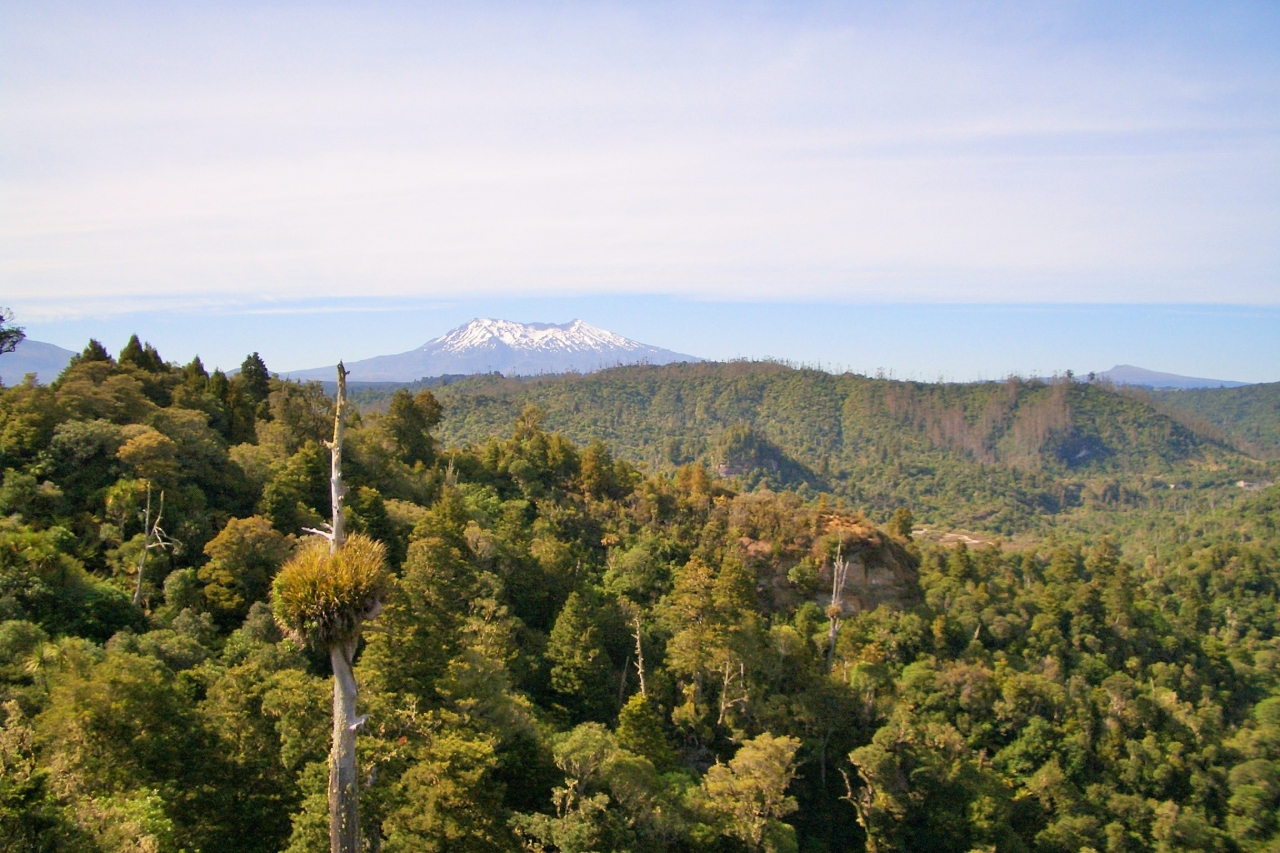
The trail passes a stand of decrepit blue gums – remnants of trial Forest Service plantings – and climbs a rocky ridge giving superb views of Mts Ruapehu and Ngauruhoe. It then sidles around Pt 783 and drops steeply through thick kanuka and toetoe to a tributary of Okupata Stream.
The tricky trekking is now nearly over. After crossing the stream, which could be dodgy in high flow, there’s a steep pumice chute, but watch out for the yawning tomos – underground holes and caverns found in pumice country – waiting to swallow trampers. Then it’s left onto Pukehinau Road and the tramp’s end.
A satisfying hike through a scenic area with many tracks to explore for those competent with map and compass.