

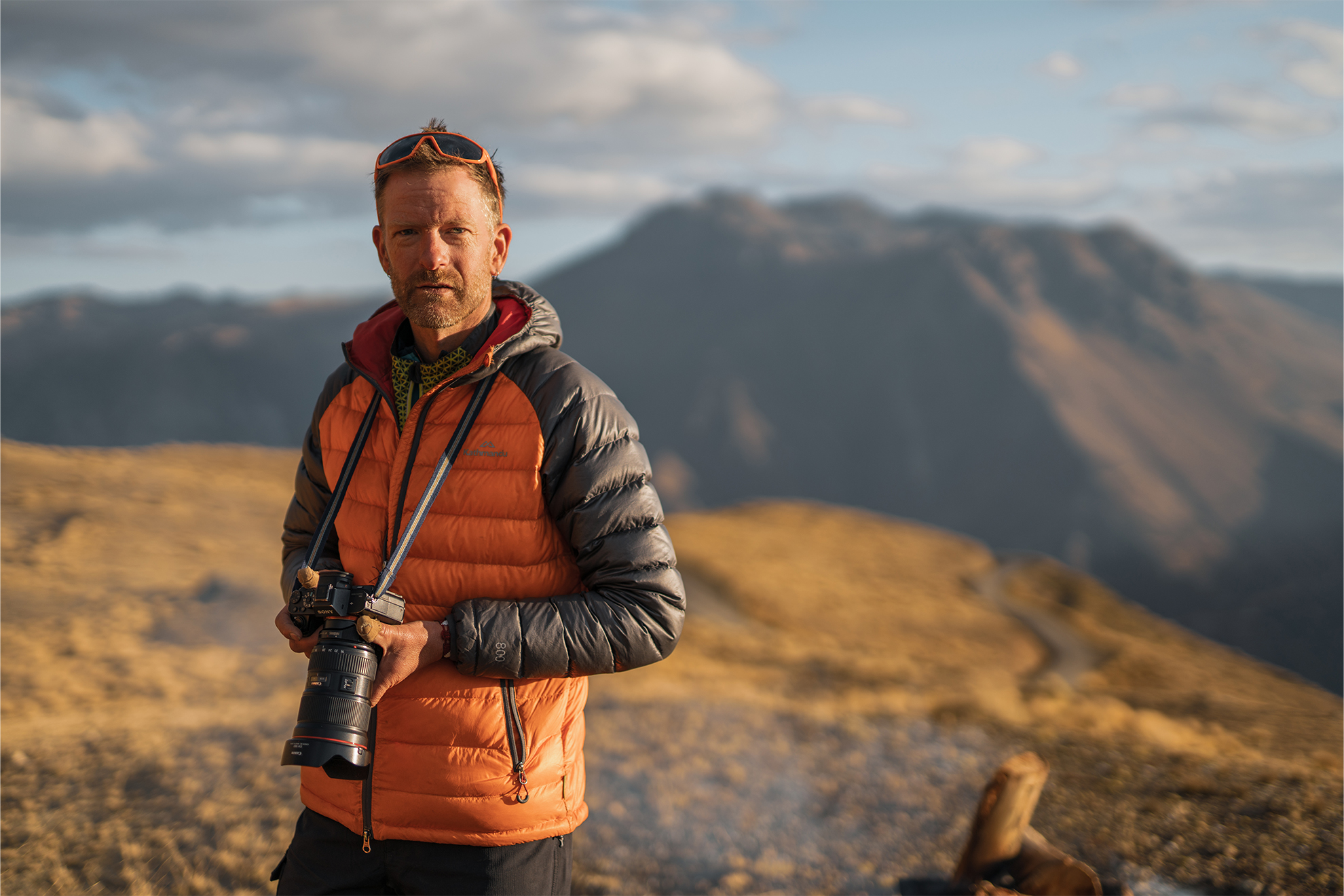
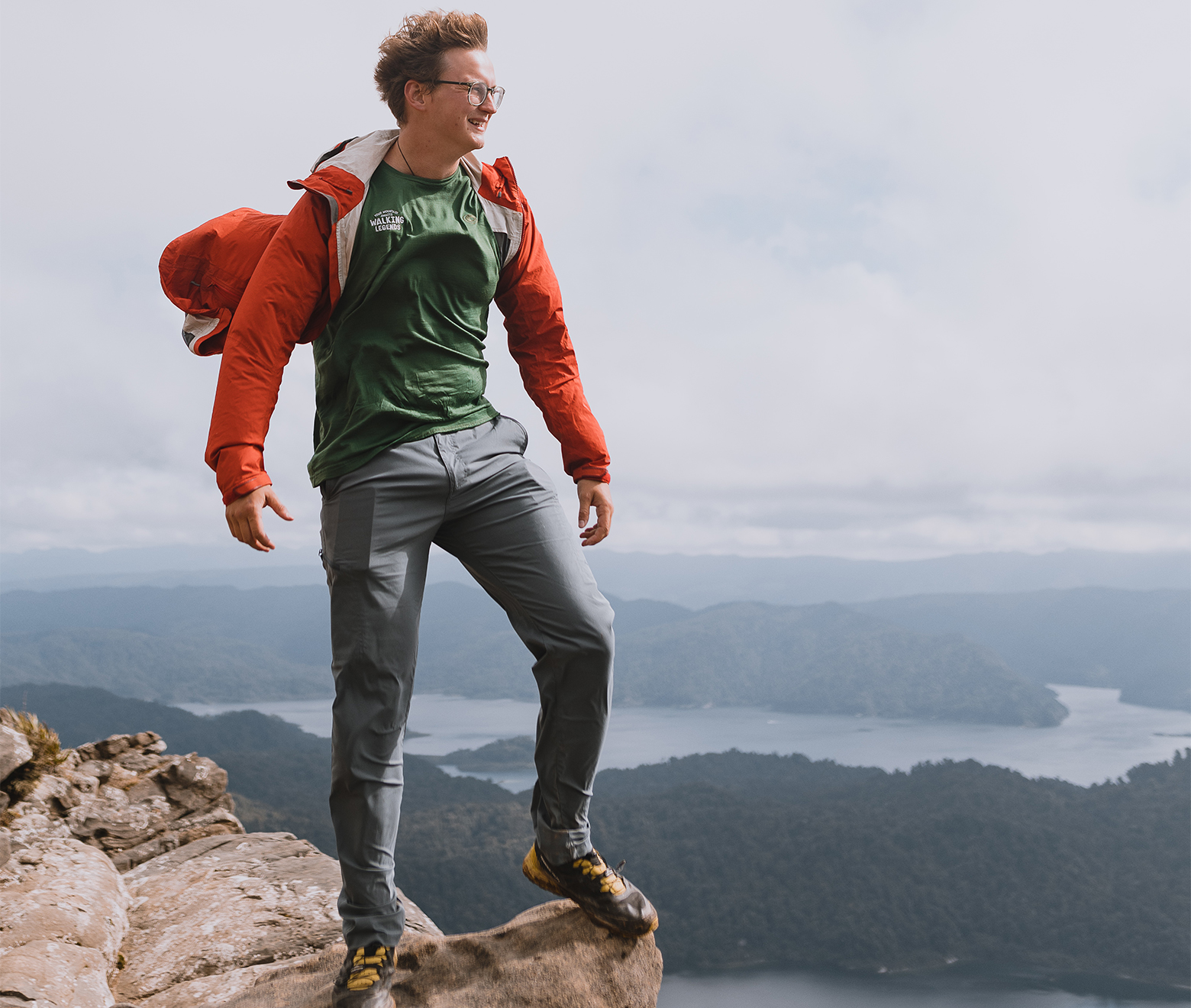
Mark’s photo (featured): Central Darran Mountains
The image was taken in Cleft Creek in the Central Darran Mountains after crossing from Turner’s Biv via Mt Makere.
In moody weather we descended tongues of snow and smooth rock slabs. Anticipating that my companion Tom was going to be skylined against the white of the snow, I waited in position until he was suitably in frame. I shot wide, at 24mm, to capture scale and depth.
The photo is composed around the rule of thirds, and strong diagonal lines draw the viewer’s eye through the photo, from the person to the valley floor.
What motivates you as a photographer?
These days, there’s a variety of reasons – principally documenting my experiences to a high standard and communicating them on my blog and in books and magazines. Telling the story of the experience, but also the story of the environment or culture and what’s unique and interesting about it.
What camera gear did you use while bike packing?
In the Americas my standard set-up was a mirrorless full-frame camera. I like to have a camera with a high dynamic range sensor that can produce a reasonable shot with the iso turned up high. The lenses were a 16-35mm f2.8, a 55mm f1.8 and a 70-300mm f3.5-4.5. I favoured a hip bag for my camera gear, because your body is damping the vibrations on the bike. A hip bag means if you see something you want to shoot, you flip the bag around, get the camera out and you’re ready to go.
If it’s easy to get the camera out, you’re much more likely to use it, especially when you’re tired.
How did you manage the technical aspects of working on the road?
I carry a 20,000mAh power bank for keeping my phone topped up and I used my laptop in the field while the battery lasted. I did most of my post-processing at a hostel or hotel. Because I blog as I travel, I would go straight through the shoot, edit and process the photos and output them for the blog. I also carried two SSD drives, a master and a clone of it. They are tiny little drives with no moving parts, able to handle rugged terrain. The best photos from each edit were also backed up as JPEGs in the Cloud, but everything is shot in RAW format.
What are your tips for ‘out there’ photos of people in the landscape?
I like to first compose an image without the person in it. For example, I might be walking along a ridge, look back and notice it’s a nice scene but it’ll be even better when my companion walks into the shot. I’m anticipating the photo, composing it ahead of time. A common theme of my work is to try and display a sense of scale, of putting the person within the wider context of the environment.
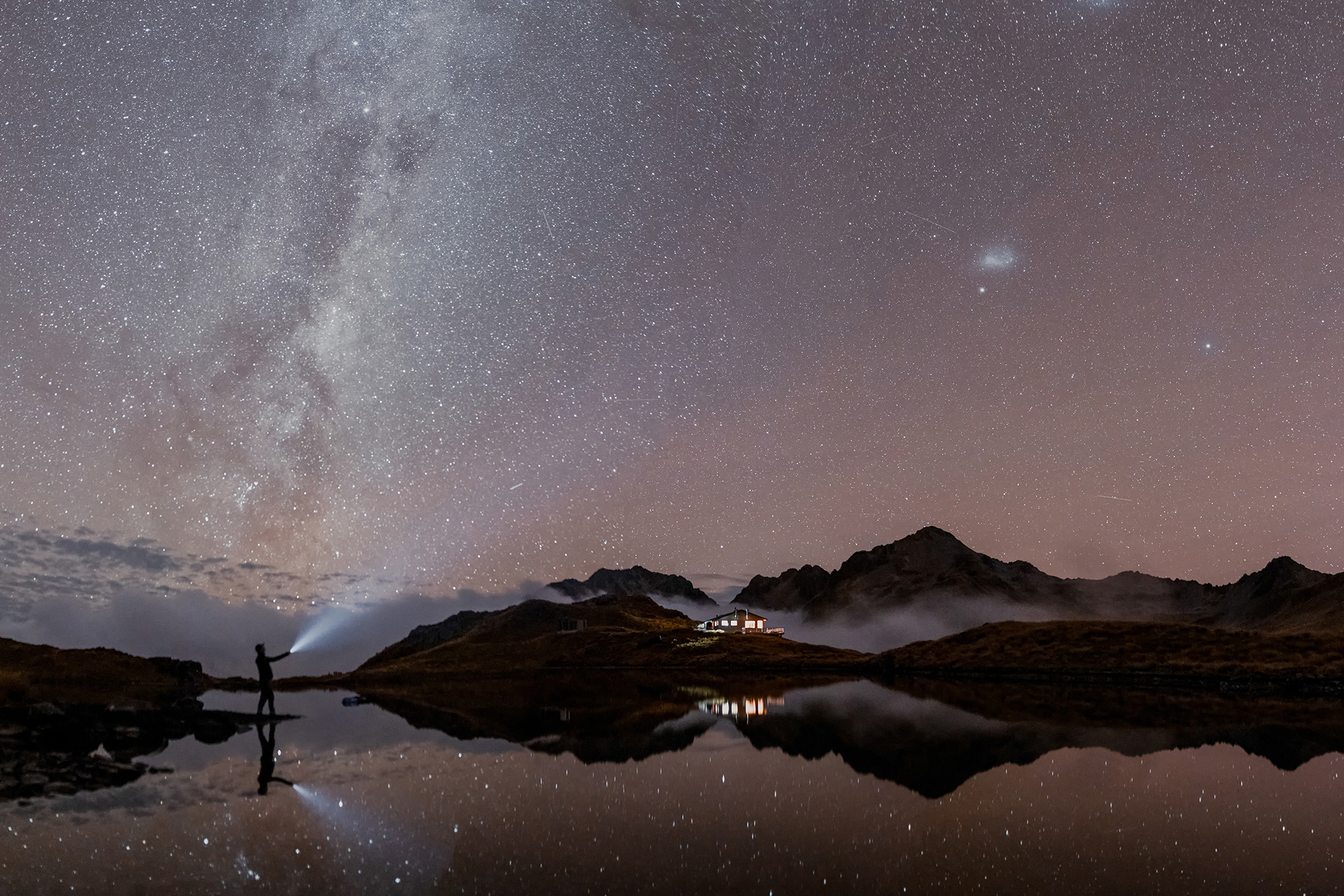
Huts and camping: Dylan Arthur
Dylan won both the 2023 Wilderness Outdoor Photographer of the Year competition and the huts and camping category with his shot of Angelus Hut at night – his first-ever entry. He’s a hiking guide in summer, based in Tongariro National Park, and spends winters in Wānaka.
Dylan’s photo:Angelus Hut in Nelson Lakes National Park
It’s a cheeky selfie. I headed out early, about 8.30pm. There were people in the common room with candles on, so it gave a nice light and ambience. The water was really still, which gave a great reflection – the stillness was the main thing I wanted to capture. I set up the camera on a timer and walked out there myself. It’s a panorama of about five frames, merged in LightRoom.
How did photography start for you?
I bought my younger brother’s camera from him for a trip to Australia about six years ago. It snowballed from there. I started researching how to take better photos, and it got me back into the outdoors.
Where do you like to photograph?
Absolutely anywhere. I love the alpine environment; Mt Cook and Tongariro in particular have a lot of history for me; they’re special places. As much as capturing big landscapes is the main objective, I like capturing the in-between moments – a friend getting to a hut, having a coffee or enjoying the view. Creating photo-stories, seeing the progression of getting into the outdoors.
What gear do you use?
I have a lightweight mirrorless camera with a 24mm prime lens that stops down to f1.4. It creates a nice depth of field. On longer trips I’ll take a telephoto with me. I always take two or three batteries – if you’re not using a camera consistently, a battery will last two to three days in normal weather; if it’s cold they go a bit quicker. Setting up a camera and taking a time lapse will go through more battery. These days, batteries have a pretty long life which is helpful.
Do you use any astrophotography apps?
PhotoPills – knowing when sunrise and sunset will be and where the Milky Way is rising and setting is a big one for me. It allows me to plan my trips around where I want to be, and when.
How do you balance adventuring with friends and taking photographs?
I do a fair few solo trips, but I love being out there with friends. From a photography point of view having a person in your frame is a good thing, it adds a sense of scale. I’m always out for the sunset and sunrise, shooting when the light looks right. I’ve had plenty of 2am starts and midnight finishes (when the others are in bed).
What are your tips for budding astrophotographers?
Get out and practise beforehand. Find out how you need to be shooting with the gear you have to really bring out the dynamic with the stars. People tend to photograph just the Milky Way; having an interesting foreground can also help to create a great image. It’s lots of trial and error.
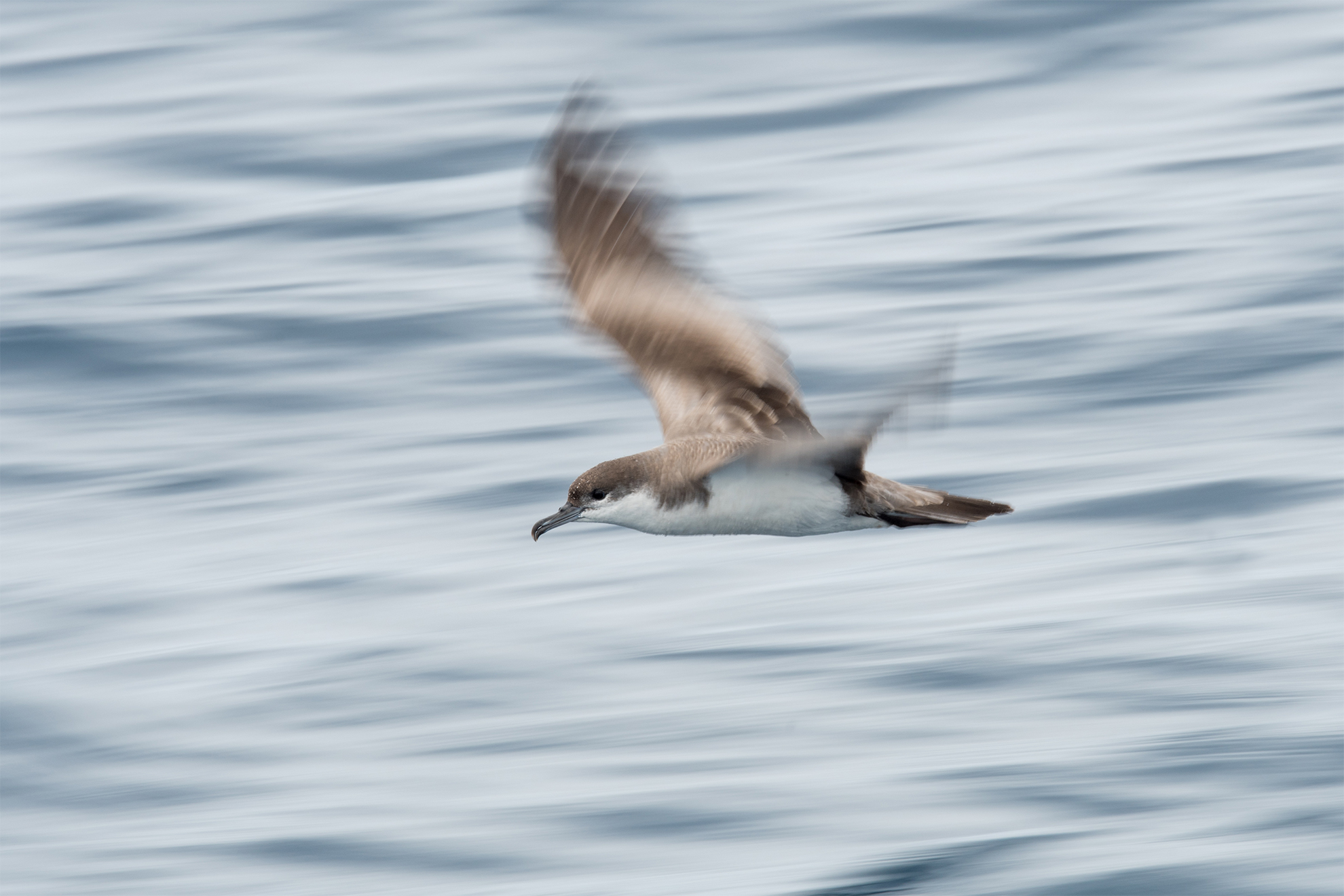
Wildlife: Edin Whitehead
Edin is a conservation photographer and seabird scientist and recently completed her doctorate on the ecophysiology of petrels and shearwaters. She won the New Zealand Geographic Photographer of the Year peoples’ choice award in 2020.
Edin’s photo: Buller’s shearwater / rako, taken from a boat in the Hauraki Gulf
One thing I try to do in my bird shots is capture a sense of movement, but retain enough sharpness so you can see the head and the eye crisply. When people start wildlife photography, they usually aim to get a really sharp image because that’s a challenge in itself. Once they’ve got some good sharp shots, I always challenge them to be counter-intuitive with their settings – to try slowing the shutter speed down and doing a pan blur. (Typically, your aperture is wide open to let in as much light as possible, with a high iso and a fast shutter speed.)
How did photography start for you?
My dad is a keen photographer and my grandad was, too. Growing up I had access to Dad’s second-hand cameras, so I always had the chance to photograph birds. Now we work together. We’ve been running wildlife workshops for a year now, it’s good fun. (Edin and Tony teach New Zealand Photography Workshops’ wildlife masterclass.)
What came first? Photography or seabirds?
Definitely the birds, I’ve been a birdwatcher my whole life.
Why seabirds?
I’m fascinated by anything that can fly.
That complete disregard of gravity. I’m envious because it looks like a whole lot of fun. I was fortunate to go to the sub-antarctic islands in 2015, and it was the first time I was on a ship away from land. It’s full of birds out there, albatrosses, storm petrels, this diverse bird life you won’t ever see on land unless you go to the islands where they breed. Their ability to live almost their entire lives on the ocean captured me.
What gear do you use?
I have two main cameras – a DSLR with an 80-400mm lens and a mirrorless with the same lens with an FTZ converter. I started using the mirrorless last year and I’m still getting used to the ridiculous frame-rate and being able to do video through the viewfinder. The good thing about the development of mirrorless cameras means the good DSLRs are selling a lot cheaper. And there’s nothing wrong with them; I still use one regularly.
What are your tips for aspiring wildlife photographers?
Know your gear, and know the species you’re working on. Spend time observing them and how they’re interacting, learn what time they’re breeding – nzbirdsonline.org.nz is a good resource. Also, know the ethics of wildlife photography and make sure you’re not impacting the environment or making the wildlife nervous. The best photography is when they’re going about their normal life and they’re not threatened by you. There’s good general information about this online from DOC for marine mammals, but a lot will come from your experience observing different species and learning how closely you can approach them.
It’s best to let them approach you, by being still and quiet and blending into the environment.
In terms of making better photos, what you leave out is just as important as what you leave in. Slowing down and taking the time to look and see what’s around your subject is an easy way to improve the composition. Do I like everything in my frame? Can I move a little bit and change the background? Being more aware helps you level up quite fast.



