

After the summer’s work ended, I tramped over the whole Heaphy, having seen only its eastern side. Fit from months spent outdoors, I walked most of it in two days, ending at Kōhaihai halfway through the third. The weather wasn’t brilliant, and I didn’t fully appreciate the track.
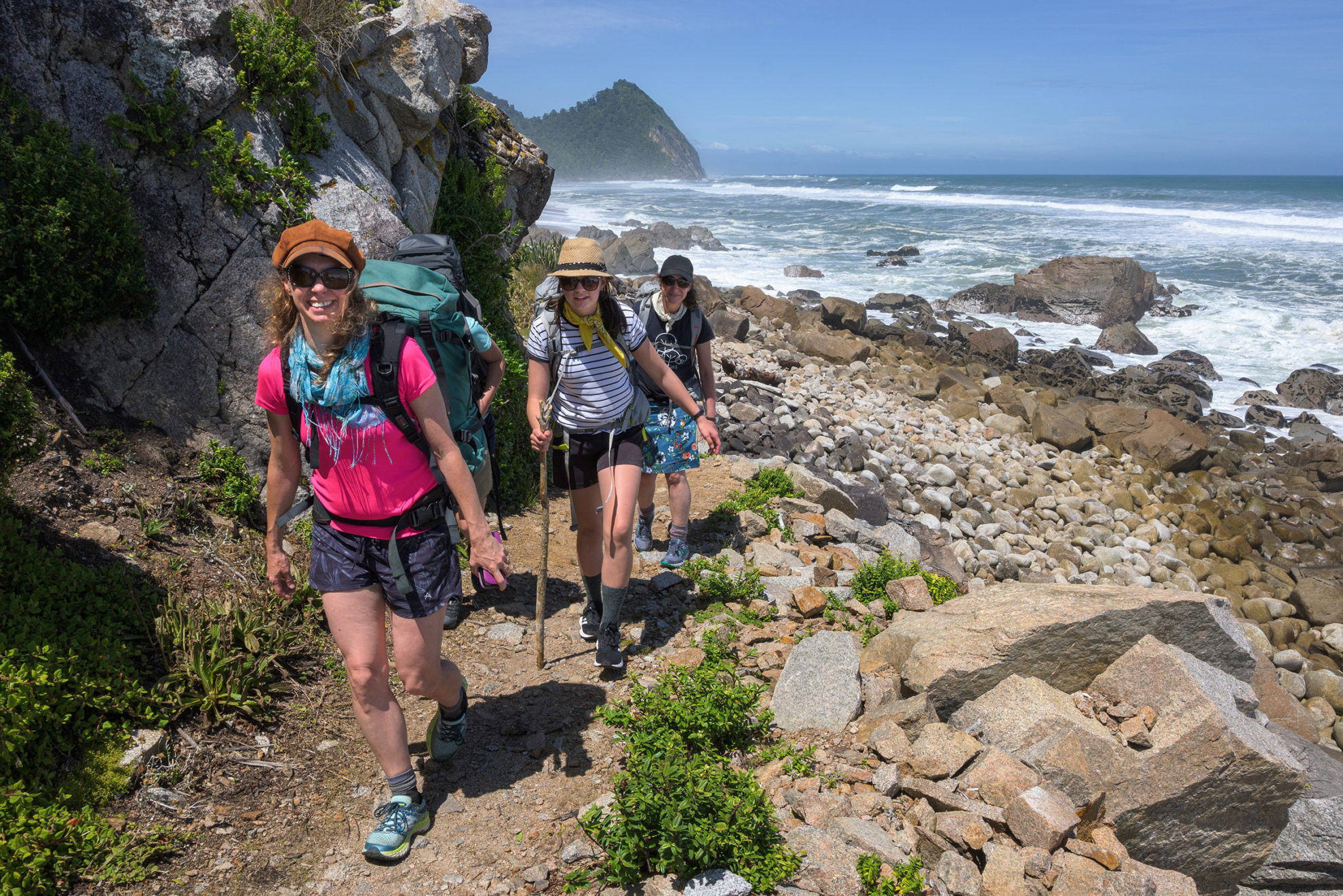
More than two decades later, the MacIver and Stanton-Barnett families arrive at Heaphy Hut. It’s hot, but the ferocious surf doesn’t tempt even Ken, an accomplished swimmer. Steep beaches, huge waves, vicious undertow. Instead, we all swim in the Heaphy River. Washing off sweat makes a pleasant end to day one. Later, the incoming tide pushes huge surges up-river, battering aside a sizable rimu log. We’re shocked by the violence of it.
My previous stay here was in the older hut, when the last of the horses that Forest Service rangers used for transporting gear still grazed on the grass. The new Heaphy Hut has internal windows, artfully etched with facets of the area’s ecology and history. It, Mackay Downs and Perry Saddle are new DOC designs, built as part of a significant upgrade.
Unable to get a booking at Mackay Downs, we opted for Lewis Hut. That means a short day of less than two hours, including a swim in the Gunner River. Aside from one other tramper, we have Lewis Hut to ourselves, and there’s laughter, reading and the click of the Rubik’s cubes that the kids have brought along for entertainment.
The price for our lazy walk is a longer third day. From Lewis Hut, the track climbs steadily, leaving the sub-tropical lowland of the Heaphy Valley for the upland moors. By the time we arrive, Mackay Downs Hut has emptied out, offering welcome shade for lunch. Then it’s onwards, over the downs.
Anyone reading English literature can’t fail to come across descriptions of moors – Emily Bronte’s Wuthering Heights, Daphne du Maurier’s Jamaica Inn, or James Herriot’s All Creatures Great and Small. Undulating uplands covered in heath, shaped by brooks, and prone to mists. If New Zealand has an equivalent, perhaps it’s on the Heaphy. The Mackay and Gouland Downs span many square kilometres: broad, flat and dissected by innumerable streams, with forest in sections but also occasional granite outcrops and large openings of sub-alpine vegetation.
Through this terrain we wander in the warm afternoon. Fernbirds click in the undergrowth and the occasional kākā croaks and whistles above.
The trail’s gradient has been undemanding, but the mounting kilometres take their toll, especially for those with shorter legs. Just before Saxon Hut, a shimmering pool glints through the beech trees. This deep bend of the Saxon River has tannin-stained water as inviting as ice-tea. Sheer bliss to float in, and we arrive at the hut clean and refreshed.
By late afternoon, mist creeps in from the sea. I feel pleased to have seen misty moors. Sun-drenched downs don’t have the same atmosphere.
Kahurangi National Park, by its sheer size and diversity, is an important refuge for many native species, and pest-control efforts have been paying dividends. In 2018, DOC made a bold effort to introduce the endangered takahē, hoping to form a second mainland population outside of Fiordland. Thirty-one birds were released and we’re hoping to see some. Signs are positive; in several places we find their straw-coloured, pellet-shaped poo.
Trampers coming the other way report seeing a takahē pair and chick up ahead. When we catch up with the kids, yes, they’ve all seen them. No sign now though. Tania and I spend 30 minutes watching. No joy.
We lunch at Gouland Downs Hut. Built in 1936, it’s the oldest on the Heaphy, dating back to when the area was set aside as a bird refuge.
The MacIvers are staying here, having missed out on bunks at the new Perry Saddle Hut. They’ll catch up with us tomorrow morning. We push on; the angular forms of the Gouland Range rising ahead. Still no takahē, but Cave Brook reveals a preening pair of whio. It’s the first time any of the kids have seen them.
Over the downs the track wends, climbing gradually, passing the boot tree – one of my few strong memories of first walking the track. I wonder at the abandoned boots. What did their owners do? Carry on in one sock?
As we climb beside Perry Creek, the mānuka closes in and mixed flocks of small passerines flit through the branches. Now beyond the downs, the chance to see a takahē is rapidly fading.
Perry Saddle Hut is a hive of activity, with a guide cooking a delicious-smelling stir-fry for his clients. I ask the hut warden about takahē.
“There’s one which hangs about here sometimes,” he says, “but it was last seen heading west a couple of days ago.”
Disappointed, we cook dinner.
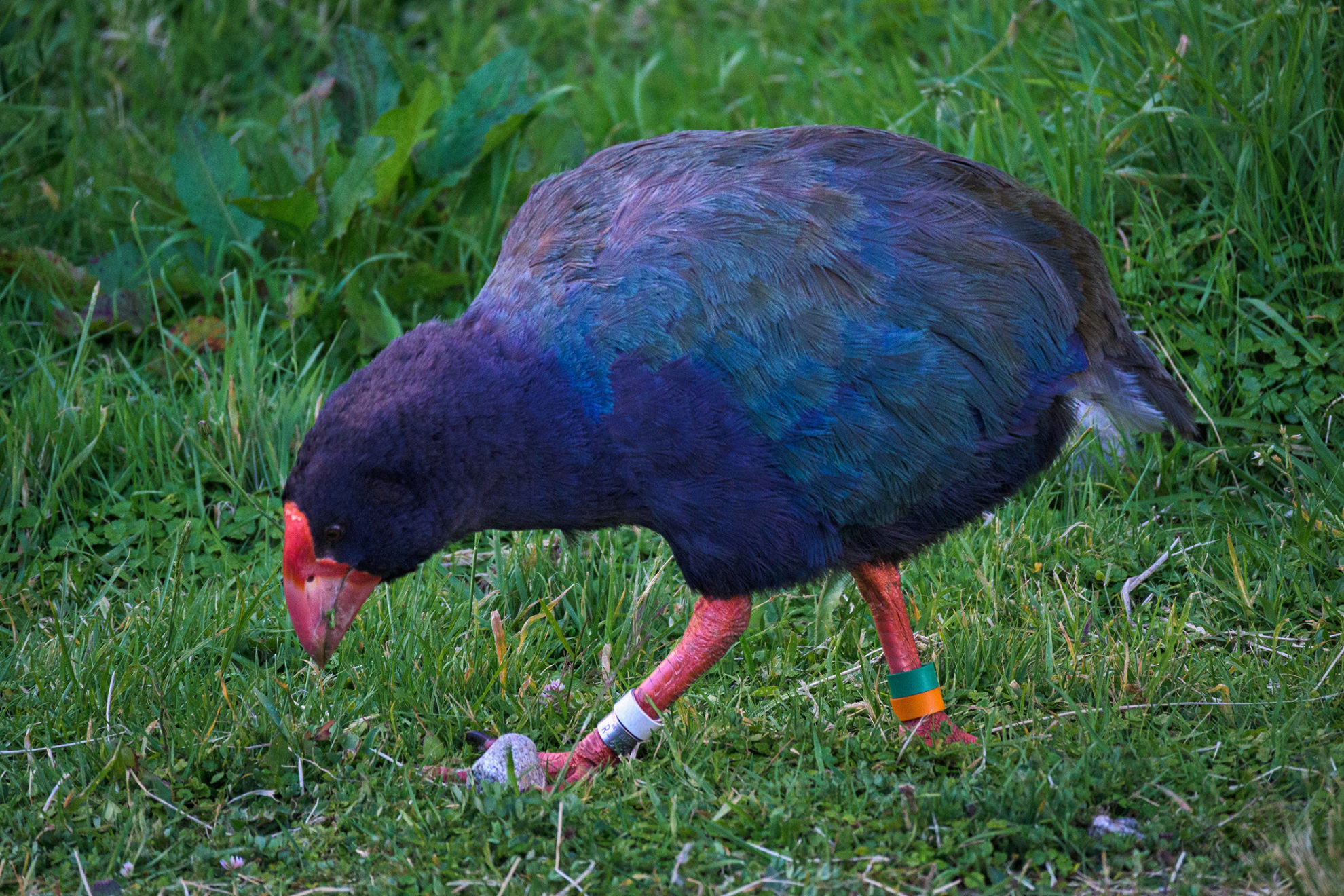
Then a rumour ripples through the hut, which soon empties as everyone rushes outside. A big, bold, green-and-blue bird struts about, unconcerned by the dozens of on-lookers, munching on the grass surrounding the hut.
“They like those introduced grasses,” the hut warden tells me. “Easier to digest that tough old tussock.”
“How are they doing?” I ask.
“About half of the original 31 have survived,” he tells me. “And there will be another 30 released soon. The breeding programme at Burwood produces plenty of birds, and the plan is to keep boosting the population until hopefully it’s self-sustaining.”
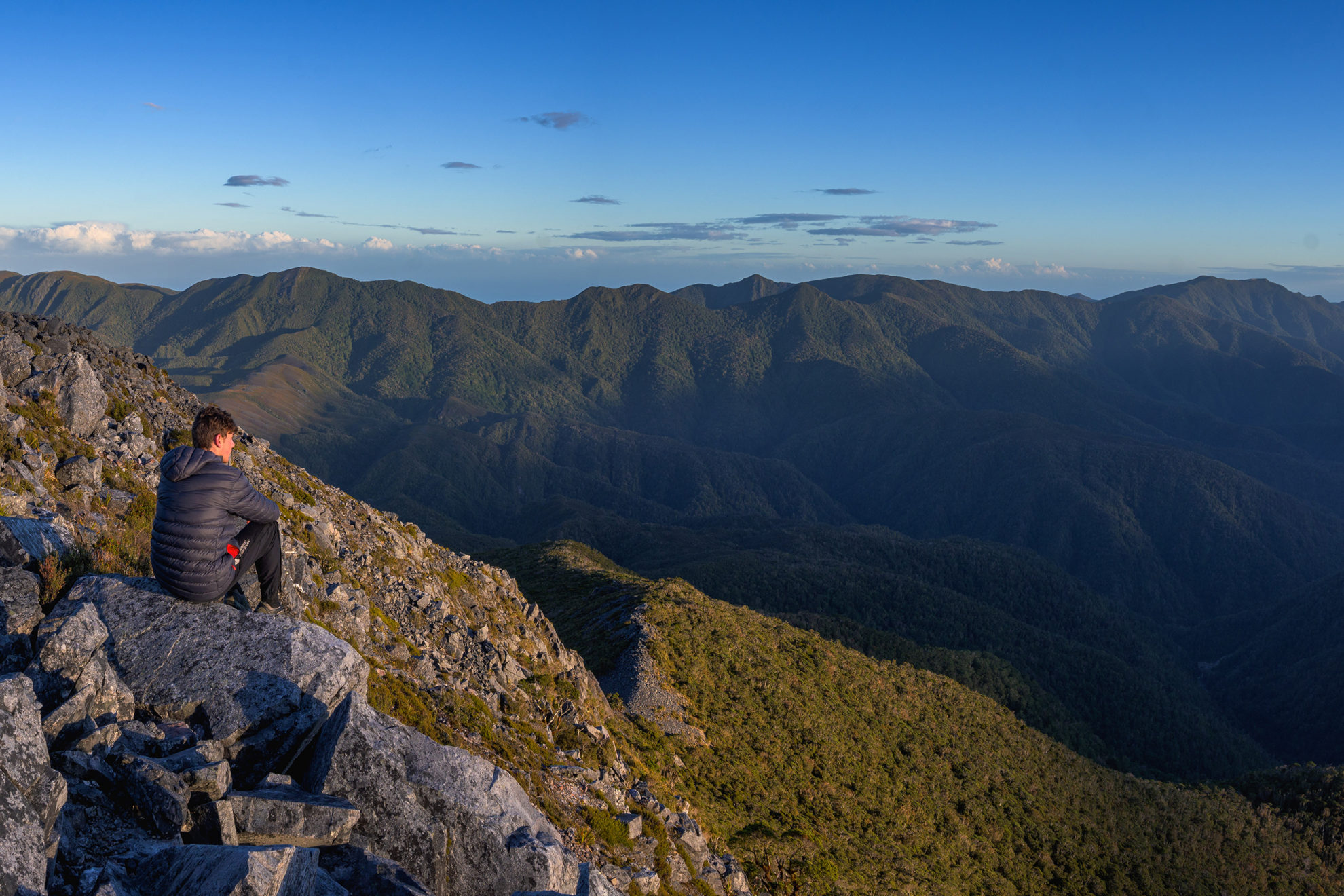
On the morning of our last day, Lee and I scramble up Mt Perry for sunrise. Westward stretches the vast acreage of the downs, and on the far horizon is the sea. East is the Dragons Teeth, as sharp and imposing as the downs are not.
The MacIvers arrive and together we walk through the beech forest. At Aorere Shelter, I tell the story of the monster pack on my first trip here. The drizzle begins, but saves its first real downpour for when we reach Brown Hut.
We’ve tramped 80km. Everyone is tired but satisfied. We’ve all seen at least one takahē. And that, quite apart from the diverse scenery, makes the Heaphy one of our Greatest Walks.



