


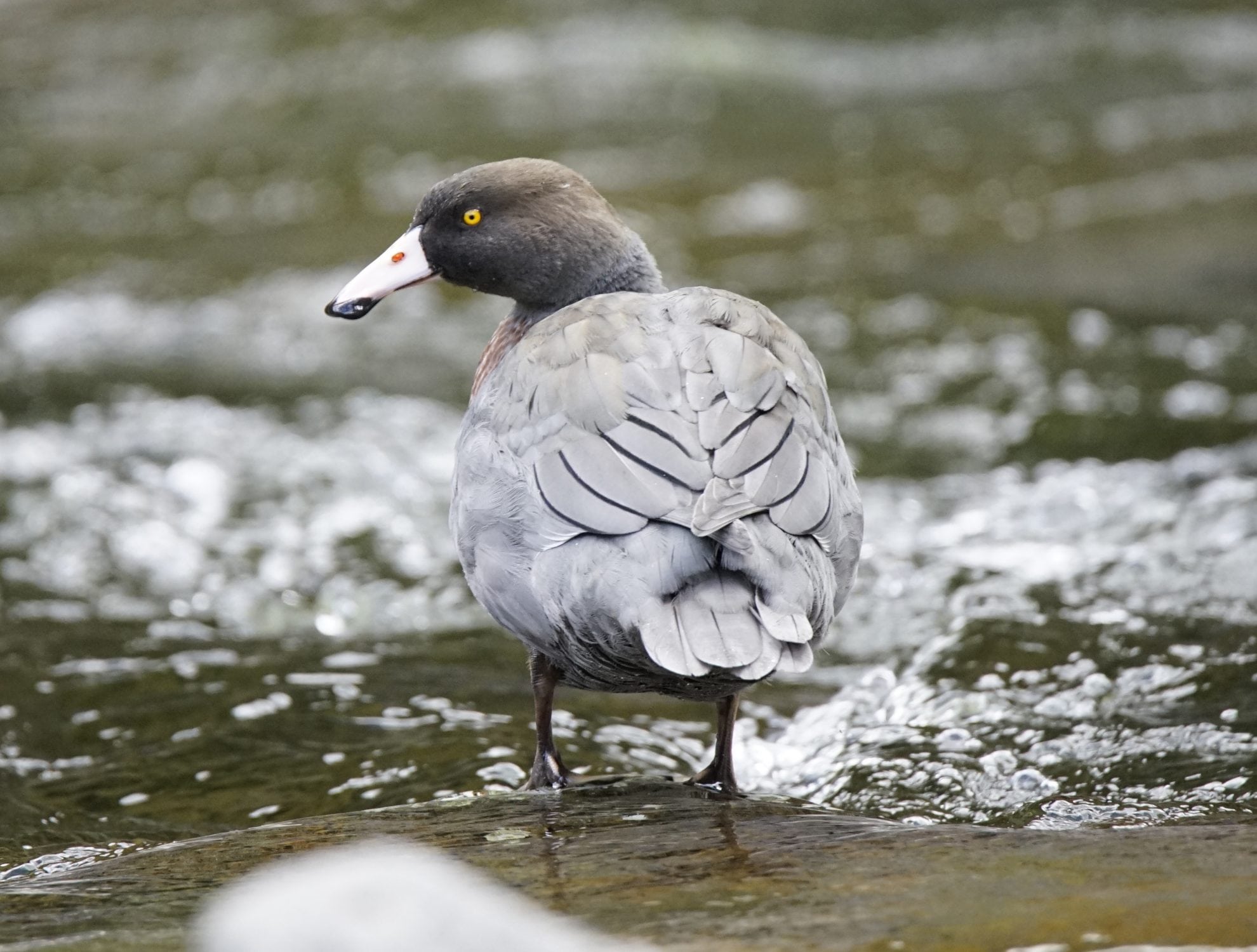
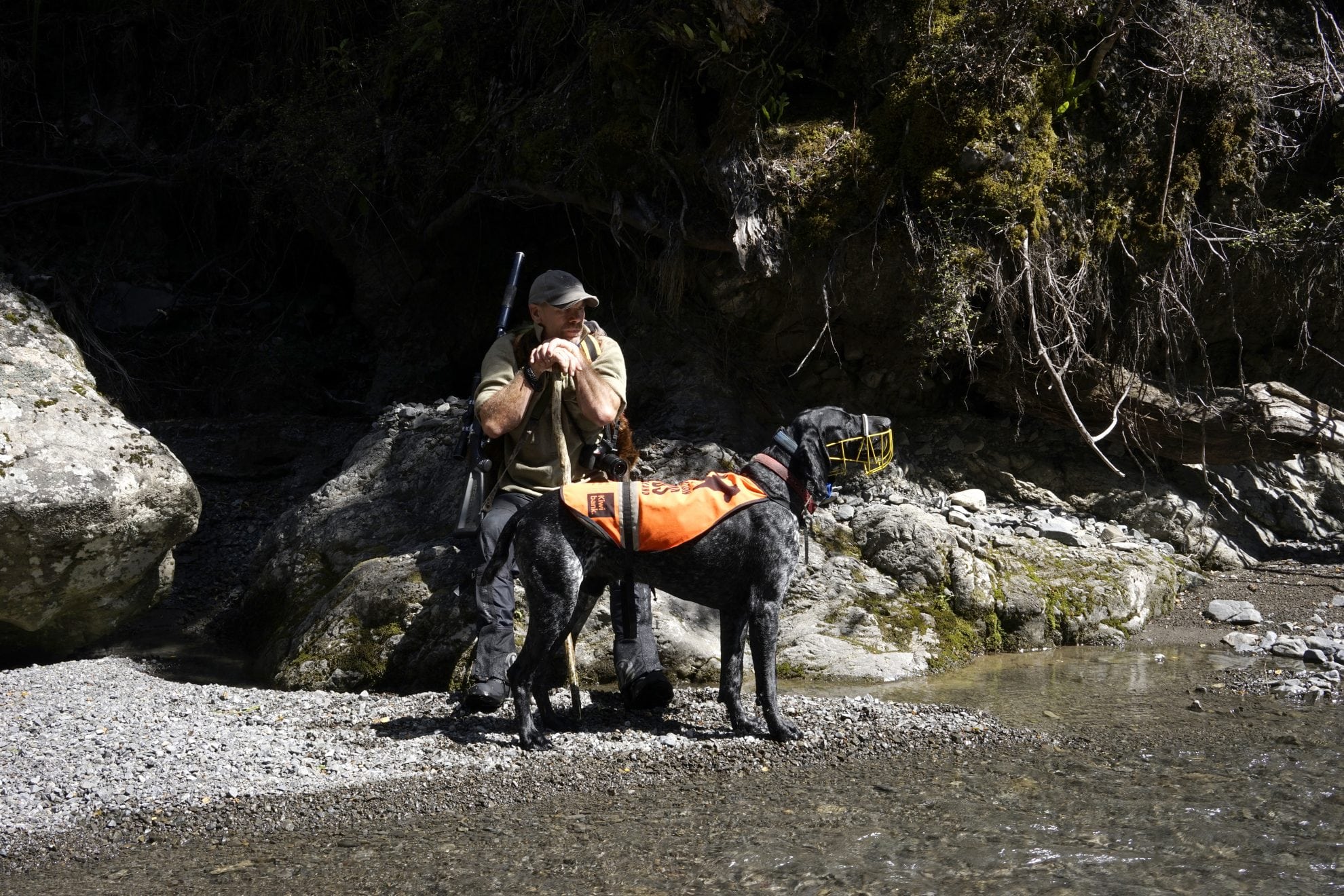
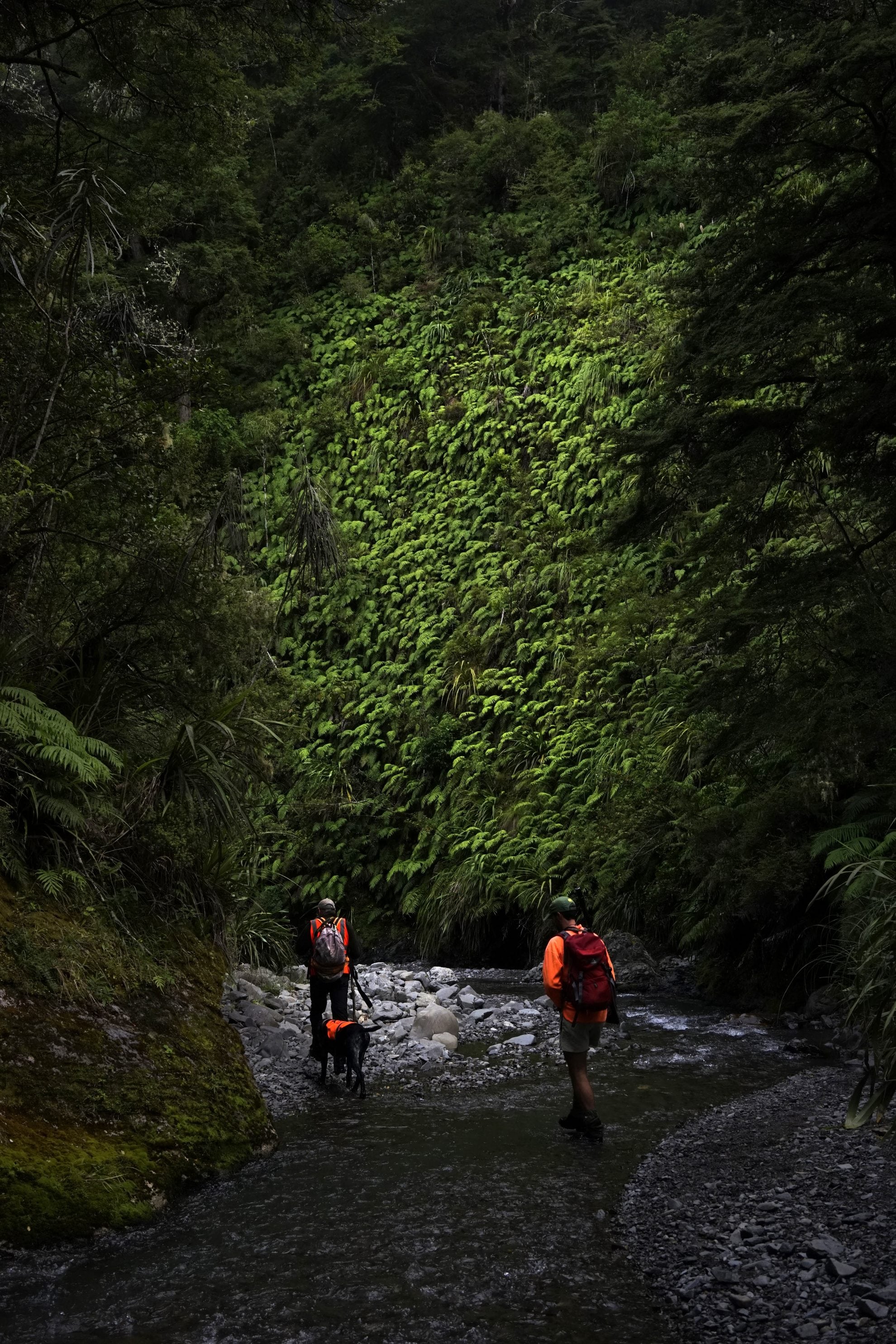
I was travelling with Whio Recovery Group leader, Andy Glaser his dog Beau and Palmerston North-based DOC ranger Nathan Lightbourne. Glaser and Lightbourne were there to count whio and to see whether a 1080 poison drop over 32,000ha of the northern Ruahine Range in November 2017 had helped the birds recover from predation. While we were searching the Mangatera River, another team flew into the nearby Apias Creek area.
Critics claim that 1080 kills and contaminates everything in the area where it’s used. We were there to put that theory to the test. If 1080 doesn’t help vulnerable Ruahine animals, the whio population would be static or smaller. If it is as lethal to non-target species as some claim, the whio population – and that of other animals – would have collapsed. But if the 1080 had done the job it’s meant to, we would notice an increase in whio numbers.
Colenso Hut, a tidy, bright and nicely-situated eight bunker that overlooks a sunny river flat, was our base for two nights. We settled in and were soon off on an evening exploration of a section of the Mangatera River.
Beau, a three-year-old German shorthaired pointer specially-trained to find whio, led the way. The dog wanted to find ducks and didn’t have much time for his humans and their two inadequate legs. Glaser described him as a teenager with ADHD: “He’s a hard worker, but he’s also hard work.”
It didn’t take long for Beau to point his first whio, but by then it was getting dark, so we returned to the hut to prepare for the following long day.
Whio wake early; we did too. There was 12km of the river to search, so with the last of the night’s mist rising from the valley, we left the open flats and walked up another branch of the Mangatera, through more deep gorges.
Weather patterns around the Ruahines are changing. The unstable mountains are receiving more regular and intense low-pressure systems that bring massive amounts of rain. Many of the boulder-strewn rivers now brim with sharp shingle washed down from the tops. Gorges that once required a pack-float to navigate are now lazy, shin-deep strolls. Rock-hopping has become gravel shuffling. This makes river travel easier for humans, but it makes a dog’s life difficult and it wasn’t long before Beau trailed bloody paw prints.
A river full of loose and highly mobile shards of rock is no good for whio either. “Stoats are manageable, but we’re seeing an [increasingly negative] impact on whio productivity in the last five years caused by huge weather events,” Glaser says. Heavy rain “sandblasts” the aquatic invertebrates off the rocks, leaving a minimal amount of food for the ducks. “They’re having to move up side streams to find food and they then become vulnerable [to attack].”
Side streams are narrow and tightly enclosed by bush, allowing stoats to easily jump a hungry duck.
That morning, Beau sniffed out a good population of young whio and their parents. It was moult season, when flightless adult ducks hide in their burrows, and Glaser reckoned there were possibly more whio than we had time to search out properly. It was a good day for the happy band of duck hunters.
Then it got a whole lot better.
Glaser carries a gun when he’s out with his dog. I’d never been hunting before and like Beau, I watched on in awe as he downed two deer in quick succession. Beau was there to find ducks and, although interested in the smell of fresh blood, he wasn’t encouraged to take part in any of the stalking, killing and butchering.
We left the gutted deer to cool under a kapuka tree and carried on up the river. The shingle was so extreme that the stream often disappeared beneath it. As red beech gave way to mountain beech, leatherwood and spaniard, we stopped for a late lunch. Then headed back to collect the deer.
The next morning, we made our way up a northward branch of the Mangatera and found more evidence of a successful breeding season. In total, over three days, Beau found 18 whio, 11 of which were nearly fledged ducklings. The Apias team found 17 adults and eight juveniles.
It was the confirmation Glaser was looking for. “[This is a ] really good indication that 1080 has had a positive effect,” he says. The last whio survey in 2010 found 12 adult whio and no ducklings.
“We estimate the [national whio] population to be about 2500,” he said. “And we believe that the unprotected population will go extinct. We know that we lose 90 per cent of nests and 46 per cent of females to stoats through the moult and breeding period. Productivity is incredibly low.”
Even with recent devastating storms, the area has seen a productive breeding season: to have 19 ducklings survive is a fantastic result.
Recent notes in hut books from apparently worried hunters and 1080 sceptics claim there has been a drastic reduction in whio and deer in the Colenso area since the 2017 drop, but Glaser found the opposite – and I have 13kg of deer steaks in my freezer that proves deer are not being wiped out.
In five years trapping stoats and rats on Ruahine rivers, I have never seen so many young ducks. The evidence of 1080’s effectiveness was there before my eyes and right under Beau’s nose.


