

Boxing Day 2019 was my first day back tramping after a year dominated by breast cancer. My parents and I walked the fern-green Pakihi Track near Opotiki and it was uplifting to again be boiling the billy and cooking damper. It felt so good to be back in the bush.
Tramping has always been in my blood. Right from when I was a baby my parents would take me and my brother out frequently. While I haven’t done many overnighters in recent years, the bush vis still a comforting and energising place to be.
I crawled through a single mastectomy, five months of chemotherapy and a few weeks of radiotherapy, hoping all the while to return to tramping. But I hadn’t realised a mastectomy and my various treatments would make using vva backpack more complicated.
So while that first walk on the Pakihi Track was a personal milestone, it was grounding too. Wearing my trusty daypack over one shoulder to avoid my surgery side and the hip belt pulled tight, was uncomfortably uneven.
Despite using hiking poles, my balance wasn’t good. Afterwards, my neck and shoulder ached, and my chest and armpit felt tight.
I’m not sure why balance is affected after breast cancer treatment, but it’s something that a number of women have commented on. With one-in-nine New Zealand women getting breast cancer, 3300 diagnosed each year and half of those having mastectomies, I’m far from alone in having to learn how to manage my changed body.
I knew that if I had any hope of making this work, I needed a better solution.
I visited my local outdoor store where I met Brent Smith, the long-time owner of Whakatane Great Outdoors. He listened carefully as I detailed the problems I was having and pointed me to a selection of hip packs. After testing a couple of options, I bought a five-litre Ridgeline hip pack, christening it on a New Year’s tramp high in the catchment of the Waioeka River in the eastern Bay of Plenty. It felt comfortable and balanced. I know five litres is nowhere near enough for a serious tramp, so I still hope to wear a backpack one day but, just like the treatment itself, it’s one step at a time.
I’ve talked with many other women who’ve had breast cancer treatment and loss of some or all of their lymph nodes, and I’ve found step-by-step is a common theme in returning to an active life. It’s not just about regaining strength and fitness: it’s also about preventing or managing lymphoedema – a swelling caused by a build-up of lymph fluid in the arm or chest area.
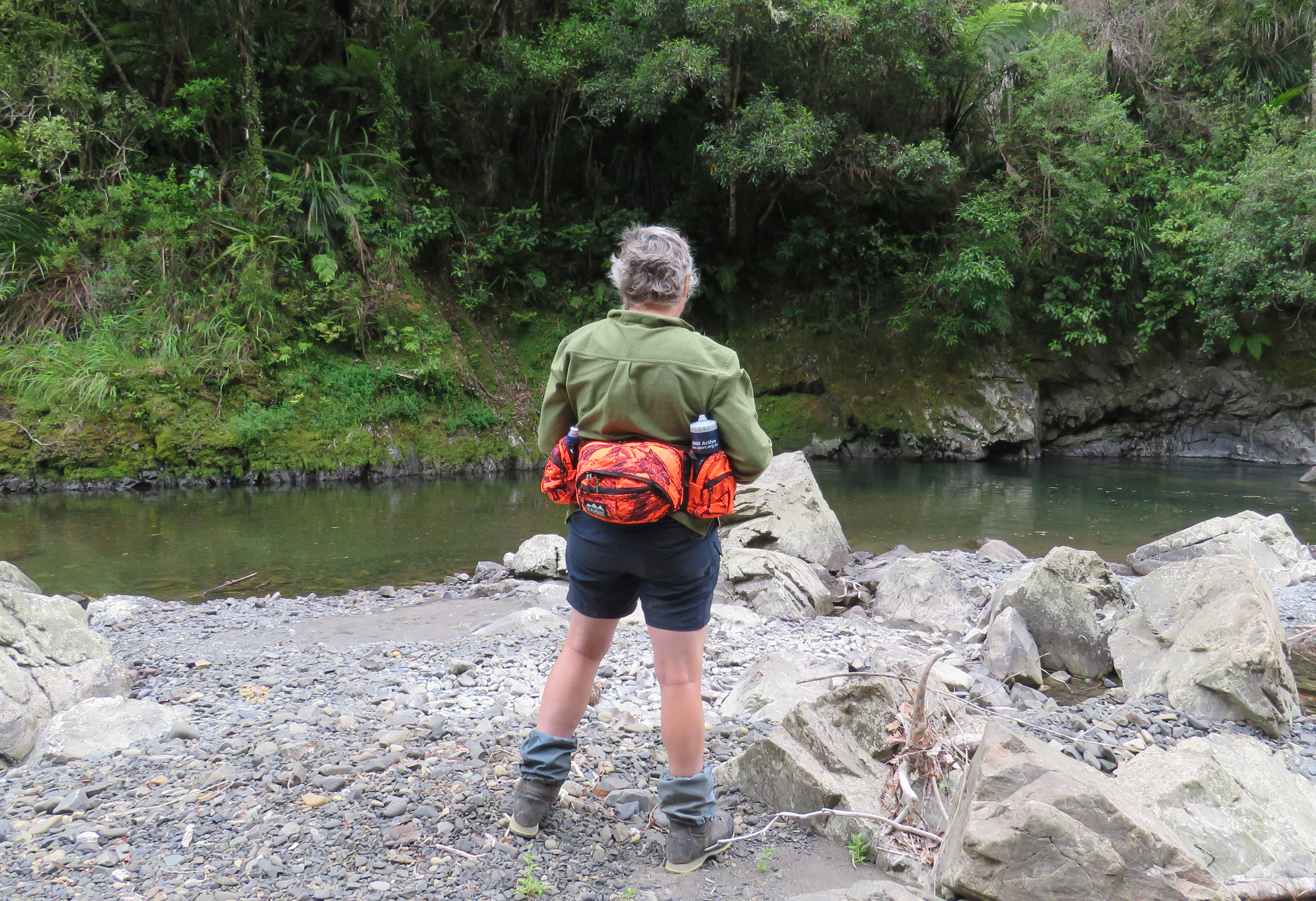
Isobel Stout from Canterbury had a mastectomy, lymph node removal, chemotherapy and radiotherapy in 2014, then a second mastectomy (with no breast reconstruction) in mid-2015. She isn’t letting her cancer journey stop her from enjoying the outdoors, but she has had to modify how she tramps. She developed lymphoedema during her treatment and it got worse after she returned to tramping.
“I found out the hard way that using a backpack made [the lymphoedema] swelling much worse,” Stout says. She completed a day hike up Mt Herbert in Banks Peninsula, using a daypack, but even that caused problems.
“I never really gave it any thought until I got into the shower at home and realised how much my arm had swelled up,” she says. “It took nearly three months to bring it back down to its new-normal size.”
For some women, lymphoedema leaves the affected area permanently enlarged. To help control the swelling, Stout now wears a compression sleeve every day.
She also explored alternative carrying options. “I began with a Camelbak hydration-system hip pack,” she says. “Then I won a Camelbak hydration-system vest, which I’ve used successfully to carry light things like gels and bars. There’s virtually no pressure over my shoulders at all.
I wouldn’t use its water bladder though – the heavy stuff has to sit on my bum in my larger Montane multi-pocket hip pack.”
Stout uses hiking poles, which she says are the “single best aide I’ve encountered”.
“I found my balance was poor after treatment. The poles built up my confidence as well as allowing me to rebuild my strength.”
It may have taken her a few years, but she is now a force to be reckoned with, having recently crossed Goat Pass in Arthur’s Pass National Park.
“It was a simply huge day for me,” she says. “It was glorious, really difficult, the hardest thing I’ve ever done, and I’m really very chuffed. I’m also still rather tired, bruised, and scratched, but there is honour in war wounds.”
Not all women have to give up backpacks after a mastectomy. Brenda Swadling of the eastern Bay of Plenty had a double mastectomy (without reconstruction), lymph node removal and chemotherapy. She regularly wears a compression sleeve that has a shoulder strap. But lymphoedema is a problem for her too and she has been forced to change the type of tramping trips that are done.
“I only do day trips now. I’m worried that if I wore an overnight pack I’d make [the lymphoedema] worse.
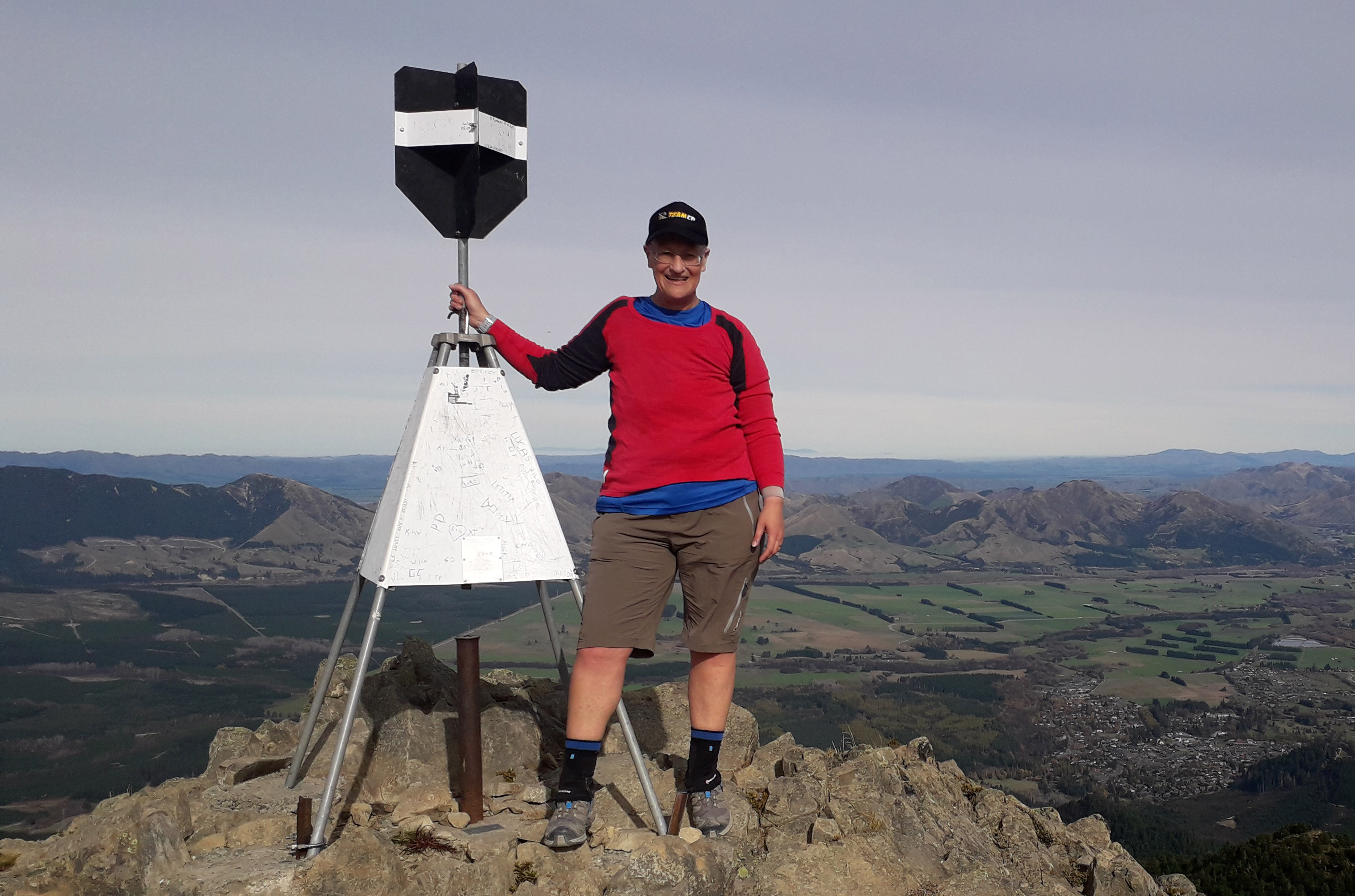
I’m prepared to let the overnight tramps go so that I can keep doing the day trips.
“I wish I’d known to keep on doing lymph exercises for two years after the surgery. I think that would have helped. I also think that aiming to regain 80-90 per cent of your previous strength and stamina is a realistic goal. Take your time! Give yourself two to five years to build up again.”
Swadling’s go-to pack is an Osprey women’s 20l model. It’s not big enough to carry all her gear, so she needs others to help.
“I’m OK with my husband taking some of my gear, but it’s still hard to let others do it,” she says.
“You have to think, it’s only a raincoat, so suck it up and let others help.”
A few years after her double mastectomy, Victoria Radley was again able to wear a full pack on multi-day tramps. Her surgery involved removal of some chest muscle and lymph nodes on one side, with no reconstruction. For the first three years she had periodic episodes of lymphoedema, and always wore a compression sleeve when tramping.
“I had to work up to it gradually, but now I can carry about 9kg in an overnight pack and on a multi-day trip I can go up to 12kg if I have to,” she says. “I wear a soft bra with a soft insert for protection. I use a tramping pole in my ‘good’ hand [the side that still has lymph nodes], and have my other hand holding onto the shoulder strap to keep the strap away from where the surgery was. I make good use of the hip belt and don’t use a chest strap.”
She also packs a compression sleeve, just in-case, and has managed some impressive tramps.
“My goal was always to carry all my own gear,” she says. “I was so chuffed when I finally did it on the five-day circuit of Mt Ruapehu.”
Marlene Kendon from Auckland found that a women’s-specific Deuter Futura 38 AC backpack suited her nine months after a lumpectomy, chemotherapy and radiotherapy. She’s since had a mastectomy, without reconstruction, and now only does day trips with a smaller Deuter AC lite 16l pack. She too uses a pole in her ‘good’ hand and wears the pack high on her back. It hasn’t aggravated lymphatic issues.
Aucklander Bronwyn Matheson is the only woman I’ve talked with who had breast reconstruction with an implant, including ‘autologous reconstruction’ to shift her back muscle round to the front.
“At altitude, my implant is always cold,” Matheson says. “I use a pole on the side of my surgery to keep my hand up. I use a compression sleeve at altitude and also wear long sleeved clothing for protection.”
She found the reconstruction compromised her upper body strength. “I was tramping in the Tararua and Ruahine ranges and found the arm strength I needed was challenging. I’ll most probably not go there again.”
As for myself, I’ve learnt a massive amount from talking with these and other amazing women. As one of my post-breast cancer friends said to me, ‘Set aside a whole year and make it your job to get through this journey’.
She was right. I’ve also been inspired by these women. I remain determined to get back out there on longer tramps, ideally with a backpack, and I now have a lot more knowledge to stay safer in the process, every step of the way.
Breast cancer treatment and side effects
A mastectomy is the full removal of the breast; a lumpectomy is the removal of a portion of breast tissue. Depending on how advanced the cancer is, some or all of the lymph nodes (small glands that support the lymph system) are often removed from the armpit on the side of the affected breast. Other treatments can include chemotherapy, radiotherapy, and/or various medications such as hormone-blocking tablets.
Each type of treatment carries potential side effects and can cause temporary or permanent damage. The lymph system may subsequently be vulnerable to lymphoedema – a swelling caused by a build-up of lymph fluid in the arm or chest area. Surgery can leave significant numb or hyper-sensitive areas, which can be an issue with pack straps. Energy levels and strength can also be impacted.
Expert tips
Two specialist physiotherapists offer advice on how to get back into tramping post-surgery.
Fitness and strength: PINC and Steel cancer rehabilitation physiotherapist Shannon Fisken says it’s important to “gradually build-up your general fitness and muscle strength, in particular your shoulder and back muscles.”
Backpack: “Look for a backpack that has curving wide padded straps plus chest /hip straps to reduce the compression over your shoulders,” says Lymphoedema physiotherapist Kathryn Vickers. “The weight will be carried on your hips.”
Hip packs: Vickers says these are a good alternative, but warns “don’t rush”. “Start with small loads, increasing at your own speed. Let others carry some of your gear.”
Walking poles: “Consider learning how to use Nordic poles – they can provide a better posture and movement than tramping poles for post-mastectomy women,” Vickers says.
Hydration: Vickers says staying hydrated is important to “ensure your lymph system and body tissues function as efficiently and safely as possible.”
Self-examination: Keep checking numb areas for pressure points or chafing.
Breast Cancer Foundation funding: Both Fisken and Vickers advised women to check if they qualify for funding for lymphoedema prevention and treatment or to participate in the PINC rehabilitation programme.
Find out more at www.breastcancerfoundation.org.nz
34 years of inspiring New Zealanders to explore the outdoors. Don’t miss out — subscribe today.

Questions? Contact us



