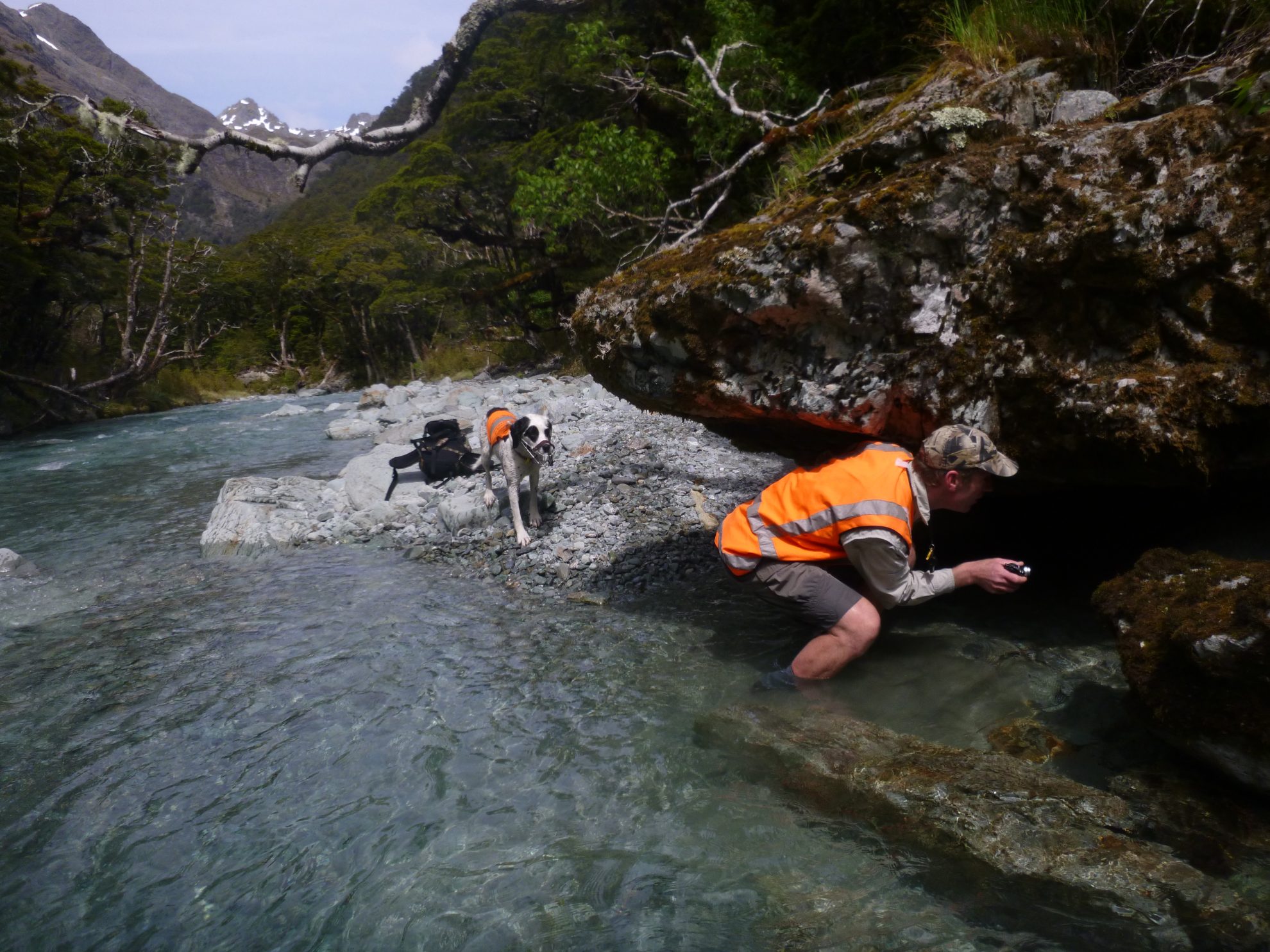
Krehic says the biggest challenge of training a rescue dog is overcoming their natural instincts to track animals.
“We’re working in environments where a dog would naturally use all of its tracking skills to find animals – normally to survive,” he says.
“What we’re doing, especially at early ages, is imprinting on them that the human scent is of great value – more valuable than a deer or possum.”
A dog’s nose is one of the most powerful in nature and can be up to 100,000 times as sensitive as a human’s. Their olfactory receptors – responsible for odour detection – outnumber ours 100 to two, and the area of their brains devoted to analysing smells is about 40 times greater.
In an open area with a steady breeze, this can mean alerting on a target from half a kilometre away – in deep bush it might be closer to 50m, Procter says.
“If conditions are right, sometimes tracking dogs can follow a trail somebody has walked a day, or even two days before.
“It’s like having an extra set of eyes, or a superpower.”
For handlers, harnessing this superpower means learning how to read their dog’s behaviour, and understanding the characteristics of scent, which can pool in certain areas and be scarce in others.
It also reacts differently across various environments, whether in a riverbed, valley or urban area.
“Scent does some pretty interesting things, and it’s all about spending time with your dog and becoming aware of that,” Krehic says.
He recalls a private search embarked on with his previous dog Stig, searching in Mt Aspiring National Park for a tramper who had been missing for nine months.
After two days of searching and no changes in Stig’s behaviour, he alerted to a scent on the Dart River.
“We would have walked right past it, but I read Stig’s change in behaviour, looked under some rocks by the river, and found the remains,” he says.
Their role in finding the woman had an emotional impact on Krehic.
“I received a letter from her family and it made me realise how much it actually means to someone to have that closure.”
Krehic’s involvement with search and rescue dog training has given him a fulfilling two decades, and the opportunity to combine his outdoor passion with a rewarding sense of achievement.
He’s met some of his best friends – and his wife – on rescues, but at the heart of it all are the dogs he has trained to bring the missing home to their families.
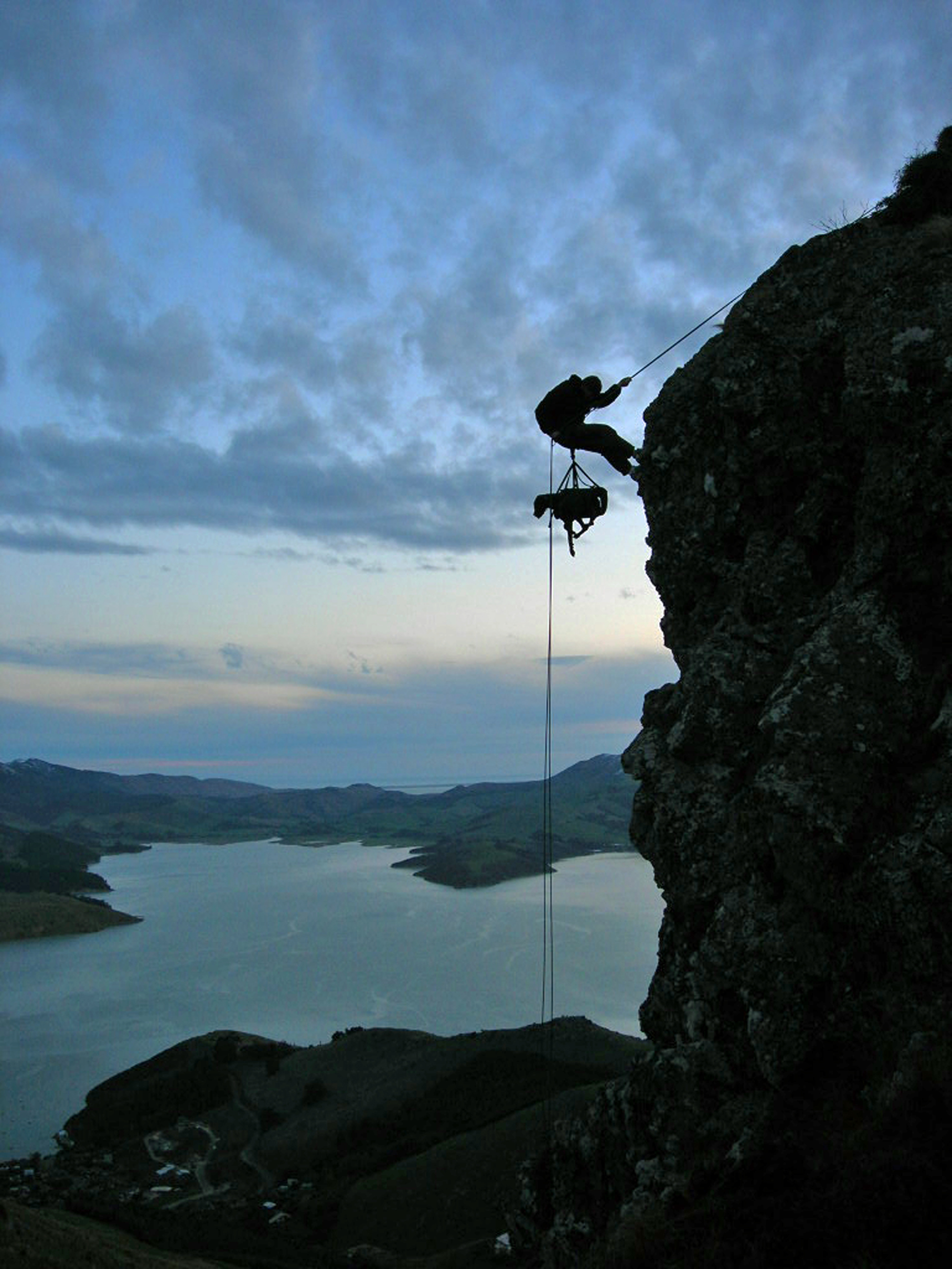
He’s now in charge of training new LandSAR handlers and their companions and says the organisation could always do with more hands – and paws.
Training new recruits takes two to three years, and Krehic warns it’s not for the faint-hearted and handlers need to have sound outdoor skills before becoming involved.
“We always talk about the dogs having a high drive, but the handlers have got to match that as well,” he says. “The job has a lot of ups and downs, and you’ve got to be able to bounce back from things that don’t go well.”
The number of callouts for search dogs has halved since Krehic started volunteering – a shift he puts down to more trampers carrying emergency communication devices.
When the search parameters are wide open, however, nothing beats a well-trained dog, he says.
Conservation is another area that relies heavily on specialist dogs, which play an integral role in the protection of endangered species
Approaching 60 in dog years, Hoki is closing in on her retirement – she just doesn’t know it yet.
Nor does she understand the impressive contribution she’s made to conservation during her lifetime.
For Hoki, it’s all been one great adventure.
Owner Paul van Klink reckons she will miss her work tracking whio up the swift clear rivers of the south-west, but believes she will be just as satisfied with a quiet retirement, with plenty of walks and swims in the lake.
“Dogs live completely in the moment,” van Klink says. “You can leave Hoki outside all day in the sun, and she will love that, but as soon as you show her any interest, she’s like alright, let’s go! They’re not like humans that need to have stimulus all the time.”
Named after her first home in Hokitika, Hoki is a springer spaniel border collie cross, whose parents – like Hoki – were overachievers.
“Her father was a hunting dog trained for hunting deer, and her mother was a lizard dog in Canterbury,” van Klink says. “Spaniels love the water, and she has been an absolute workhorse. Once you put her muzzle and vest on, she just wants to go to work.”
A day on the job can mean crossing 20m high swingbridges, swimming across turbulent rivers, and – Hoki’s favourite – riding in the chopper to remote sections of conservation land.
“As soon as I put her on the lead, she’ll be dragging me towards the helicopter. She always wants to sit right behind the pilot so they can reach around and give her a wee pat,” van Klink says.
“She likes to see where we’re going, so she knows she’s got an adventure ahead.”
Once on the river, Hoki takes off in search of the elusive ducks, which are famously hard to spot in their rugged habitat.
Van Klink follows behind as best as he can on two legs, crossing the river where it’s safe and waiting for Hoki’s signals.
“In Fiordland, the rivers are deep, so Hoki can sometimes go across where I can’t go. She has separation anxiety though, so doesn’t like being too far ahead,” he says.
If conditions are right, and a good breeze is flowing up the valley, van Klink says Hoki can catch a whio’s scent from up to half a kilometre away.
Once she’s onto it, she will slow to a stealthy creep, and eventually point with tail erect at the spot where the whio is hiding.
If she’s done well, the bird can be within a metre.
Hoki and van Klink are part of DOC and Kiwibank’s Conservation Dogs Programme, which uses highly trained dogs and handlers to locate threatened species and pests in the backcountry.
Hoki is certified to work with kea and whio, but has spent most of her career tracking the latter.
“I’m a bit biased, but I think she’s done pretty well. She’s found a lot of nests, and there have been some great adventures for us in the backcountry,” van Klink says.
“It’s been an amazing part of my career, but it’s coming to an end now. She’s getting old and she won’t be able to do it for too much longer.
“I’m undecided if I will train another dog up. It’s a young person’s game, and I’m a bit scared of failing – of getting another dog and having it not work out as well. Hoki has never let me down on the river.”
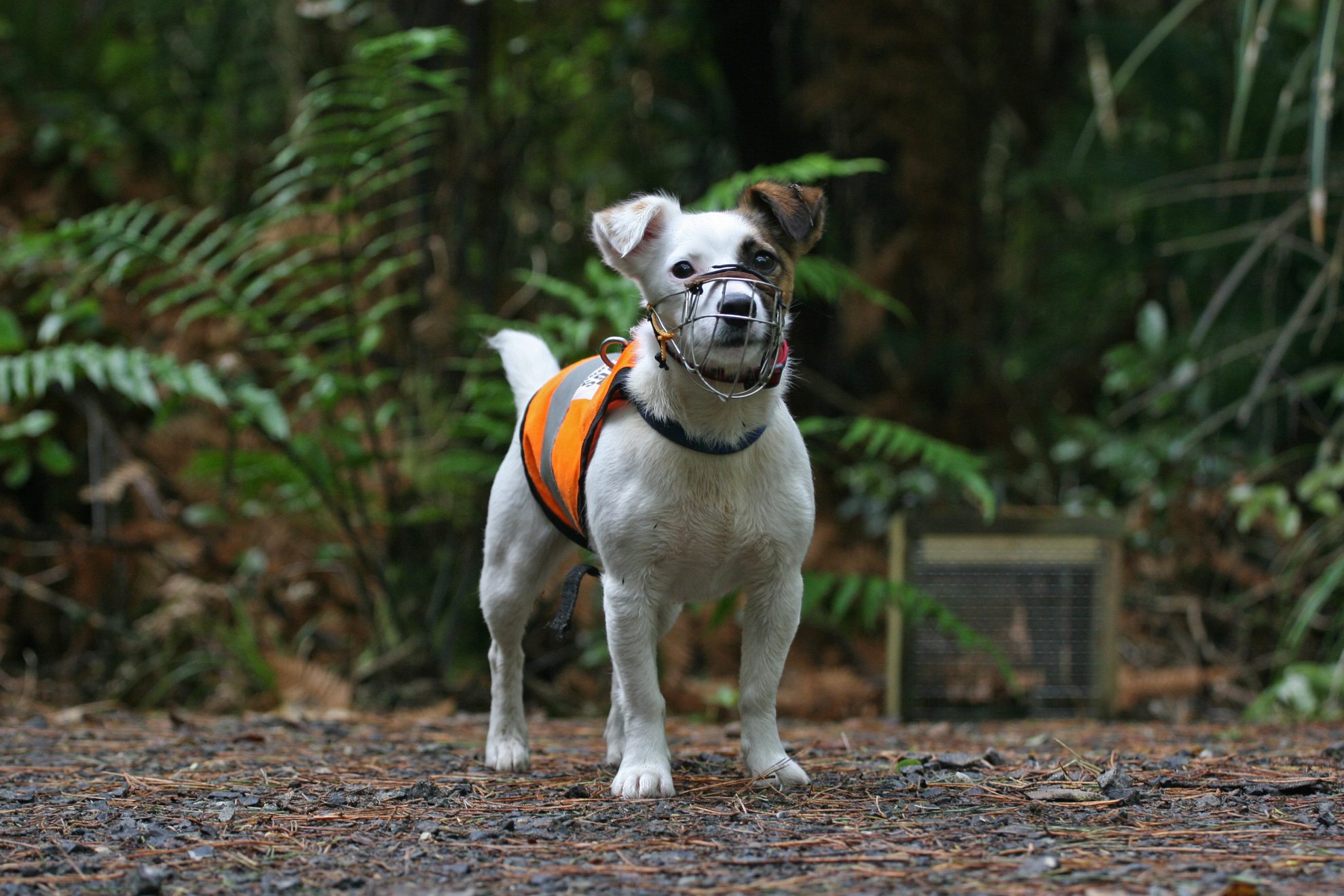
Gadget may be one of DOC’s smallest contractors, but she too has a big job on her paws.
The six-year-old mixed terrier has a nose for rodents, and she uses it to great effect – owner Sandy King says it’s in her genes.
Since she was a pup, Gadget has been trained to track mice and rats on some of the predator-free havens of the deep south, including Ulva, Secretary and Resolution islands.
Through thick bush and tussock, around wharves and buildings, the pair scour any sites that seem ‘ratty’, searching for stowaways that could cause chaos if undetected.
“I’m basically being paid to take my dog for walks in nice places, although it’s not always that idyllic – there is some pretty difficult bush we have to get through,” King says.
If a rodent’s scent is detected, Gadget gets frantic and hones in on the animals.
“Even though she is trying to catch it, she usually doesn’t, or can’t because it will be buried in a hole or up a tree,” King says.
The location will be marked by GPS, and any faeces or fur found will be collected for DNA identification, as it can be vital to know the sex and species of the pest.
Like SAR dogs, Gadget’s biggest motivator at work is playtime – the pot of chew toys at the end of the rainbow.
King started her training simply, using a dead rat as a plaything on the end of a string.
“Gradually I would start hiding it after getting her interested in it, or drag it along the ground so she could follow the scent trail and seek it out,” she says.
“The reward was a play, and we progressed from there.”
Because much of the work is done on predator-free islands, rodents are rarely found and, like any human worker, Gadget can get bored.
“It’s a bit reversed, as a successful day means finding nothing, and that’s a different mindset for people who are hunting,” King says.
To keep up morale, King monitors behaviour and steps in if she sees Gadget is getting tired or frustrated.
“You don’t want to make the job into a chore, as it’s meant to be fun,” King says.
“There are times when you have to say this isn’t working, let’s just go home so she can curl up on the mat and I’ll have a cup of tea.”
At home, Gadget is a fun-loving dog with a splash of mischief, King says. She loves children and chasing balls.
On the job, she gives it her all and is loyal to a fault.
“We have some long, hard days that are tough on a small dog, but she just soldiers on,” King says.
She’s even been known to fall asleep on her feet after arriving at the hut for the night.
King says Gadget is one of many tools used in the conservation battle, and while she may not have the coverage of an aerial poison drop or the 24/7 stamina of a baited trap, she does her part, and she does it well.
“There is nothing as effective as a dog in doing what a dog can do,” King says.