


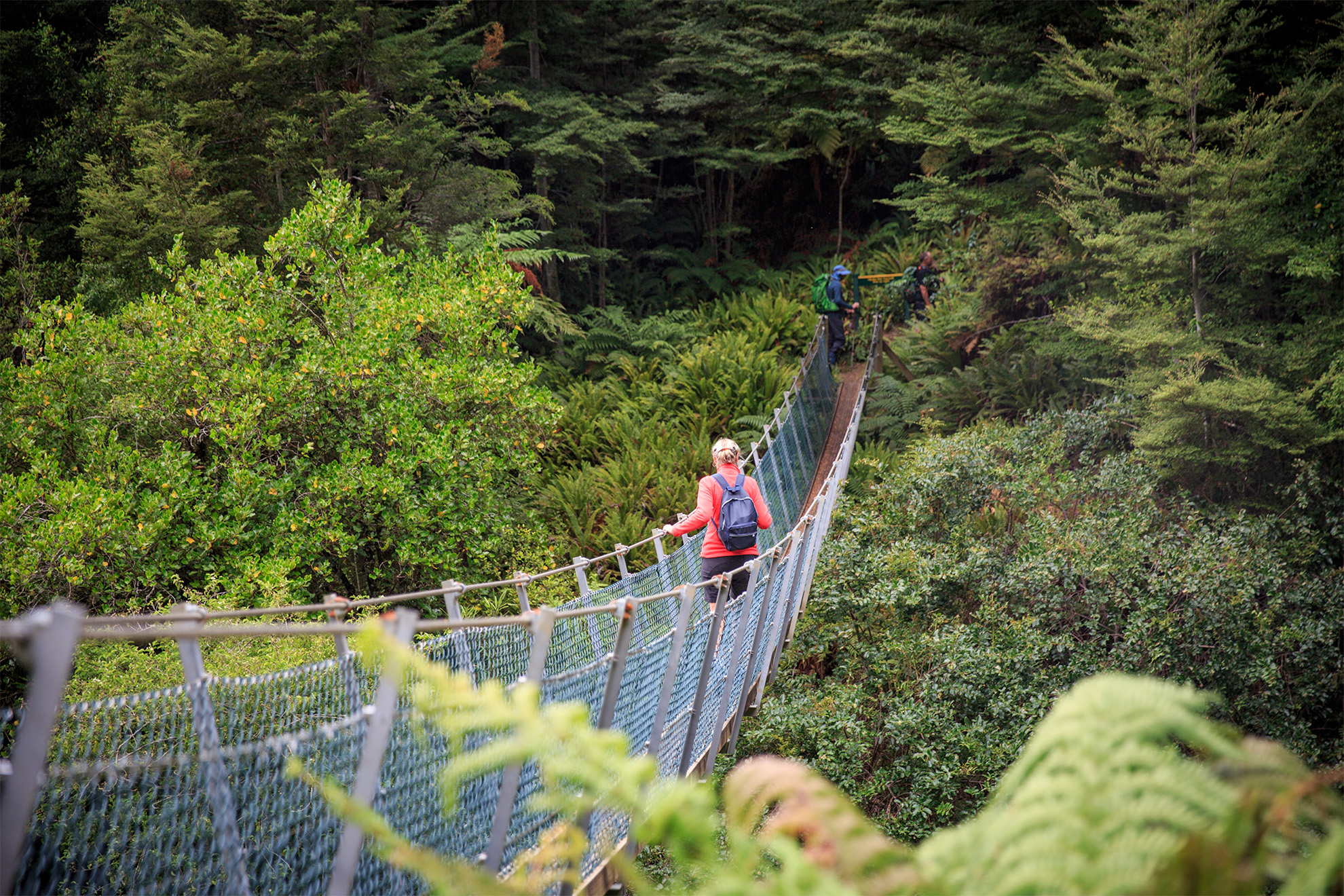
The Hump Ridge has over 10km of boardwalks, seven of them newly constructed as part of the $7.9m track upgrade project, which also involved upgrading the trail surface, installing interpretive panels, and future-proofing track sections against climate change and natural hazards by building alternative routes and bridges.
As I walked deeper into the forest, the massive ferns and dense undergrowth slowly changed to beech groves, ancient podocarps and majestic hardwoods. With sunlight filtering through the canopy and no other hikers about, it was mesmerising; as though gothic tales were waiting to be told.
Just before the final steep 5km ascent, I stopped to refill my bottle at Water Bridge. An old billy is supplied here, to be tossed into the roaring stream below and hoisted back by thirsty trampers.
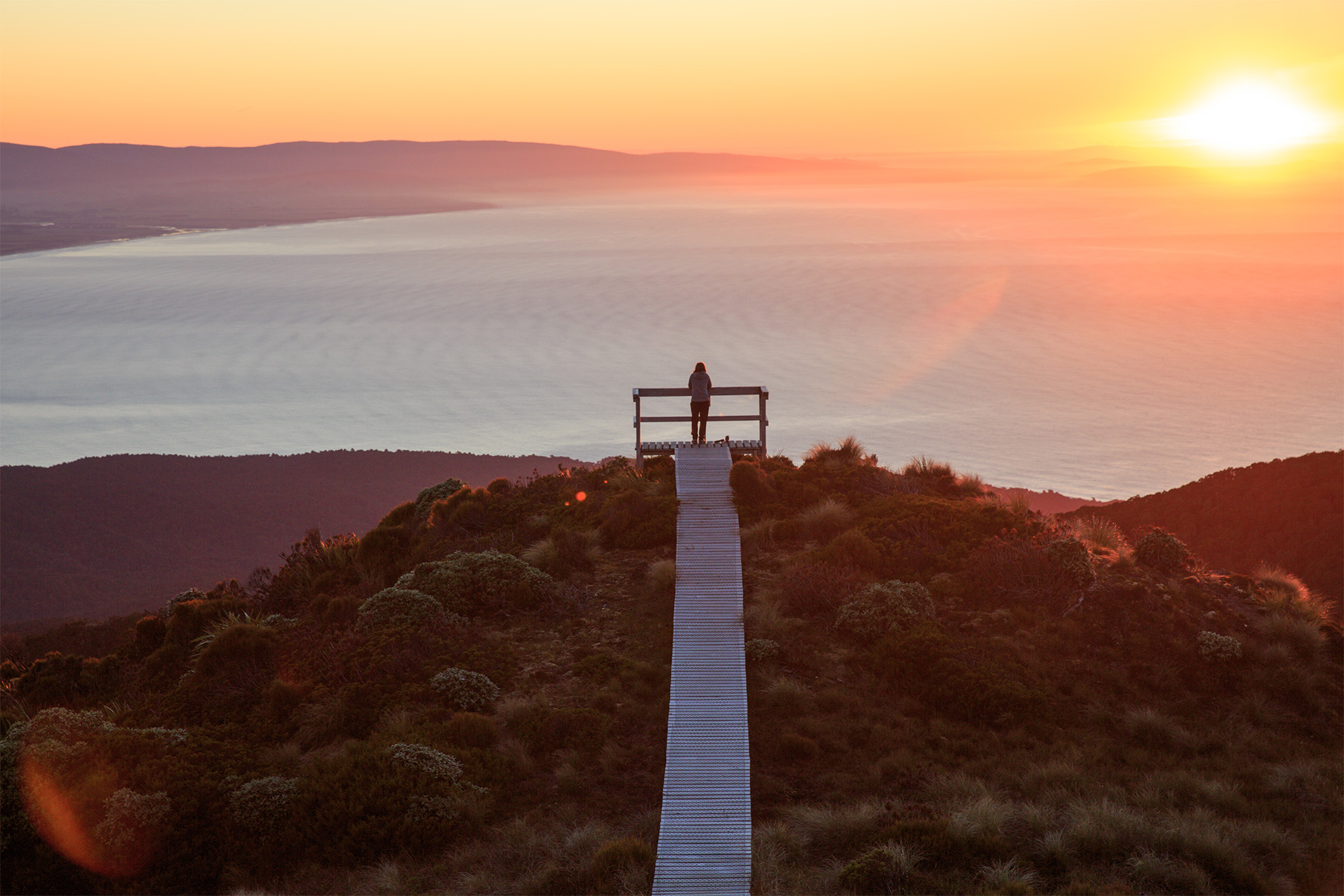
From above the bushline at Stag Point is the first glimpse of Ōkaka Lodge and the vast expanse of Te Waewae Bay. The stunted trees give way to grasses and ground-hugging plants such as mountain daisies and snow tussock along the winding boardwalk to the 1014m summit.
Here is the ultimate showstopper: the view north takes in Fiordland’s majestic mountains and Lake Hauroko, New Zealand’s deepest lake; south is the ocean stretching towards Rakiura Stewart Island and Hautere Solander Island.
Below the summit loop is Ōkaka Lodge – modern, spacious and warm with shared bunks and private rooms, a well-equipped communal kitchen (a hearty meal of Tūātapere sausages with mashed potato costs $15 for a single serving), hot showers ($20 per shower per lodge) and a small shop with wine, beer, soft drinks, snacks and dehydrated meals. Sleeping bags can also be rented ($20 per lodge) or your pack could be choppered up for an additional $150.
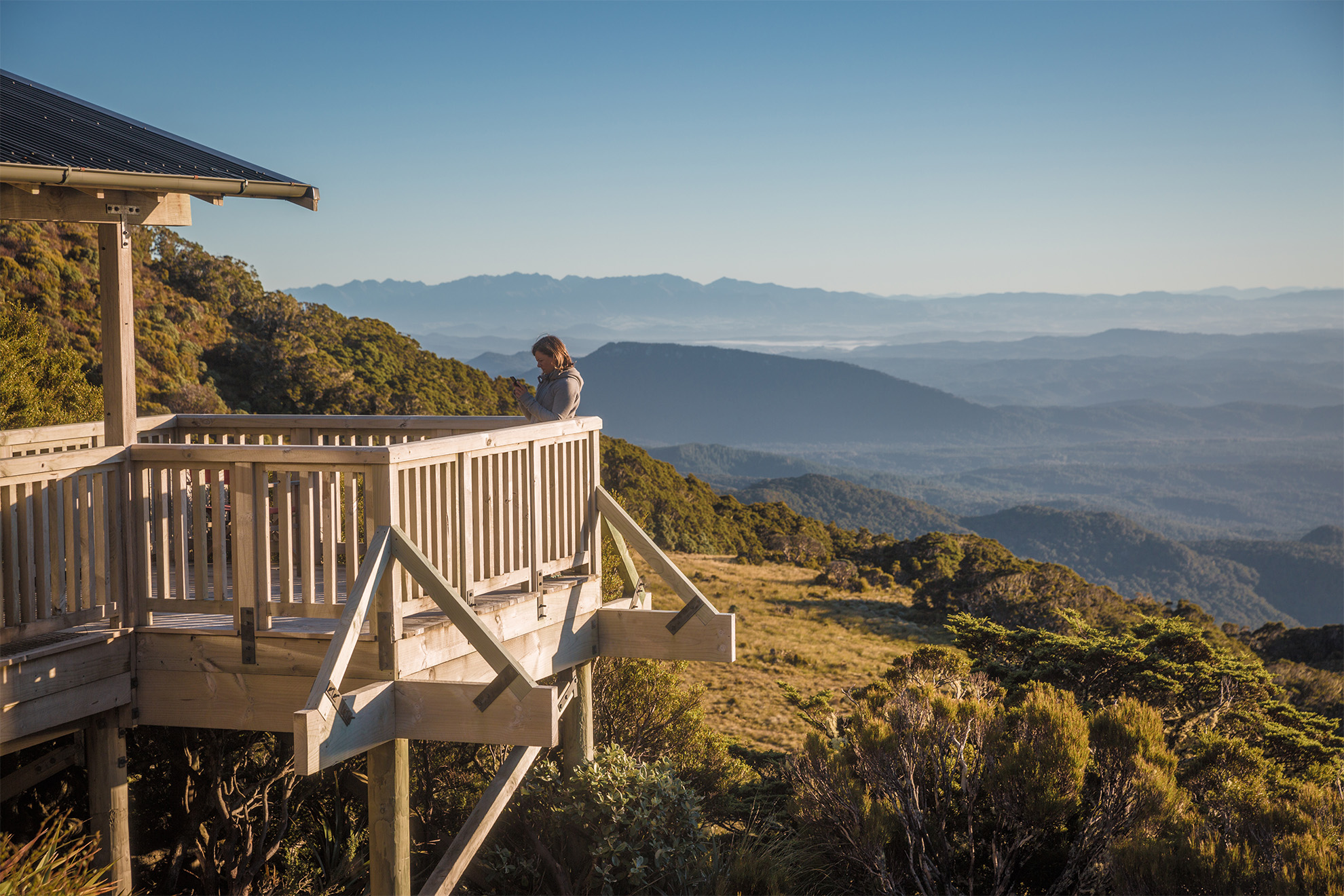
Karin and Johannes, an Austrian and German duo in their third season as lodge managers, told me a famous historic waka that visited the area was the Tākitimu. According to Ngāi Tahu, Ōkaka (Hump Ridge) is one of the massive waves that hit the canoe in Te Waewae Bay near the mouth of the Waiau River.
That evening, a storm lashed the lodge. It continued overnight with sleet and howling wind at dawn, and, for a few exhilarating minutes, a light snowfall. The weather was expected to improve, however, and I left the comfort of the lodge, venturing along Hump Ridge towards Tītahi Luncheon Rock, a stone slab that extends into the void from the ridge. For centuries, tīpuna (ancestors) paused here on their journeys from the coast over Ōkaka as they travelled inland to the lakes and forest for mahika kai (collecting food and other natural resources).
The sun was shining brightly now and from the rock’s summit the forest resembled an immense jade-green carpet all the way to the sea.
I descended along boardwalks and countless steps towards Port Craig. This was another 21km day, mostly downhill with a final flat section.
On the way the track crosses four historic wooden viaducts. Percy Burn viaduct, reputedly the largest surviving wooden viaduct in the world, spans 125m and is an impressive 35m high. It’s made of imported Australian hardwood, and in the 1920s, along with three others – Edwin Burn, Sand Hill and Francis Burn – once carried logging trains to the Port Craig sawmill on a 14.6km line. Today, this line allows trampers to explore the beauty of Waitutu Forest.
As part of the Great Walk upgrade, a new 58m swingbridge has been constructed parallel to Edwin Burn viaduct in case it ever becomes unusable. There is a magnificent view of the old viaduct from the bridge, and I couldn’t help but marvel at its structural integrity and geometric ingenuity. Towering timber piers are anchored on solid concrete footings, their strength bolstered by diagonal and longitudinal steel bracing.
I arrived at Port Craig Lodge, on the edge of Te Waewae Bay, in the early afternoon. It’s an area steeped in nostalgia. Port Craig, formerly known as Mussel Beach, was once bustling with activity. There’s an interpretive trail around the old mill site – a must-do side trip – that explains the milling process. After World War I, Port Craig was home to the country’s largest and most advanced sawmill, and the plan of the Marlborough Timber Company was to log one of the country’s last major coastal native forests. However, the project that employed 200 men faltered with the Great Depression, and in 1929 the port became a ghost town. Just the school building remains, now transformed as Port Craig School Hut. Other remnants include a decaying engine boiler, wagons, winches and other iron artefacts.
The final day to Rarakau car park is a 20km tramp along the coastal fringe. As I set off, a pod of Hector dolphins danced through the waves along the coastline. The track winds through dense podocarp forest before reaching the sea at Blowholes Beach from where it continues along the coast. The circuit reconnected at Pipi Tuariki/Flat Stream, where I had deviated inland on my first day. From there I retraced my steps along the coastal path.
At the car park I was reunited with George and felt a surge of excitement – I had successfully ‘stumped the hump’.
The Hump Ridge Track is not just about scenic routes and majestic vistas; it’s a trail that unpacks Māori history, retells a sawmilling legacy and is a testament to the power of community collaboration. The track embodies the spirit of a township, with the Great Walk status the pinnacle of recognition.
That it continues to be managed by the community as kaitiaki simply distinguishes it from other Great Walks.


