The New Zealand falcon/karearea is one of only four native raptors left in New Zealand. (The others are harrier hawk, morepork and barn owl.) With an estimated 6000 to 8000 individuals, the falcon is classed as ‘nationally vulnerable’.
The highest known density of karearea is found in Kaingaroa pine forest in the central North Island, though it is widely distributed on both main islands. That the birds have adapted to living in pine forest shows just how comfortable they are living in a wide variety of habitats, including from the coast to above the tree line, in podocarp and beech forests, on tussock lands and even roughly grazed hill country.
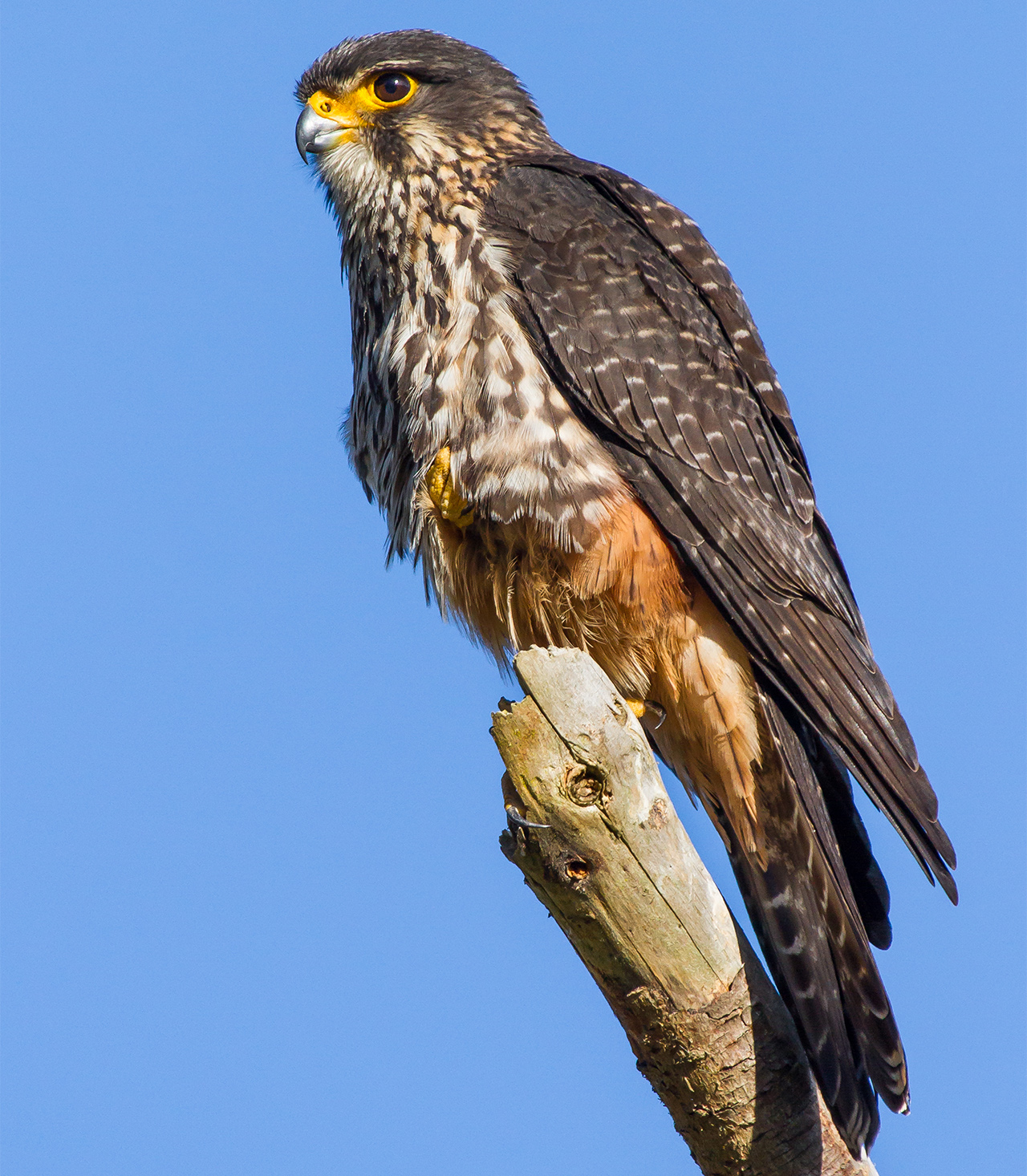
The falcon can be described as largely dark brown on the back, with a streaked cream breast and a rufous, red/brown under the tail and thighs. Birds of all ages have a dark eye and a distinct malar stripe (moustache) running from the back of a strongly hooked bill vertically down the face. Adults will have yellow legs, eye-ring and cere (fleshy skin just above the beak where the nostrils are). Juveniles are a blue-grey colour.
Males are approximately one third smaller than females, being about 40cm (females 50cm) and weighing between 240g and 350g (female between 410g and 720g).
The falcon’s incubation period is only about 30 days, but the actual breeding can be anywhere between late winter and early autumn. The brooding is done mostly by the female while the male will be out hunting. For this reason it is usually the male who is the dive bomber when people unknowingly get too close to a nest. Nesting sites vary according to habitat and terrain but will always be just a ‘scrape’, be it on a rocky ledge in steep open high country or under a log in a cut-over forestry block. Clutch sizes vary between one and four eggs and fledglings become independent at around 14-15 weeks of age.
Karearea hunt and kill their food, which consists mostly of small- to medium-sized birds, but occasionally they will take much larger prey such as black shags, poultry, pheasants and even mammals such as rabbits and young hares. Victims are killed with a powerful bite to the neck. Some insects such as cicadas, dragonflies and huhu beetles are also taken, although more so by juveniles during the period that they are learning to hunt for themselves.
An ethical guide to visiting the Muriwai gannet colony
Trending Now
Dirt bike trial on Tongariro Northern Circuit gets approval
The 2026 Wilderness Outdoor Photographer of the Year competition
Knockin’ on heaven’s door
The 2026 guide to sleeping mats
Walking through the valley of Hope
Subscribe!
Each issue of Wilderness celebrates Aotearoa’s great outdoors — written and photographed with care, not algorithms.Subscribe and help keep our wild stories alive.