Super skiing
After doing a one-day ‘ski the Tasman’ adventure in 2019, I was drawn to the featured terrain of the Tasman Glacier, so much more inaccessible and mysterious than my native snow home of Ruapehu. Wary of crevasse risk and my utter lack of local knowledge, I gathered a group of friends and we hired two guides for five days based at Kelman Hut. We ranged in experience from LandSAR types and former outdoor instructors who wouldn’t need to think twice to rig up a three-to-one pulley to retrieve a buddy from a crevasse to gun skiers who were less familiar with the ropes.
Our guide George Loomes let slip to us one day that the lead guide, Tai Naka, had a famous saying when the two of them had skied together on the West Coast. Whenever confronted by a challenging ski descent, he’d say “It’ll be alright … if you don’t f*** it up.” I felt that, for sure. There’s objective and subjective danger in the hills: subjective is where you f*** it up; objective is where it f***s you up. Subjective danger depends on your skill and experience level, while objective danger occurs no matter how skilled you are – the risk is the same.
To be fair, Tai and George were both impeccably safe in their approach, giving us clear instructions on exactly where to ski (ostensibly for safety, but somehow they also always managed to pick the best snow). I soaked up as much of their knowledge as I could, bugging George for his take on the potential avalanche risk of this or that feature, or the cohesion of the snowpack, and asking Tai questions about his decision-making process. They were both confident skiers, with a style that only comes from learning when you’re young – cutting smooth tracks like a hot knife through butter – whereas my style is more akin to a drunken spider missing its other six legs.
Five days of clear, perfect weather meant no opportunity for bad-weather plan-B activities of practising crevasse rescue techniques or being allowed to dangle from an ice wall, but my disappointment was offset by the good luck of such unusual weather. I was also mildly disappointed nobody fell into a crack; I didn’t want anyone to hurt themselves but a gentle break of a snow bridge and an extraction could’ve been exciting. May you live in interesting times, goes the old Chinese curse.
Body of knowledge
Twenty years after the Kiwi trio knocked off Aoraki/Mt Cook, another trio met with tragedy on the Linda Glacier in 1914. Sydney King and guides Darby Thomson and Jock Richmond were caught in an avalanche after successfully climbing the mountain. All three perished but only Richmond’s body was retrieved.
It took just 13 years for the remains to begin to emerge from the hungry glacier. In January 1927, a climber and his guide – after narrowly escaping death on an attempt on Mt Tasman – stumbled across a right leg and a foot of one of the climbers. The whole foot was perfect, but the rest of the leg was badly bashed up. Twenty-five years later, in November 1939, more remains began to emerge.
The media was breathless and sensationalised: ‘Torso in glacier’, ‘Glacier gives up victim’, ‘Human remains’ read the headlines. The bodies had been broken up by the movement of the glacier; it gave back a human trunk, a piece of bone with a sock stuck to it, some clothing and part of a rucksack on the lower part of the Hochstetter Glacier, in a section frequented by tourists. The torso was missing a head, arms and legs and had been compressed, but was ‘fresh and well preserved’. The mauled remains had travelled 6.4km in that time.
A memorial was constructed shortly afterwards. It still stands, only a short distance up the Hooker Track, with individual plaques paying homage to those lost in the national park. Tourists womble past, selfie sticks in hand, unaware of the deathly history they are passing or the dangers of ravenous glaciers that snake through the nearby valleys.
A different glacier
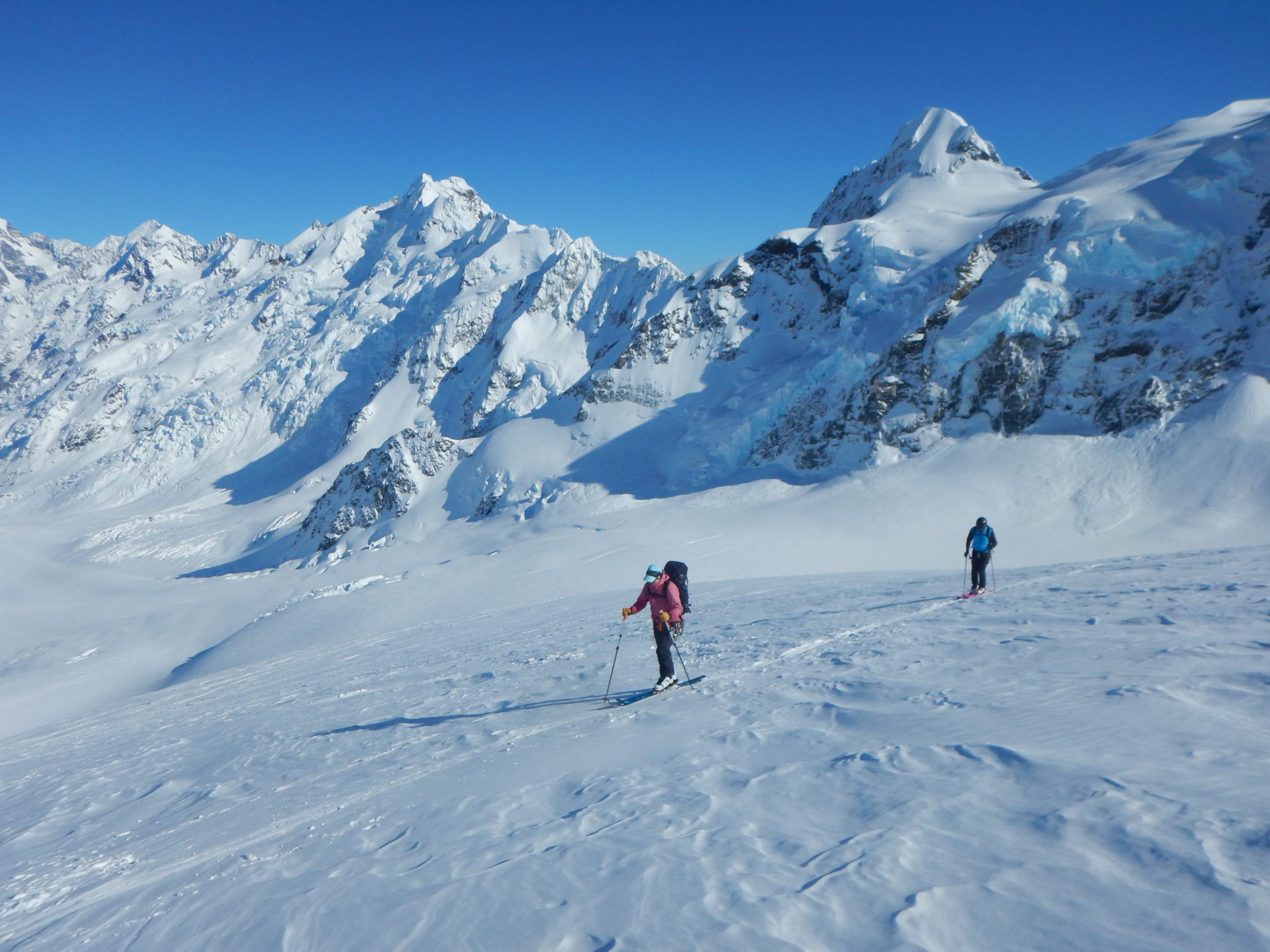
Our ski touring group was named the Exploding Possums – so-called after a discussion on how cool it would be if there was a poison that would make possums explode after they ingested it. Our various fitness levels made for relaxed days out, around 1200m of ascent and descent on skins and skis each day. (Miles fitter, George and Tai always looked fresh as daisies.)
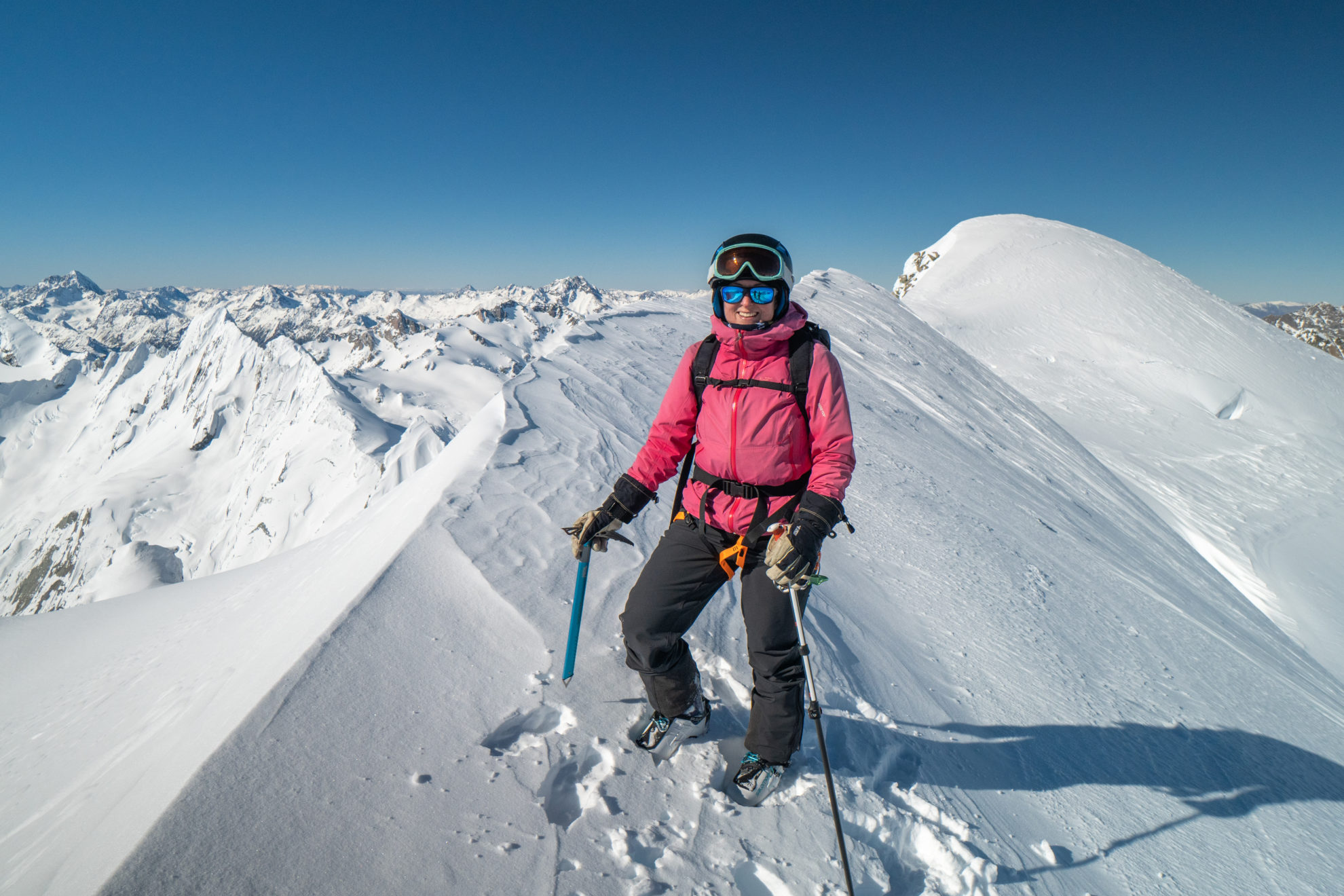
The first day took us on a loop around the Tasman Glacier, down the skier’s right and up the skier’s left, fresh powder turns and a lot of whooping from the group as we went. On subsequent days we skied the lower Anna Glacier and ascended Hochstetter Dome – my first Aoraki/Mt Cook peak (although it’s more of a shaped dome and less of an actual peak) – with stunning views into the Whataroa Valley in Westland. The Anna Glacier was named after Anna von Lendenfeld, who was the first to ascend Hochstetter Dome with her husband, Robert, in March 1883, back when such an undertaking was far more adventurous – and arduous.
Another day, in good conditions, we skied down the Murchison Headwall into the Murchison Glacier – a fairly rare achievement I’m told. It was cold; our bindings iced up and one of the Possums had to warm hers up by hugging it inside her jacket. There was much bashing of the ice that formed on our gear, despite the sunny and windless day.
We skinned up to Starvation Saddle and hooned down the Mannering Glacier, where I caught an edge and cartwheeled. One ski came off and I wondered, briefly, if I could remove the remaining ski to retrieve the other one, or if I should keep the ski on to ensure my weight was distributed across more terrain in the event I was standing on something dodgy. While thinking about it, the next skier in line zipped past, delivered my ski, and kept going; dilemma solved; death by crevasse avoided.
On our last day, we donned our heavy packs for the flight out and skied as far down the Tasman Glacier as conditions allowed, with a side trip to ski the Darwin Bowls at around 2200m beneath Mt Darwin. I was hoping we’d see the infamous groomer at the icy end of the glacier – historically used to groom slopes and ensure a smooth landing for ski planes – but the snow didn’t extend quite that far.
Scrape marks on the crevasse
Low snowfall levels and higher than usual temperatures help glaciers to regurgitate things – and they’re not always bodies.
In February 2010, small scraps of orange-painted corrugated iron emerged from the Fox Glacier. Local guide Marius Bron believed they were discarded items from chimney repairs made in the 1950s at Chancellor Hut. Unwanted, they were thrown off the cliff onto the glacier below.
Poo is a similar story. Before humanity really knew any better, human waste was either collected in bags and chucked into crevasses, or toilets were positioned in such a way that the waste went straight into the gap (pity the unfortunate user in a strong gust of wind). Overseas, this habit has become a whiffy problem as aged and frozen poo emerges on glaciers and begins to defrost.
Our guides reckoned the walkway adjoining the main hut to the toilets at Kelman Hut is the windiest spot on the entire Tasman Glacier. Despite the good weather we experienced, it was still quite fresh.
After the trip, still gripped by the idea of dead people on hiatus in crevasses, I went to the DOC Visitor Centre in Aoraki/Mt Cook Village, where they have memorial books full of profiles of, and information about, people who’ve died in the park going back as far as records allow. It’s not just those who’ve died in the wilderness from risky pursuits, either; the books include deaths such as car accidents within the national park and even heart attacks.
The books indicated not many ski touring fatalities over the years, which was reassuring. Most were climbers. I found one from 1998: 35-year-old doctor Mark Stickland was ski touring with two friends on the Tasman Glacier when he fell 20m down a crevasse. He was on foot, rather than skinning (which distributes your weight across the snow more evenly). He’d begun to cross a crevasse at the head of the glacier when one foot sank in snow up to his knee. He tried to find an alternative way across but fell through and landed on his back inside the crevasse. Stickland was already dead when his mates got to him.
The one that haunts me is Tom Christie, who fell down a crevasse on the Fox Glacier in November 1935 and has never popped out. Searchers found a hole in the ice near Pioneer Hut with scrape marks on the lip of the crevasse. It’s thought he tried to jump it but it was wider than he thought.
‘Marks of his boots were traced to the edge of the crevasse, and it was seen that the ice out on the edge was broken,’ a newspaper report said.
The bottom of the crevasse wasn’t visible and by the time the alarm had been raised, he wouldn’t have been able to survive the extreme cold, even if the searchers had had a rope long enough to reach him.
The Divide’s western glaciers move at a much faster rate than those on the eastern side. Christie should’ve popped out long ago, according to calculations made by climbers at the time. But still, his body remains frozen and hidden, probably encased in ice, held up somewhere, somehow, subsumed by a silent, slow-moving glacier, keeper of secrets, perhaps for eternity.