

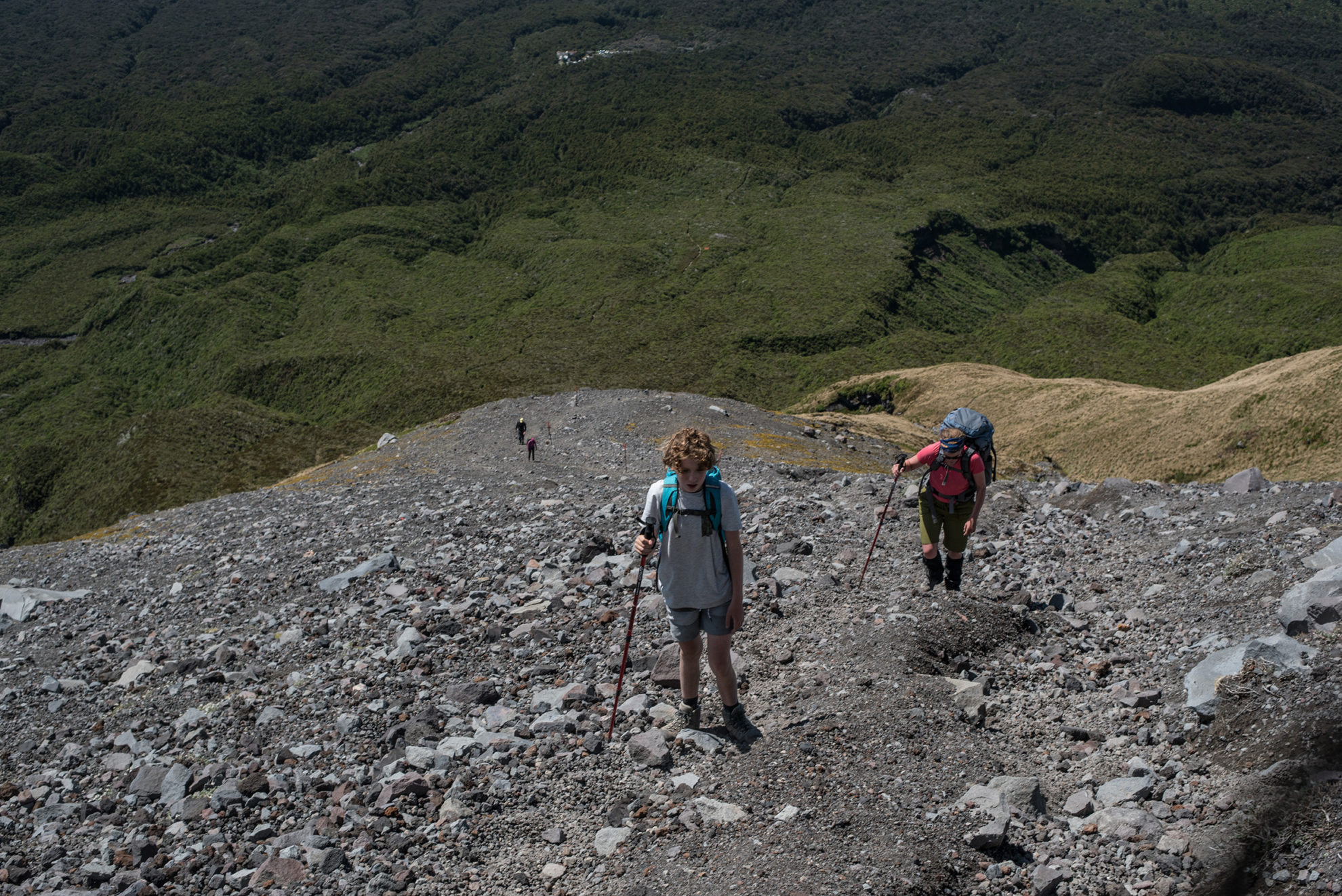
Parting ways with our new friends, we gathered our breath to face what lay ahead: a steep scramble up the scree slope of Fanthams Peak, nearly 500 vertical metres up. We met two parties coming down. Both reported that the snow near the crater had foiled their summit bids. “I wouldn’t risk it without an ice axe and crampons,” one party member said. The second group did have ice axes and crampons but said they still turned back. Suddenly our summit bid seemed in serious doubt.
Climbing Taranaki from the south has several advantages. It’s far less crowded than the conventional route from North Egmont, which on some days can see a conga line of day-trippers. The south guarantees space from the crowds and allows the climb to be broken into two days by spending a night at Syme Hut which at 1950m, is the second-highest hut in the North Island and one of the best alpine huts anywhere in the country.
Twelve-year-old Dorian found the going particularly taxing on the scree; anyone unfamiliar with the frustrations of gaining traction on steep, loose rocks would. It was a classic two steps forward one step back routine. To add to the strain, the sun was belting down and the task became a good old-fashioned slog, heart rate soaring, legs aching, sweat dripping. Syme Hut is a gift that’s definitely earned. Perhaps every tramp should feature at least one hellish slog like this; it’s good for the mental toughness. (Although, Dorian does not agree with this sentiment.)
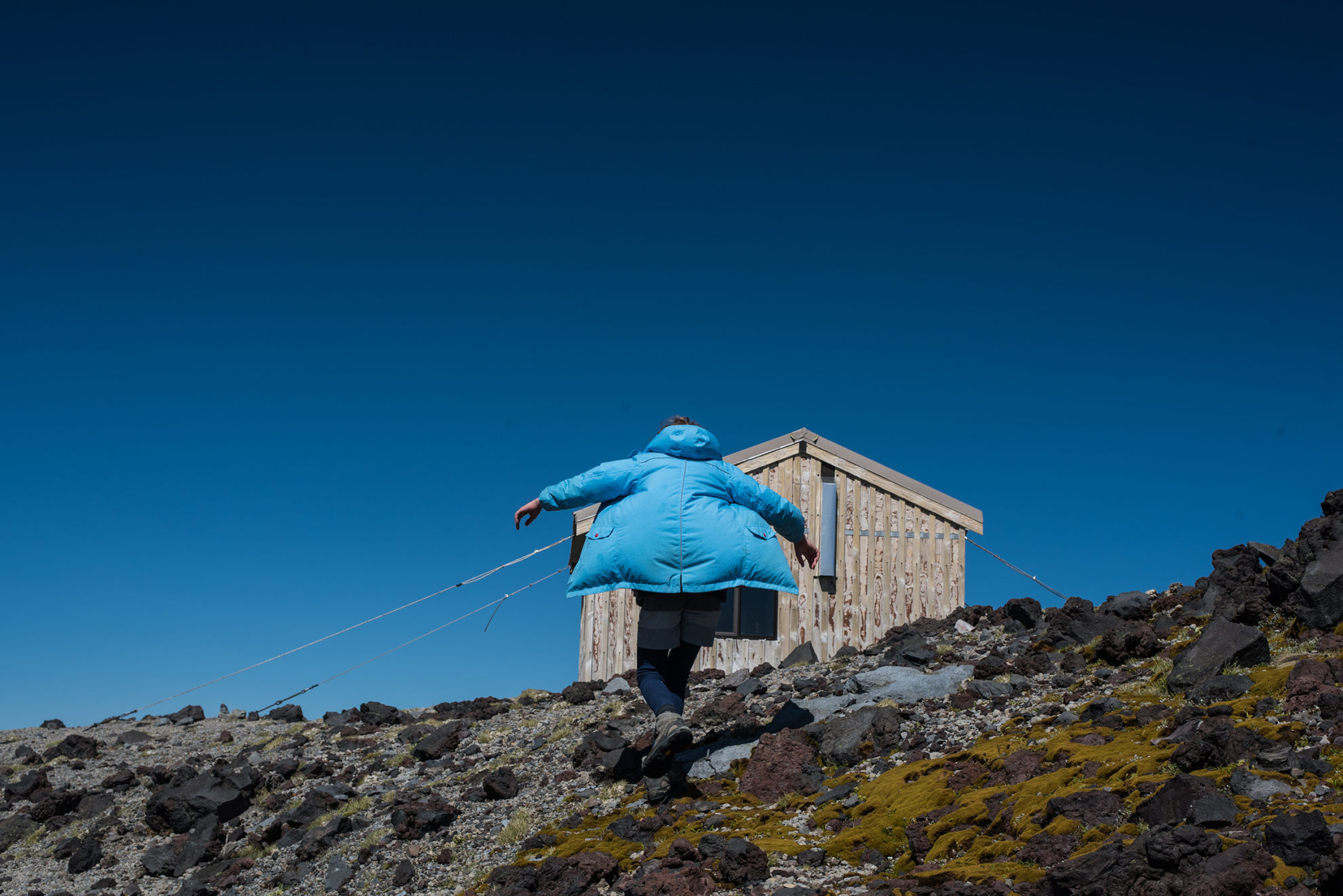
The struggle gives way to an incredible feeling of achievement when the climb is over and the terrain levels out to reveal the barren bowl of Rangitoto Flat, between Fanthams Peak and the mountain proper. In front, sticking out like a pimple on a gravelly, bald head, is Syme Hut.
A young German couple were lunching in the hut when we arrived. Taranaki Mounga filled the entire window frame, like a giant had suddenly appeared outside, threatening to flatten the hut in one stomp. I studied the patterns of rock and snow as they formed triangles down from the crater and saw that the rock funnelled to an arrowhead just below the crater lip. I sipped my tea contemplatively. There was no way to avoid the snow to get to the summit. But then one of our new German friends gave me hope. He said he had just got back from the summit, crossing the snowfield without an ice axe or crampons, with little trouble. What to make of this? One group turns back with the required gear while another proceeds (and succeeds) gearless.
Originally, we’d planned to try for the summit in the morning, but I figured our best chance would be if the heat of the day had softened the snow. Even so, I couldn’t rouse interest from either Karen or Dorian, so I set off alone, descending at first into Rangitoto Flat where stubborn snowdrifts pooled in depressions, then picking a poled route that faded to a faintly scuffed zig-zagging trail in the scree as the slope steepened.
Soon Syme Hut was far below, just a tiny blemish on a lonely peak that seemed to float like an island on an ocean of cloud. The scree was a slippery customer and I was using my hands as much as my feet to scramble as the gradient increased. There was no way I could escape being funnelled to the tip of the rocky pyramid, and after nearly two hours I stood on the arrow tip of the last available patch of rock. A sense of inevitability hit me. It was always going to come to this. I reported my predicament via two-way radio to Dorian at Syme Hut.
“What are you going to do?” he asked me.
“I’m not sure,” I replied. Then, maybe to delay making a decision, I asked: “What’s mum doing?”
“Reading a book in the sun,” he replied. “I think she might be asleep actually.”
Struggling to stay upright I reached a boot out and tentatively prodded the snow. It was hard – not rock hard but ice hard. Rock hard I could handle. I wondered if I was careful I might be able to kick small ledges into the ice with the side of my boot, enough to keep me upright so that I might traverse the last 50 metres or so to the crater rim and the safety of rock. But the stakes were too high.
In early May this year, two more people tragically died attempting the summit from Syme Hut, possibly slipping and falling from somewhere near this very spot. In the end, the decision was easy. I turned back and headed (skidded) back down the mountain towards my family, leaving the summit for another time. I figured it wasn’t going anywhere.
I’ve learnt from experience there’s an addictive euphoria from making the decision to turn back, when you finally know you’re safe. It’s happened to me a few times now, and I think there must be something evolutional in it – the flooding relief of safety replacing the chest-tightening adrenalin of minutes before when facing the prospect of an unnecessary foray into mortal danger.
I have a feeling a younger me would have pressed on, like the young German guy, trusting my balance and nerve to convey me over the ice so I could breach the crater wall and claim the summit. It would have been a good view from up there. But, from the vantage point of age and experience, I had a sudden yearning to lie beside Syme Hut and read in the sun; to be with my family and wait for the colours of sunset to work its magic on that beautiful mountain – something you can’t see if you’re standing on the summit.
My decision to turn back seemed justified when just four months after our trip I read a news report that a man had slipped on ice while climbing the same route and slid 100m, requiring rescue by helicopter. I felt sorry for him: he would have missed sunset.
I certainly had no regrets, especially later that night as the last of day’s light streamed in through the hut window, warming our faces as the ground outside cooled. The collapsing sun bled intense orange as it drowned in the Tasman Sea, draining the colour from the mammoth mountain camped outside, until it wasn’t there at all.



