

After encountering a few sections of Rakiura’s infamous mud, we reached a DOC sign bluntly stating ‘this track is no longer maintained’. We headed off with a little trepidation. Were we in for a hell-bash through the devil’s scrub?
Pleasingly, the route was relatively easy to follow. This first part leads through forest dominated by rimu, kamahi and broadleaf, and experiences a reasonable amount of traffic from DOC biodiversity rangers visiting the only known breeding site of the southern subspecies of the New Zealand dotterel.
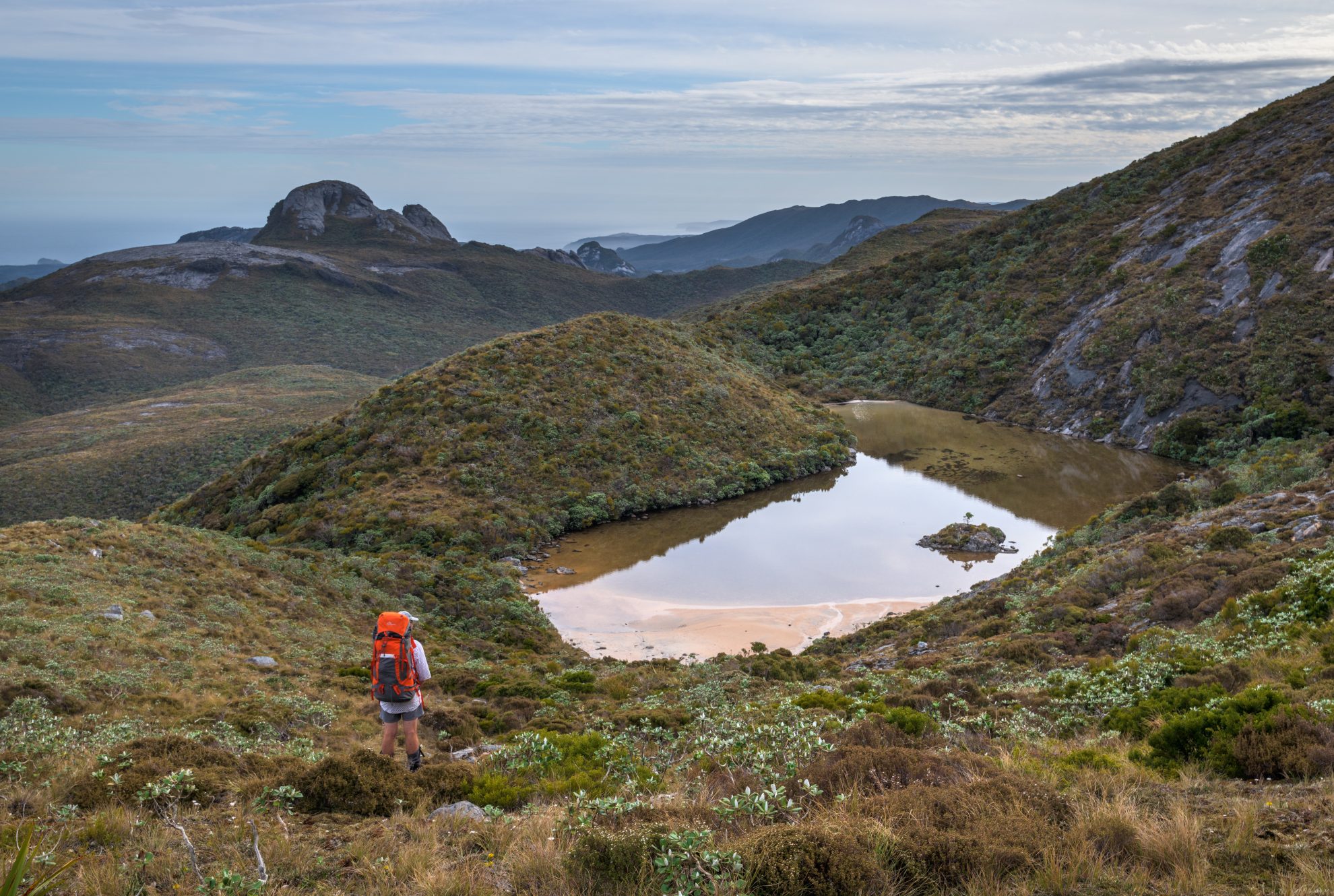
At about 400m, we reached the scrubline – some 600m below the altitude I’m more familiar with in the North Island ranges. Short wooden stakes marked the way. We lost the route while crossing an alpine bog, before finding it dropped into a creek for a few hundred metres. That entailed the usual gymnastics among mud and scrub, overbalancing with a heavy pack, every limb at a different angle. But it was by no means hellish. Soon enough we reached the tops proper and the beginning of the strangest range I’ve ever traversed.
A series of granite knolls interspersed with peaty alpine bogs, the Tin Range features vast expanses of weather-beaten scrub, all at a latitude closer to the South Pole than to the equator. It felt like we were tramping off the end of the world, headed south to where the triangle of Stewart Island tapers to nothing.
We followed the faint trail through pretty fields of Māori onion and mountain daisies, avoiding patches of leatherwood. And then – incongruously is the right word again – a dotterel flew past. Larger than their northern counterparts, these southern birds call with a slightly different chep-cherp. Why on earth does a coastal bird choose to nest on the bleak, peaty tops of the Tin Range? Fewer predators to contend with? A masochistic instinct? Stupidity? I don’t know. Regardless, it was delightful being among these appealing birds in such an unlikely environment.
On Table Hill, the first significant summit, we sat among plates of granite heaped among the smaller rubble. Before us lay the vast expanse of Rakiura, the vista receding to Doughboy Bay, the Ruggedy Mountains, Codfish Island and even as far north as Mt Anglem – the island’s highest peak. Mercifully, the weather remained calm. Today, we aimed to reach the only reliable source of water for camping: a tarn nestled below Mt Allen.
By now, the ground trail had faded almost to nothing, but previous trampers had left a few scant markers; a broken stick of leatherwood poked into boggy ground; faded tape tied to a branch, or even flakes of granite, placed in the soil like small tombstones. “The trail of the tombs,” I thought, as clouds began to gather and the light faded to grey. On flat sections, we took care to stay on route because any foot-trail soon dispersed among the scrub. On Blaikies Hill, we viewed the peculiar granite domes for which the Pegasus area is renowned. Lees Knob was the first.
In contrast, Mt Allen, the highest peak of the Tin Range at 750m, was not dissimilar to many in the Tararuas. On such ridges, your intuition says “stay high” to avoid the worst of subalpine scrub, but at Mt Allen that would cause serious trouble. Instead, you have to traverse east. About one kilometre south of Blaikies Hill, we dropped off the crest of the range, followed leads through the scrub towards Pt526m, then picked up a trail that leads down to a fork in the headwaters of the Kopeka River. From this fork, the rough route climbs through scrub onto a knoll at 605m, directly east of Mt Allen.
It was hard work, but looking across to the thick, dark vegetation cloaking the flanks of Mt Allen, we knew we’d nailed it. Across ledges strewn with flaking blocks of granite, we made our way to the tarn – the only sizeable one on the entire Tin Range. It was a wee oasis among the scrub, with its own sandy beach and even a tiny island, topped by a lone tree. Number of tent sites: one.
We’d been on the hoof for a tiring 12 hours. As I cooked, the sandflies pestered me until I grew exceedingly bad-tempered.
“What’s up with you Barney?” Darryn asked. “You’re not normally this grumpy.”
Underneath it all, I realised, was growing tension at no messages from Rob. Are they even at Port Pegasus? Additionally, we seemed to be burning through our gas canister alarmingly fast, and although we had spare food should we need to retrace our steps, I knew of trampers who’d been pinned for days on these tops by ferocious winds. Darryn and I discussed the options, and with his analytical mind, soon arrived at the crux of the issue.
Pointing at the InReach, he said, “What would we have done if we didn’t have this thing?”
“Carry on with the A-Plan,” I admitted.
“Well then,” Darryn said, “It’s really the device which is causing you anxiety when there could be any number of reasons why Rob couldn’t send us a message. They know we’re coming. Let’s trust the plan.”
As if in answer, Rakiura lived up to its name that night with glowing skies, and we heard another kiwi. It seemed a good sign.
Travel on our second day turned out to be shorter and easier than the first. It was not unlike the Tararua tops, complete with leatherwood and mist. But once the clag cleared, the outlook could not have differed more. Gog, Magog and the offshore Muttonbird Islands materialised. Near here, the last of Rakiura’s kākāpō were rescued before feral cats wiped them from the face of the planet. We saw pipits and bellbirds, but the biggest thrill of the day was watching three whitetail deer bound off down the slope.
We plodded on. Then, finally, Port Pegasus came into marvellous view. The second largest harbour on the island, it is a vast wilderness of stunted forest, wetlands, bays, islands and inlets. Despite its seemingly pristine appearance, the area has witnessed a surprising amount of human industry – including boat building and tin mining.
We passed Lees and Granite knobs and made steady progress south. True to trip-notes gleaned off the Internet, three wooden poles marked the route down off the ridge. We followed a faint trail of cairns until reaching the historic Tin Range Tramway, built to transport materials during the 19th-century mining era. Incongruous was the right word again as we looked across a skilfully constructed and still largely intact stone dam, surrounded by dense impenetrable scrub.
Two routes lead off the southern Tin Range: the tramway and the surveyors’ tracks. We chose the latter. Following a defined track offered a pleasant rest for the mind, without the need to constantly navigate and check the map. In a surprisingly short time, we found ourselves staring over the lapping edge of the sea at the North Arm of Port Pegasus. With a swim, I washed off two days of sweat and grime.
This was our rendezvous point. But would anyone pick us up?
To save gas, I lit a fire with the abundant manuka twigs. While we sipped tea, I decided to check the InReach device. No message from Rob, but there was one from my wife Tania. Bless her diligence: she’d gone online and been able to see messages from both Rob and me. She had soon deduced that neither one of us was receiving the other’s messages. Acting like a remote cellular secretary, she relayed messages via Wellington and we soon knew that we’d be picked up in 30 minutes.
Uncertainty turned to pure unadulterated joy as we saw Paul Dahl and James Alker arrive in the runabout. Soon we were motoring over the dark green waters of the bay, visiting Belltopper Falls and the site of an old fish-processing plant. We called into the idyllic site of the North Pegasus Hunters Hut before watching blue penguins plod ashore at Pearl Island. Paul and James spoke of seeing whales and New Zealand sea lions. This was a watery wilderness as well.
At Islet Cove, Paul deftly manoeuvred the boat towards the wee sandy bay. My publisher Robbie Burton was there with a big grin on his face. “Sod off, this beach is private,” he greeted us. It was great to see him, the atmosphere of friendship amplified by such a remote and unlikely meeting place. We hauled our packs up to South Pegasus Hut. In residence was Craig Potton with fellow photographer Scott Freeman. Rob and Nick Groves were away camping on Bald Cone.
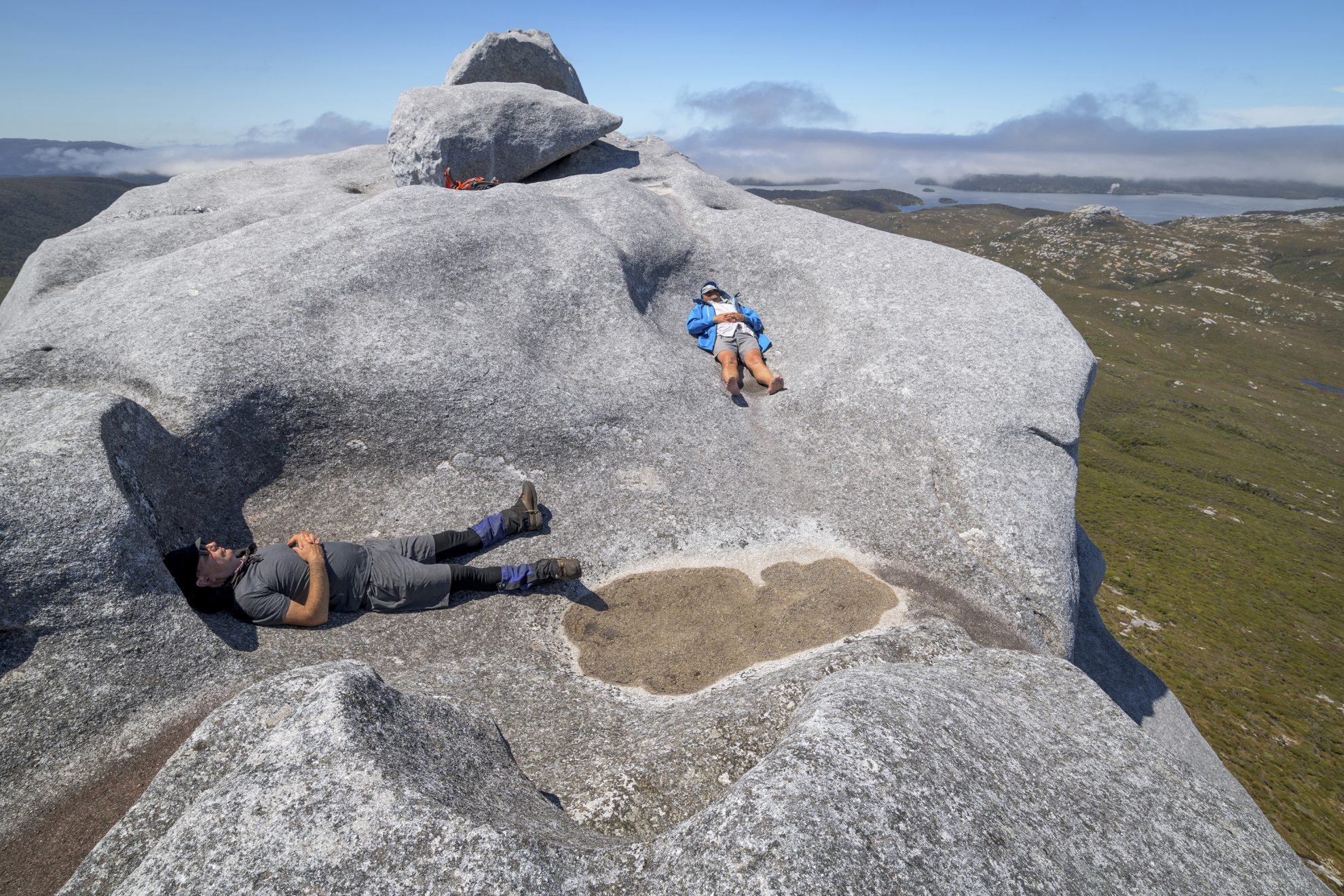
So it was the following day that Darryn and I joined Robbie and James on the trip to Magog. Over the previous week, James had been systematically climbing all the high points in the area, while Robbie aimed to snooze on as many summits as possible. Access to Magog and Gog is up Cook Arm, passable by boat only at high tide. The ever-obliging Paul dropped us, and James led the way, having diligently read the route notes left by yachties in the hut. Like anything in this scrubby wilderness, the trick is to nail your route. We weaved through the leads of open bracken, trying to avoid the bands of tight scrub. James likened it to being on an icebreaker, finding the leads between the bergs. Get off route, and your progress will slow to a standstill.
From the saddle below Hielanman, the route up Magog follows a sneaky little line through tight patches of manuka, over ledges and around the southern side of the peak, until it gains the higher exposed granite. I had a bath in one of the granite scoops, which had filled with water from recent rain.
At the summit, we had reached a paltry 282m but we were on top of the world. A fine day overlooking one of the great wilderness areas. Gog and Magog are names from the Hebrew Bible, sometimes referring to people, sometimes to places. Later Roman interpretations pose Gog and Magog as abominable kings, driven away by Alexander the Great. Whatever their origins, they are outlandish names for a strange place. We had walked across half the length of Rakiura to get here, and I felt a singular sense of achievement.
With Rob and Nick back from a successful camp, everyone reunited at the hut for a final fabulous feast.
Darryn and I got just two days at South Pegasus before the ship came to collect us. Too little time.
Four hours aboard the ship took us back to Bluff; the disappointment at leaving tempered by watching the mollymawks and albatross glide over that other great wilderness – the southern ocean.



