

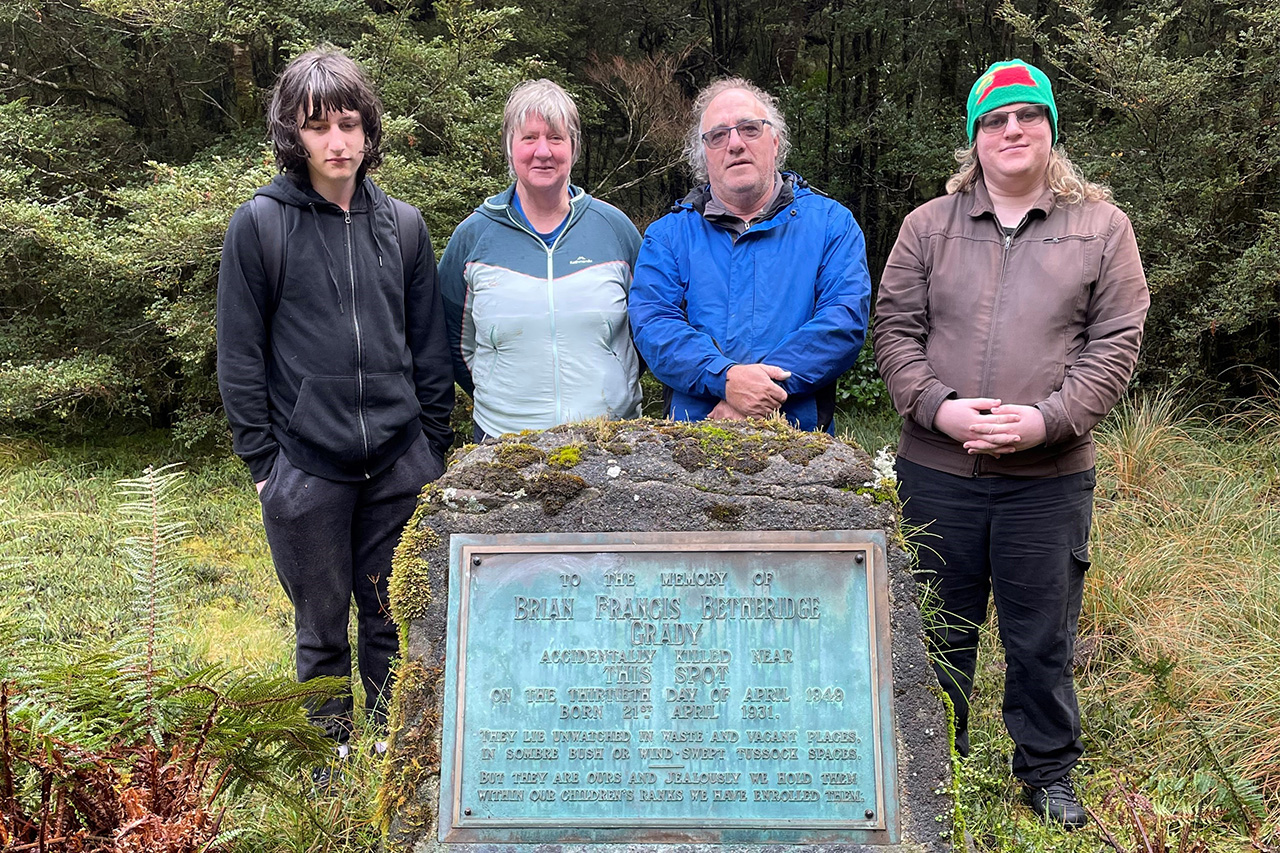
Last year Heather, Warwick and their children visited the memorial, flying in by helicopter.
“My family never really got over it,” says Warwick. “It’s hard to find anyone who’s been to the memorial or knows about it, but without it, Brian wouldn’t be remembered. If anyone wanted to research it in years to come they have a place to start.”
Adds Heather: “It was very moving to be there. I felt it was important for my children to see the area and to understand the background of the deer culling industry. These guys were dropped in and left for months. They had to shoot their meat to supplement their meagre rations. It was a tough life for a 17-year-old.”
New Zealand is full of memorials to people who’ve died in the mountains. Some, like the Alpine Memorial at Aoraki / Mt Cook, emblazoned with plaques, each commemorating a climber who had died in the national park, are very public. But others, like Brian Grady’s, are almost anonymous. Known only to a few, they offer solace to the family of the dead, and quiet reflection to those who stumble upon them.
Like impromptu roadside memorials to car crash victims, these memorials are unlikely to gain official sanction. The Department of Conservation prefers to see the fallen honoured through the creation of huts or bridges, or structures that can aid others.
Heather Grady says that while the old forestry service paid for Warwick’s family to visit the site when he was a teenager, DOC hasn’t been as accommodating in recent years and has attempted to limit access for the family to visit via helicopter and even proposed to remove the memorial altogether.
“I think it’s really important that the memorial is there,” says Heather. “Brian died in service to his country. It’s a hugely significant site.”
DOC director of planning permissions and land, Natasha Ryburn, denies that DOC ever proposed to remove the memorial but says the Mt Aspiring National Park management plan states, “memorials and monuments should generally not be permitted in the park”.
Sanctioned or not, some memorials have stood the test of time and are unlikely to be going anywhere. Kevin Blatchford lives as close to the Tararua Range as you can get, in a farmhouse near the Mt Holdsworth Road end. He sometimes looks up at the mountains that rise from his backyard and wonders if his father’s cousin Basil is looking down on him, from his grave on the tops above.
An experienced deerstalker, Blatchford was tramping alone in 1959 when he succumbed to atrocious conditions on Tarn Ridge, one of the ranges’ most remote and exposed places. His body was found a week later and buried where it lay. A wooden cross forever marks the spot, an unavoidable landmark for trampers doing the Northern Crossing, materialising out of the mist like an omen.
Kevin Blatchford, who was 12 when Basil died, has never seen the memorial. Following Basil’s death, Kevin’s father forbade him from venturing into the mountains on their doorstep. “My brother and I always wanted to go further into the Tararuas, but Dad would never let us,” Kevin says. “He said it was too dangerous after Basil died.”
Kevin may never visit the spot where Basil died, but he draws comfort from the memorial being there. “We’ve never forgotten Basil, we think of him all the time. We were speaking to someone just the other day who went past his grave, so it’s nice to meet these people and talk about Basil. A lot of people see the memorial.”
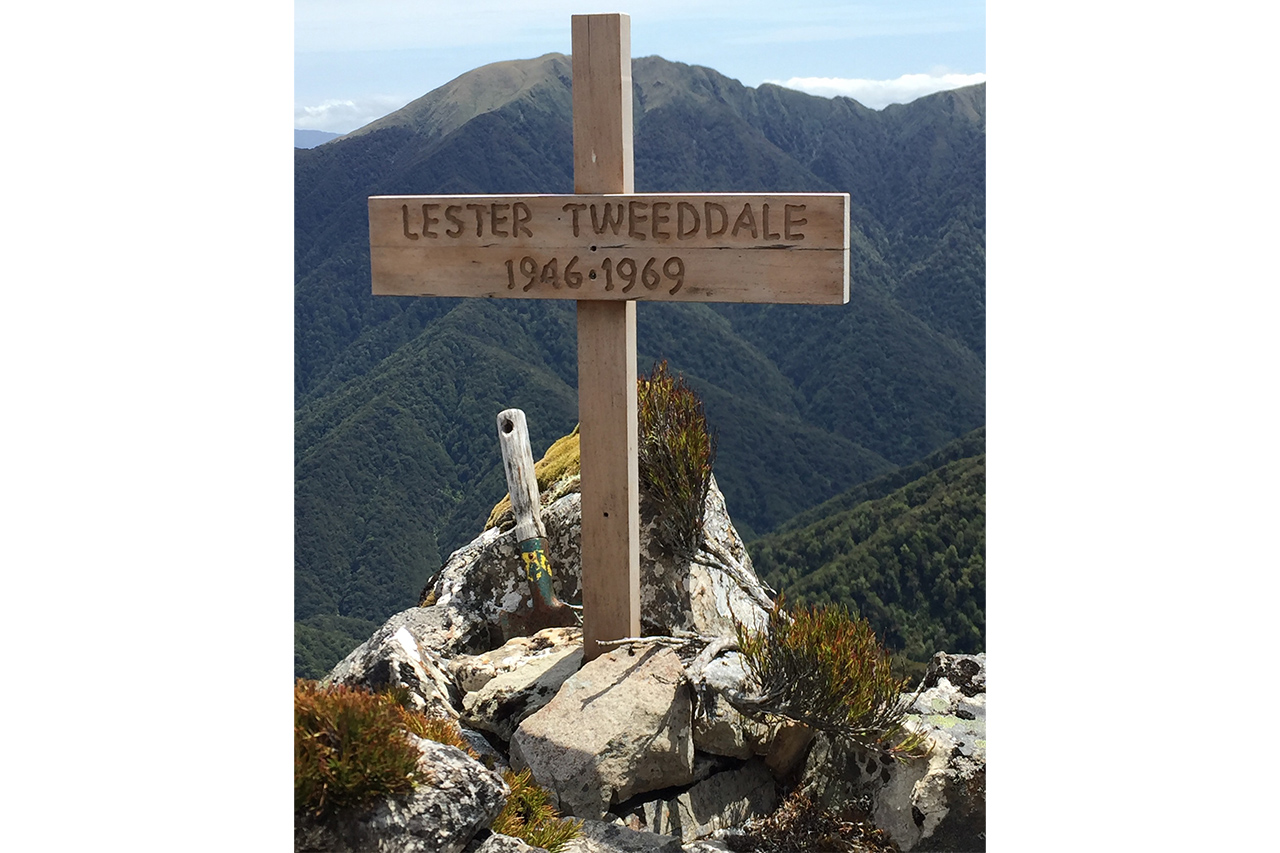
Not many people will see the memorial to Lester Tweeddale, a police constable who died near Mt Holdsworth in 1969, aged 22. Tramping alone in June, Tweeddale climbed to Powell Hut, just above the bushline on the eastern side of the range. The weather was deteriorating, but he made the fatal decision to attempt the summit of Mt Holdsworth. Battling deep snow and whiteout conditions, he took the wrong ridge – likely while descending – and headed south-west off the mountain towards a steep slip at the head of a 70m waterfall on Isabelle Creek. His body was found when the snow thawed in October at the bottom of the waterfall.
A small plaque honouring Tweeddale hung in the third incarnation of Powell Hut, but when the hut was replaced in 2019, the plaque didn’t reappear.
“That really peeved me,” says veteran Tararua tramper Joe Nawalaniec. “The plaque told a story, and it really affected me because I knew how brutal that terrain was. Lester had always been at the back of my mind and with the plaque vanishing, well, I wanted to put it right.”
Nawalaniec shared his idea for a new memorial with a local doyen of Tararua tramping, John Rhodes, who skilfully routed a sturdy memorial cross out of tōtara. In June 2019, on the 50th anniversary of Tweeddale’s death, Nawalaniec and his friend Franz Hubmann tramped to a point on the rarely traversed High Ridge overlooking where Tweeddale died and, mixing concrete in a blizzard, dug a hole, set the cross in the concrete and said a short prayer.
“We had a moment thinking about Lester,” says Nawalaniec, “then we set the cross in the cement.”
Nawalaniec says very few people will see the cross, but that’s not the point. “It wasn’t put there for people to view it. It was put there for Lester.”
“What they’ve done is wonderful,” says Don Tweeddale, Lester’s younger brother, who was 19 when Lester died. “They’ve gone out of their way to put that memorial there to Lester; it means so much to us.”
When Lester was reported missing, Don and another brother drove down from Taihape to help with the search. They spent a night in Powell Hut, waking up the next day to find snow piled high up the door of the hut. “It was so intensely cold that we just knew there was no hope for Lester. Nobody spoke it but we realised he was gone.”
Don says Nawalaniec contacted him prior to installing the memorial, to get the family’s blessing, which he was more than willing to give. “It’s so commendable what Joe, Franz and John did. It’s important to remember who he was and how young he was. It was overwhelming for everyone. To lose him at that age really affected us; my mum especially for the rest of her life.”
Tweeddale’s isn’t the only memorial Nawalaniec has installed in the Tararua Range. When his mother-in-law Val died in 2019, he scattered her ashes on the track he was cutting on Waiohine Ridge and nailed a white cross to a rogue pine tree, under which he placed a teacup and a saucer. “She’d never been to that part of the track, but I told her I’d put her up there,” Nawalaniec says. “She was very happy to hear that. Every time I go up, I refill her cup with tea and lay fresh flowers.”
Nawalaniec is something of a memorial magnet. Several years ago, he stumbled upon a memorial bench on the No 1 Line Track in the Ruahine Range, put there by the family of a young pilot who crashed his plane nearby. “I think about him because he should have had kids and maybe grandkids by now. An entire family line wiped out because of one mistake.”
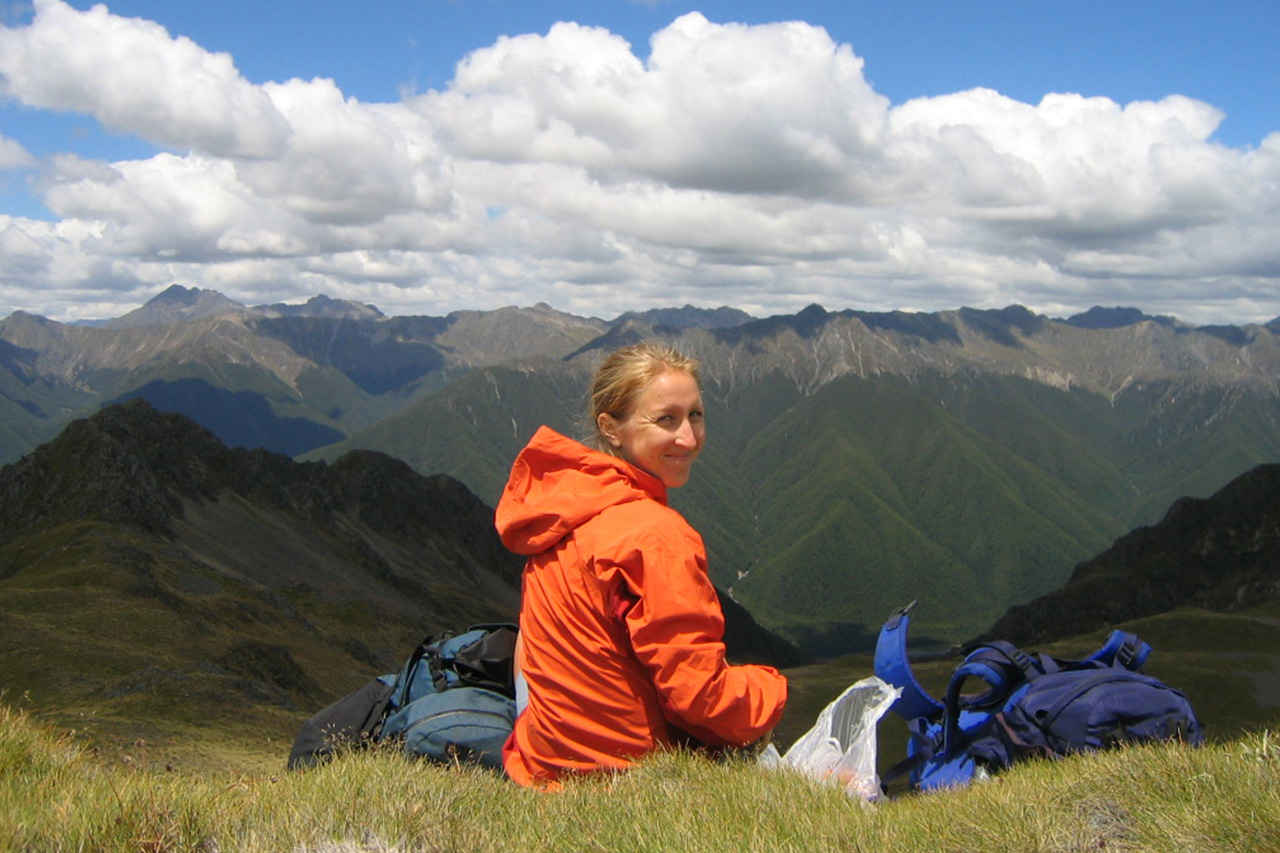
Blenheim local Peter Jerram also knows what it’s like to lose a child.
“It’s about as bad as anything that can happen to a person,” he says. “After 15 years, it still hurts like hell.”
Jerram’s daughter Jane died of exposure during a storm on Mt Blanc in 2007, along with her partner Mark Emerson and two other climbing companions. She was 26.
With so much of her life ahead of her, Jerram feels her loss every day. A talented engineer, Jane was working in France when she died and had been awarded a scholarship to do her doctorate in geotechnical engineering. Three months after her death, Jerram and his wife Ally went to Grenoble, France, to scatter some of Jane’s ashes on a nearby mountain. They returned a year later when Jane was awarded her PhD in memoriam.
But they also wanted a memorial in the New Zealand mountains. The couple owns a bach near St Arnaud, directly under the peaks of the St Arnaud Range, on the eastern shore of Lake Rotoiti. It was up there they buried the rest of Jane’s ashes, along with Mark’s, inside a prominent rock cairn. On maps, the peak is simply known as Pt1787m. But to Jerram, it will forever be Jane’s Peak.
The hole in Jerram’s life was gouged even deeper five years ago when he lost Ally. His wife’s ashes now lie with their daughter’s, the two most cherished women in his life reunited again, forever part of the mountains they loved.
“I’m pretty much an atheist,” Jerram says. “But I go to St Arnaud and look up there and I can’t help feeling they know I’m looking at them, that I’m around. It gives me a lot of comfort.”
Jerram can also visit a bench seat on the Wither Hills behind Blenheim, which has a plaque for each. The final line of Ally’s epitaph reads, ‘At peace here with Jane’.
For the Grady family, their hope is that Brian’s memorial will keep his memory alive, no matter how many people see it. To know it’s there is enough. On their visit last year, Warwick barely recognised the site, with bush reclaiming much of the grassland. He says that in 50 years it might become overgrown and forgotten, lost forever.
The family took some photos, replaced some pieces that had fallen off, and cleaned the monument so you can read the epitaph, an extract from a poem by Henry Adams:
They lie unwatched, in waste and vacant places,
In sombre bush or wind-swept tussock spaces,
But they are ours, and jealously we hold them,
Within our children’s ranks we have enrolled them…
On the flight out, the helicopter pilot flew the Grady’s over the ridge from which Brian had fallen. A red deer lifted its head to the sound of the chopper. It watched them for a moment, then turned and stepped back into the cover of the trees.



