

Ola Shahin walked into the Kaimai Range with no intention of coming back out. She parked her car on Lindemann Road and set off with no food and no direction in mind.
Nobody knew where she was going, and that was the idea. She wanted to disappear, to let the elements take her quietly and without fuss.
She didn’t expect nature to instead save her life.
For hours, Shahin walked the bush track, stopping often to lay down and find peace amongst the bird song and the trees. She was searching for a final resting place, but what she found was a tranquility so alluring, it convinced her to keep walking.
She eventually found the refuge of Waitawheta Hut, close to 10km from her parked car. Exhausted, and with nobody else in the hut, she quickly fell asleep on a bunk.
Waking later that evening, Shahin found she was no longer alone – two trampers had arrived and were settling in for the night.
She told them of her day, and shared her true intentions for visiting the Kaimais. Her companions listened without judgment, and the three spent the night in typical hut fashion; playing cards, drinking hot chocolate, stargazing and hunting for glowworms. Shahin had found her peace, her place, and her people.
“It definitely did save my life, as clichéd as it might sound,” she says. “That day made me realise that I do have a safe place.”
The following morning, Shahin decided it was time to brave the world and began the walk back to her car. Unbeknown to her, she had been reported missing and police, search and rescue and other volunteers had located her car, and their paths would cross that afternoon.
Shahin, 25, talks openly of her experience in the hope she can help those who feel they’re not allowed to have mental health struggles.
“I believe everything happens for a reason, and the reason I had to go through it is to help others,” she says.
Growing up in a community that didn’t talk about depression, Shahin felt isolated in her feelings and unable to find support.
“A lot of people don’t talk to others because they’re ashamed. Stigma is a horrible reason for people to die.”
Since that day in November 2017, tramping has become a lifeline for Shahin. Before her night in Waitawheta, she had never stayed in a tramping hut, and now she gets out as often as she can.
Time alone in nature continues to refresh and relax her, and she finds fulfilment taking in the small details of her environment, the colours and sounds that often go unnoticed.
While relief comes in different forms for everybody, Shahin feels grateful she has found her own source of peace in nature.
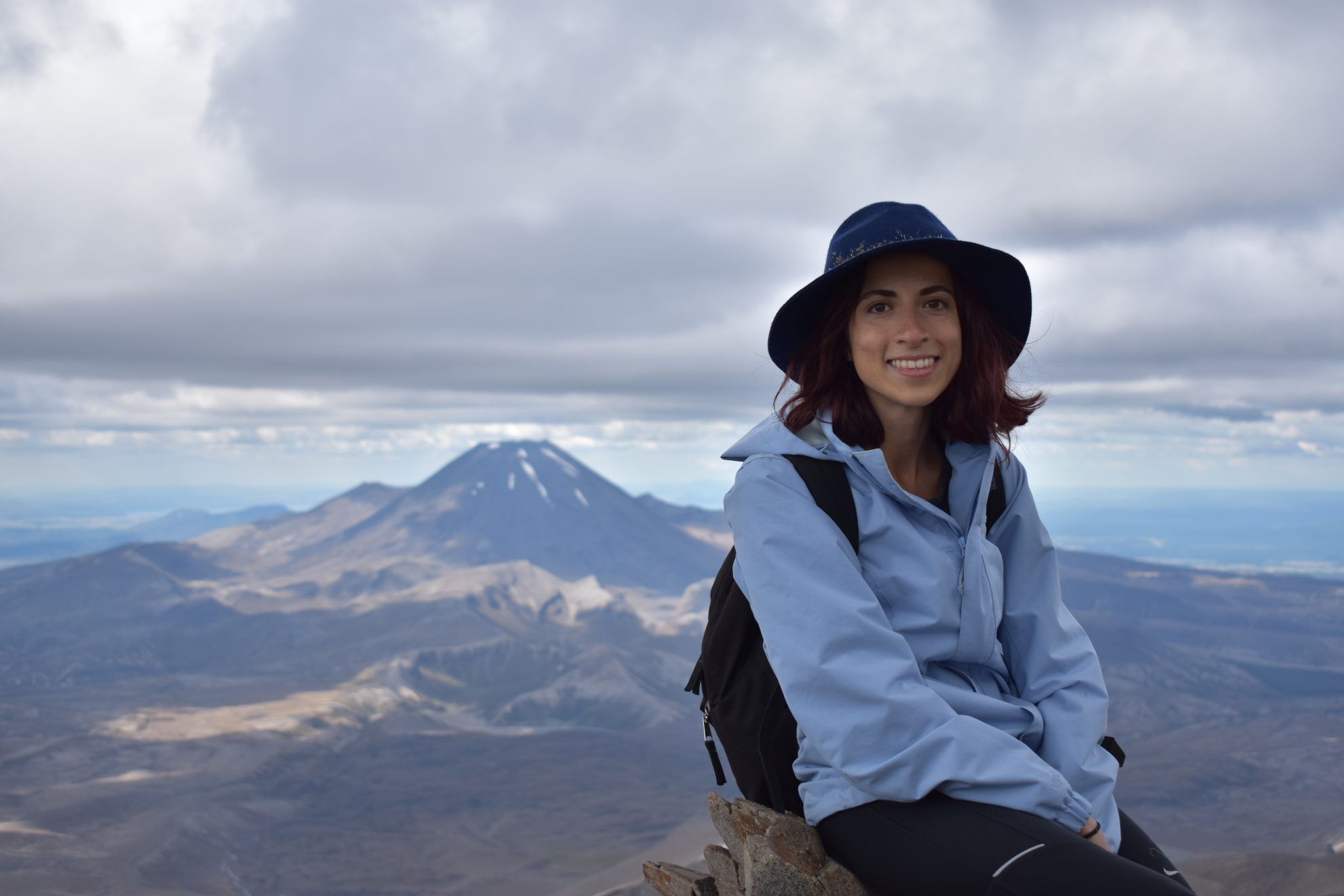
“I’ve realised that not everyone has that safe place,” she says.
Shahin plans to complete all nine Great Walks, and has crossed two off already.
To commemorate a year since she found hope in the Kaimai Ranges, she walked the Heaphy Track with Kathy Roberts – one of the people involved in the search for Shahin and who is now a close friend.
She also retraced her steps to Waitawheta Hut – this time with friends – to reflect on the life-changing journey she made on her own.
“I wanted to go back, and I thought it would be nice to share it with people,” she says. “It was empowering to go in with a different mindset. It changes a lot of things. That place will stay special to me for a long time.”
Massey University Professor of public health, Jeroen Douwes, says there is increasing scientific evidence to support the benefits to the mind and body of green spaces.
“Indigenous populations have long known, and many generations before us have seen, the positive benefits of a healthy ecosystem,” he says.
“By removing ourselves from nature and losing part of our biodiversity, we have contributed to a poorer ecosystem, and I think it’s naive to think people are not affected.”
The benefits of being in the outdoors – beyond the basics of exercise and vitamin D – are numerous, Douwes says, and simply seeing greenery can be enough to make people feel better.
A study has shown that surgery patients who looked out over green space recovered quicker than those who didn’t have views.
“People like looking at green space, and from an evolutionary point of view, we may have been programmed to enjoy it, or feel a need to be close to green space,” Douwes says.
Getting into nature is also associated with a broader exposure to a diversity of microorganisms, which can have a positive effect on the immune system, and studies have linked time in the outdoors to increased social cohesion.
Using the outdoors as a pillar to support hauora, or wellbeing, is becoming more prevalent in health care too, Sport Taranaki’s Gaylene Phillips says.
“There has been a groundswell of focus on people wanting to do more natural things for their health, whether that’s getting more physically active or changing their diet,” she says.
Phillips is the Ministry of Health’s green prescription contact for the Taranaki region. Working with patients referred by medical professionals, she helps to facilitate physical activity for people living with health issues such as diabetes, cardiovascular disease, anxiety and depression.
“Sometimes it’s just the fact that people have no transport, or nobody to exercise with, so we put them in contact with people that are doing that in the community, like tramping clubs or walking groups,” she says.
Initiated 15 years ago, green prescriptions have received consistently strong results, with 89 per cent of participants in 2018 noticing increases to their fitness and health levels.
Having isolated wilderness to enjoy in New Zealand makes a difference too, Phillips says, although “it’s something a lot of people take for granted”.
Lifelong tramper Rob Gerard certainly doesn’t take the wilderness for granted.
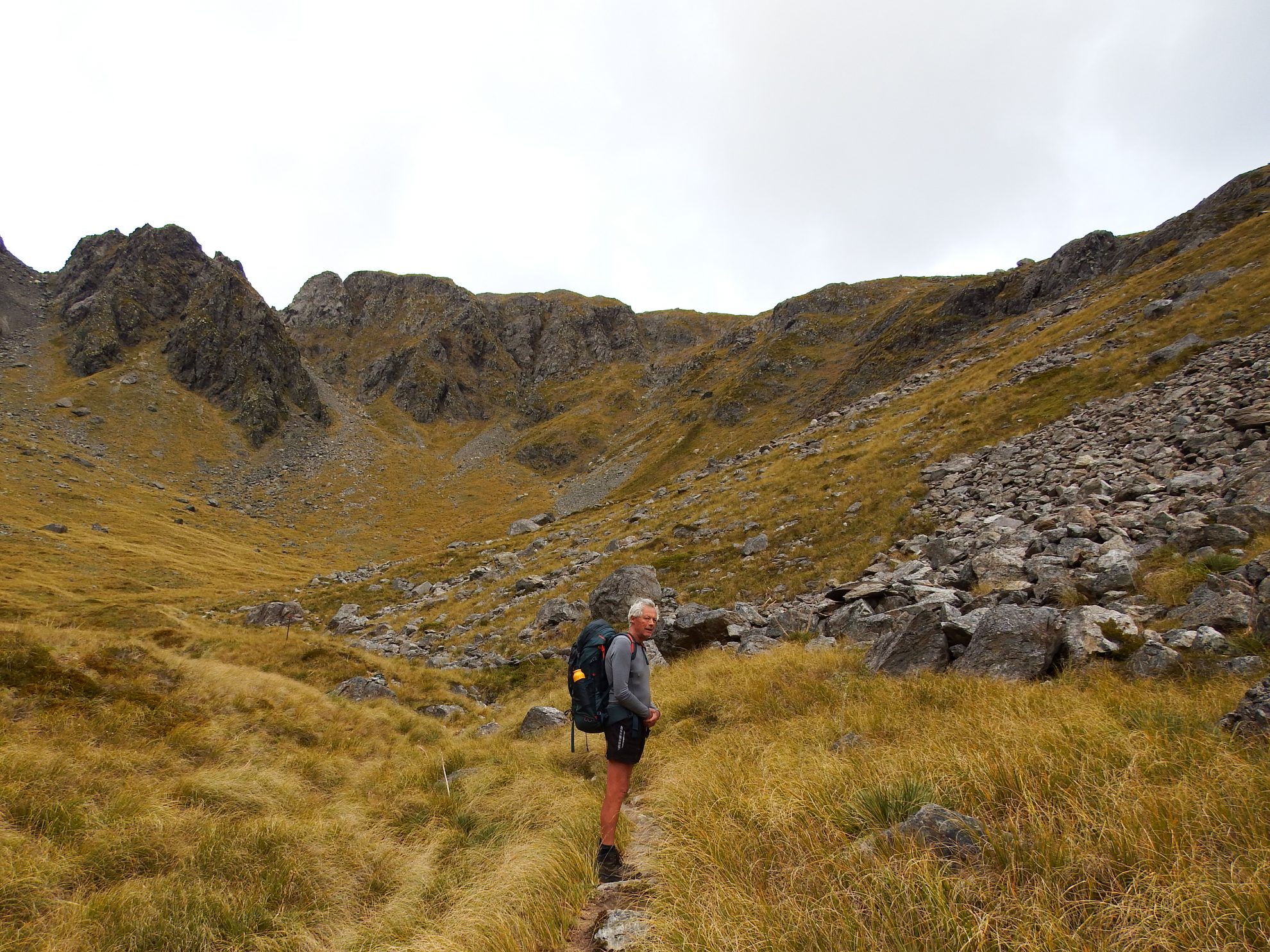
A recent fall on the Copland Track had the 72-year-old awaiting hand surgery when he spoke to Wilderness. Chipper as can be – and still suffering a concussion – he recalled the five hour walk back to his car with a broken hand and head injuries, unable to remember the number which follows four (but knowing he had stopped to chat with a group of “more than four” concerned hikers).
It’s the most recent in a series of setbacks to befall Gerard – but nothing seems to break his spirit and keep him from enjoying the outdoors.
Following a knee injury several years ago, Gerard found himself immobilised for a month while awaiting surgery. Expectations of post-op recovery turned to disappointment when a month later, he found himself considerably worse – and it wasn’t just his knee. Gerard’s whole body had turned against him.
A mystery joint problem – suspected to be an autoimmune disorder, but still undiagnosed – had taken hold of him.
“It started because I lost activity, and once it got a hold on me it just took over,” he says. “It would take me half an hour to get out of bed, and every day was a seven out of 10 on the pain scale.”
Short walks left him exhausted and needing bed rest, and his doctor advised him to take it easy. He gave that a crack, but a week of inaction left his joints so ceased he could barely move, so step by step, he started to earn his life back.
First five minute walks, then 10, then quarter of an hour, and soon after, gradients.
“The more I extended, the better I got and the less recovery time I would have afterwards,” he said.
Eventually he was setting off on hour-long walks, always pushing his limits.
“The first time I walked for two hours, I was pleased with that, until I got home and had two days in bed,” he says.
“But even if you do a walk and have to spend half a day in bed, don’t worry about it – go and do it again. It’s another step forward.”
An outdoorsman for much of his life, Gerard realised his plan to spend his retirement tramping was up in the air – close enough to grasp, but only if he kept fighting for it.
“It’s almost a sense of being re-born. Tramping is now so much more precious. I’m not going to live forever, so might as well get on and do stuff,” he says.
Having re-cut his teeth hiking the Port Hills, Gerard decided – against doctor’s orders – that an overnight hike to Welcome Flat Hut would be a decent challenge.
Tackling the 18km Copland Track in under seven hours – not including a “restorative” tea break – Gerard was rewarded with the best night of his year amongst friends at the hut. The return journey passed without a hitch (unlike his most recent trip to the hut), giving him the confidence to throw himself headlong into as many trails as he can manage.
From bed-ridden beginnings to cosy bunks amongst the mountains, Gerard’s continuing improvement has him buzzing about life again.
“The driving force is a love of the outdoors and wanting to get out there, and then discovering against all of my medical advice, that it works,” he says.
Graham Bocock is another who knows well the value of the outdoors. Born and bred in Taranaki, he’s spent much of his 70 years enjoying all that the mountainoffers the region, from slopes to sea. He feels privileged to now pass that passion on to another.
Bailey came into Bocock’s life through the the Big Brothers Big Sisters Taranaki programme seven years ago when he was 10 years old. The pair connected immediately.
“Sometimes it takes months or a year to develop a strong relationship, but we hit it off from day one,” Bocock says.
The programme helps more than 100 vulnerable youths in the region, and thousands more nationally. It requires mentors to spend at least an hour a week with their assigned tamariki, but for Bocock, this wasn’t enough.
There’s one thing everyone who
tramps into old age has in common –
they just get out there and do it
“That involvement grew into something much bigger – it took on a life on its own,” he says.
One of their first outings together saw the pair explore – and get a bit lost – in New Plymouth’s Pukekura Park. It was Bailey’s first time in the park, and he “came alive” in nature, Bocock said.
When he discovered Bailey had never been to the mountain, Bocock took him to the visitor centre for a stroll, and so began Bailey’s love of tramping.
A member of the New Plymouth Tramping Club, Bocock was well placed to expose his ‘little brother’ to the wonders on their doorstep.
At 11, Bailey topped the Pouakai Range, and at 12 he summited Mt Taranaki. Now 17, he is a veteran of 110 tramps with Bocock alone – the pair celebrating their 100th tramp milestone in 2018 by climbing Mt Ruapehu.
The mutual love for the outdoors has proven to be the backbone of their relationship. It has also helped Bocock to enjoy a very active 60s, having cut down on tramping in his middle years.
“Bailey claims he kept me off the couch, and there’s probably some truth to that,” he says. “I’ve found if you want to keep doing it, you’ve got to keep doing it.”
Bocock says the relationship has been mutually beneficial, and expects they will be friends for life.
“The whole experience of mentoring a kid is awesome. It’s a real privilege to have the opportunity to make a positive difference in the life of even just one young person,” he said.
“There’s no question in my mind that he’s going to have a much better life. He’ll be a different father to his kids than he might have been. It has very far reaching effects.”
Accessibility to New Zealand’s wilderness can be life changing, but not everybody gets the opportunity, Bocock says.
“It’s a great thing for young people to have a love of the outdoors. A lot of them don’t get to experience some of the great things we have in life, nature at its best,” he says.
Paralympian Mary Fisher says it’s important for all Kiwis to have the opportunity to disconnect from technology and experience nature.
“There should be places that are accessible for everyone – it does so much for holistic health,” she says.
Born with the genetic vision disorder aniridia, Fisher’s sight is limited to light and dark – not enough to make out the views hikers work so hard to see.
Having four of five senses was more than enough, however, for Fisher to enjoy herself on the Kepler Track last November.
She recalls the moment her tramping group broke through the treeline onto the alpine tops, in awe of the landscape she couldn’t see. While Fisher used the senses available to her to smell the earth and feel the breeze on her face, her friends described for her in rich detail the landscape’s many textures and colours.
With 10 pairs of eyes fixed on the same scenery, Fisher’s view became a collaborative painting of adjectives and nouns on her mind’s canvas – “accumulative memories”, as she puts it.
Fisher, 25, has always had a love of adventure and the outdoors. She grew up accompanying her family on day walks – her sight during childhood years allowing her to follow brightly-coloured packs to keep her bearings.
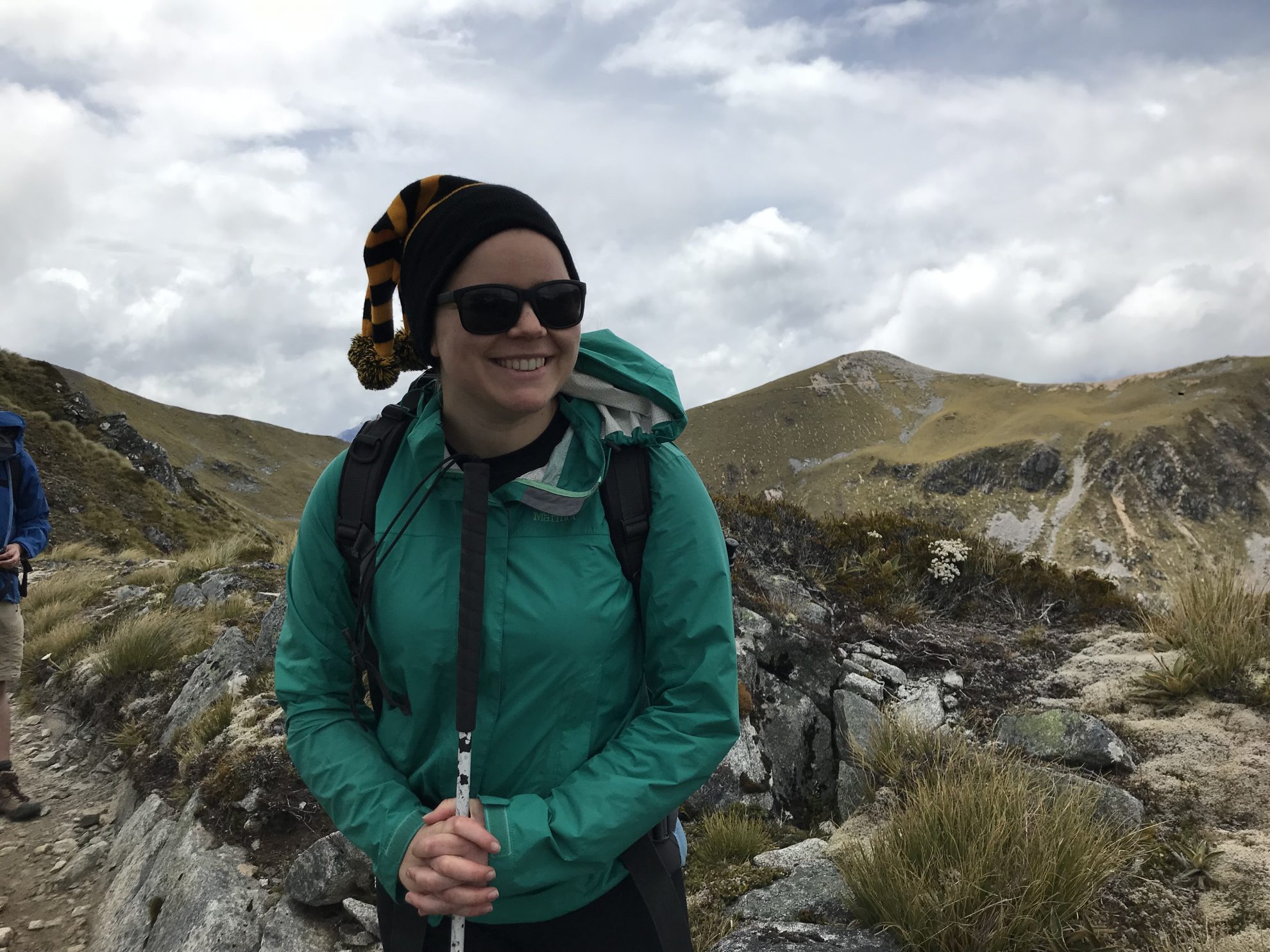
Sometimes she would hold up the group a little, and other times she would rush ahead, but the more she got out, the more she enjoyed the outdoors.
She took up swimming at age nine, and at 19 won her first gold medal at the London 2012 Paralympic Games, earning another at Rio in 2016.
Her thirst for a challenge as strong as ever, Fisher jumped at the chance to join a friend on her family tramp of the Kepler – her first Great Walk.
With a strong base fitness, and bolstered confidence from her participation in the Tarawera Ultra Marathon, she felt ready to tackle 50km of the trail.
Tramping blind is a lot different to walking the footpath, Fisher says. It requires communication, trust, balance and technique.
While walking with a cane serves her perfectly well on more predictable terrain, it’s far less practical when navigating the random rocks and roots dotting the track.
Where she was unable to use the cane traditionally, a guide would walk ahead of her, holding one end of it to steer her around obstacles and keep her safely following the ridgelines.
Verbal warnings prepared her for upcoming obstacles, and in trickier sections – such as when a loud downpour drowned out her guide’s voice during a steep descent – she required a bit of extra help.
Fisher was thrilled at how well her group worked together, with every member taking a turn to guide her – even if they were a little nervous.
And while she loved the attention to detail given in descriptions, sometimes it was a case of the less said, the better.
“It’s important to know about changes in terrain, but if the guide describes everything, I have no time to just listen and take the moment in. It’s all about finding the right balance between chatting, and just being there,” she says.
Naturally, Fisher drew a few more looks than the average tramper, but she took the extra attention on the chin.
“There were plenty of people with walking poles, but it’s not an everyday occurrence to see somebody with a cane. People would have a chat and ask how it was going, and the subject of me not being able to see was broached, but mostly everyone was just interested in how guiding worked.”
Fisher is taking a break from swimming for the time being, but she’s already planning her next trip: walking Lake Waikaremoana with a group from the Blind Foundation.
Whether acting as lifeline, inspiration, teacher, or challenger, the outdoors gives indiscriminately, and the lesson is in the eyes of the beholder. Four Kiwis, all with different backgrounds and needs, find a magic amongst the trails that couldn’t be found in their homes or on screens.
Professor Douwes says it’s no overstatement to say science has a long way to go in understanding the benefits of the outdoors
“The one thing we do know is it probably doesn’t have any adverse effects,” Douwes says.
“A hike here and there, taking your dog out or having a stroll in the park will make a big difference to your health.”
34 years of inspiring New Zealanders to explore the outdoors. Don’t miss out — subscribe today.

Questions? Contact us



