Leaning Lodge, Rock and Pillar Scenic Reserve
A planned winter trip to Rock and Pillar Scenic Reserve gave me the idea to give snow shoeing a try. Advice from our trip leader that he’d encountered icy conditions a fortnight before and that crampons would be a good idea cast doubts in my mind, but a friend assured me that snow shoes would be as good as crampons on the icy bits and much better on the soft bits. So a quick call to the hire shop secured the last snow shoes in town.
The track to Leaning Lodge zigzags up a farm track along an easement created as part of the tenure review process. The katabatic wind was strong but not too cool as our group of 10 started, but by the time we reached the small hut used by the University of Otago Botany Department as a base for field work it was decidedly cooler. By now, large parts of the track were covered in snow.
About three hours from the cars brought us to the point where the track levels off briefly, marking the turn-off to Leaning Lodge. Conditions had become unpleasant and inhospitable. The wind was roaring and very cold. When the hut came into view, a quick assessment of the icy conditions in the gully we had to cross suggested that now was the time to try the snow shoes.
The snow shoes were a lot quicker to put on than the crampons my companions had brought and proved to be a lot easier to master. Although the descent into the gully initially seemed a little daunting, it turned out to be a simple task and I was soon in the hut and claiming my favourite bunk.
A brew was next on the agenda, so after lighting a cooker and emptying some water bottles into the billy, a couple of us grabbed snow shovels and a selection of receptacles and headed in search of the stream. A couple of test holes in likely spots brought us to the conclusion that we’d be looking for a while. So we headed back inside, checked the fuel situation and commenced a snow melting production line. As always, it was a frustrating exercise, with each billy-full of snow producing a meagre amount of water.
Leaning Lodge was built as a ski hut in 1957. It is redolent in character but unfortunately is now somewhat dilapidated. I was disappointed when the trust that now owns it decided that it was beyond repair, although accept that that is probably correct. Preparations for a replacement hut are well underway.
After a convivial evening, we arose to a beautiful dawn. The wind was still strong, but less so than on Saturday, so we decided to head for the top of the range. Here, the snow shoes really came into their own. Snow conditions were highly variable, with icy sections, icy crust and soft spots, up, down or along all handled with equal aplomb. Only sidling on steeper slopes was a little tricky, while I soon learned that I was better making my own route than following the footsteps of the crampon wearers.
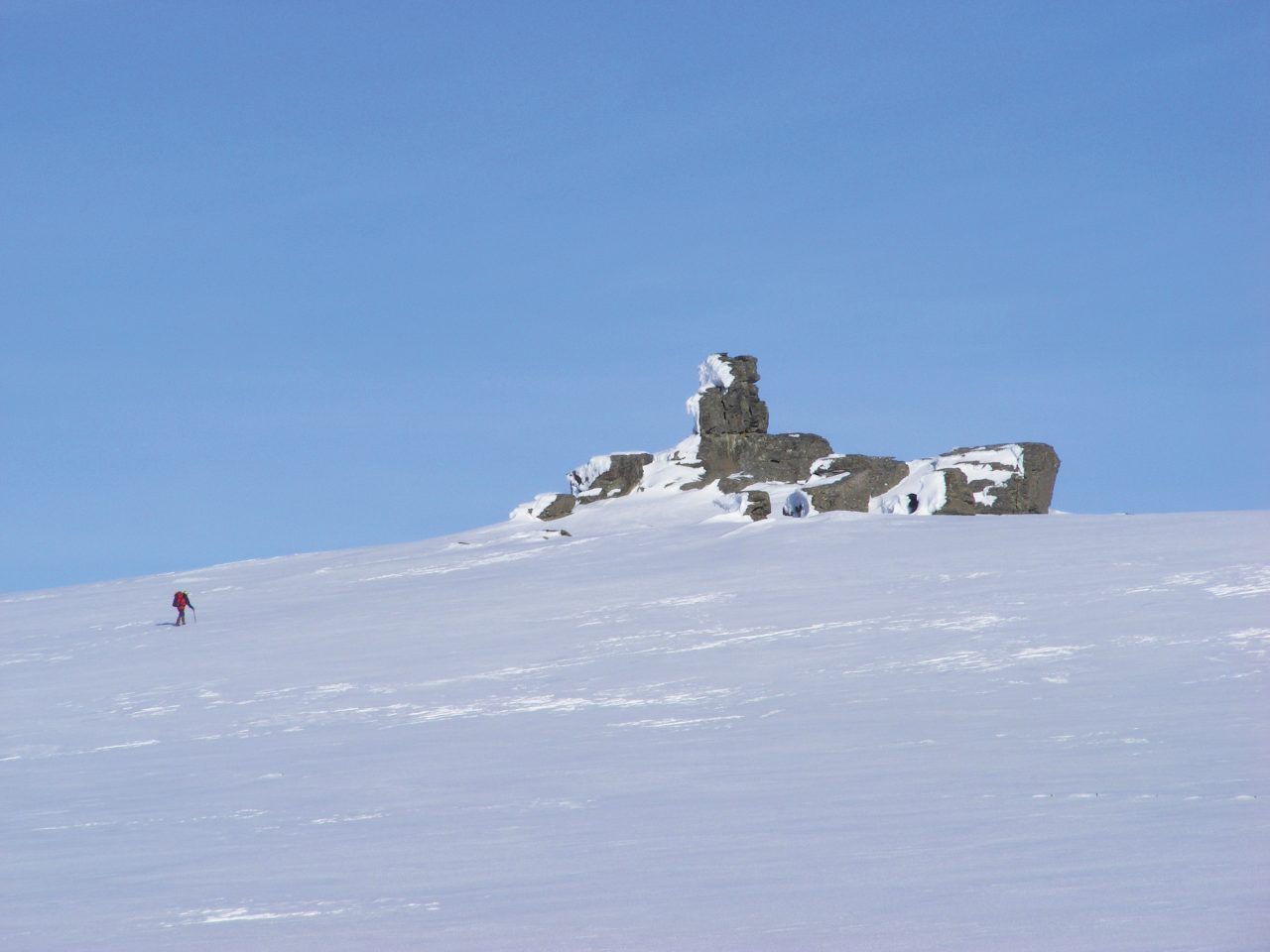
The summit plateau of the Rock and Pillars can be a spectacular place, and on this day it surpassed itself. As you come up onto the plateau, your eye is initially drawn to the monolithic Castle Rock to the sorth and then, as you continue to climb, the myriad other tors that give the range its name. Grahame Sydney country then appears – the Hawdun Range, Mt St Bathans, the Maniatoto Plain, the Lammerlaw and Lammermoor ranges. Finally, the big southern peaks are ranged along the distant horizon – Mt Aspiring, Mt Earnslaw and Mt Tutoko.
The snow shoes made an incredibly efficient means of transport as we made our way to Summit Rock, where the remains of an old trig bear testament to the strong winds – the boards are smooth and there’s not a speck of paint to be seen.
A short stroll downhill brought us to Big Hut. The hut was initially the Otago Ski Club’s main post-war base and had been threatened with removal by the Department of Conservation in its facilities review a few years ago. It was decidedly chilly inside, and it seemed to be much more sensible to have an early lunch break outside in the sun.
The route down from the hut is fairly direct. It’s well marked by large poles with reflectors on them – some even have solar-powered lights.
As tussocks started to appear in the softening snow, the snow shoes proved to be the best mode of travel. Below the snowline, the track was marked with more conventional waratahs. Unfortunately, the tenure review negotiations on this route didn’t produce an ideal outcome, as it descends into a gully rather than staying on the more logical ridge. Finally, it flattens out for the last five minutes to the car park.
– David Barnes