How do you recognise a safe place to cross a river?
You are at a river that you want to cross. You have taken into consideration the first rule: if in doubt, keep out. After careful evaluation you have decided it is safe to cross. The next thing is to decide where to cross.
Track and signs
Generally, but not always, a track will lead to the best crossing point. Sometimes, though, you will have to look up or downstream for the exit. You may even need to walk along in the stream bed before reaching the exit point. On a marked track the exit will usually be identified with an extra big orange triangle.
With a braided river, or where the route goes over an island, the best crossing point may not be in a direct line. The orange marker on the other side may only mark the best point for some of the crossing. You might need to do a section of the crossing up or downstream of the marker.
Rivers often flood, which may gouge out the river bed or change the river edge. This may make a marked route difficult or dangerous. You may need to look up or downstream for a better place.
Shape, width and depth
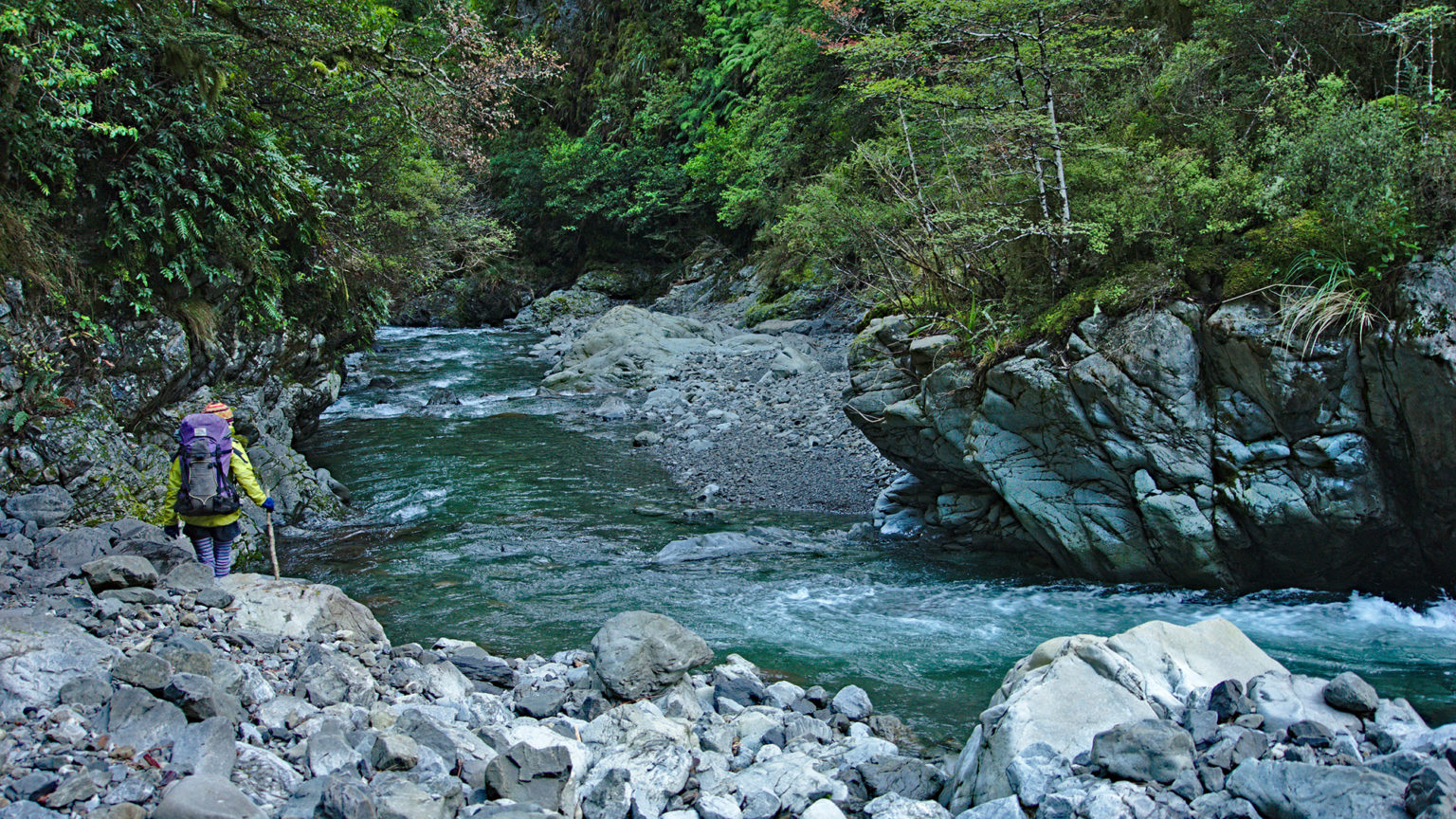
Rivers meander and form S-bends. As the current goes around a curve the water is pushed to the bank on the outer side of the bend. This creates a deeper channel near the outer bank. If you arrive at a river on the inside bend you may see shallow water and be tempted to cross there. You could be only a few steps from the other bank where there’s a deep channel with a swift current. Continuing could get you into trouble, even taking those last few steps. It is much better to cross between the bends.
It may appear easier to cross at a narrow point. But this is where the river will be deeper and the current swifter to force through that constriction.
The depth of the water must be considered. Deeper water is often slower, with less force. Here, the river bed is often more even and easier to walk on with fewer obstacles than shallower, rapid water.
Downstream hazards
Check downstream and consider what will happen if you lose your footing. You wouldn’t want to be swept over a waterfall, through dangerous rapids, a narrow gorge, into strong currents, a bigger river or the sea. Avoid crossing where you could be swept into trees overhanging the banks. Many people drown when they become entangled in entrapments from tree roots and debris hidden by trees.
Bridge piles, abutments and other man-made structures in the river can create a range of hazards such as hidden entrapments and altered currents. Watch out for strainers – things that let the water through but create a barrier or entrapment for a tramper. These include fences, rocks close together and submerged trees. Note that a single stick seen above the water may signal an entire submerged tree.
– Heather Grady is an instructor with Outdoor Training New Zealand