From Everest to Aotearoa

August 2022

Read more from

August 2022

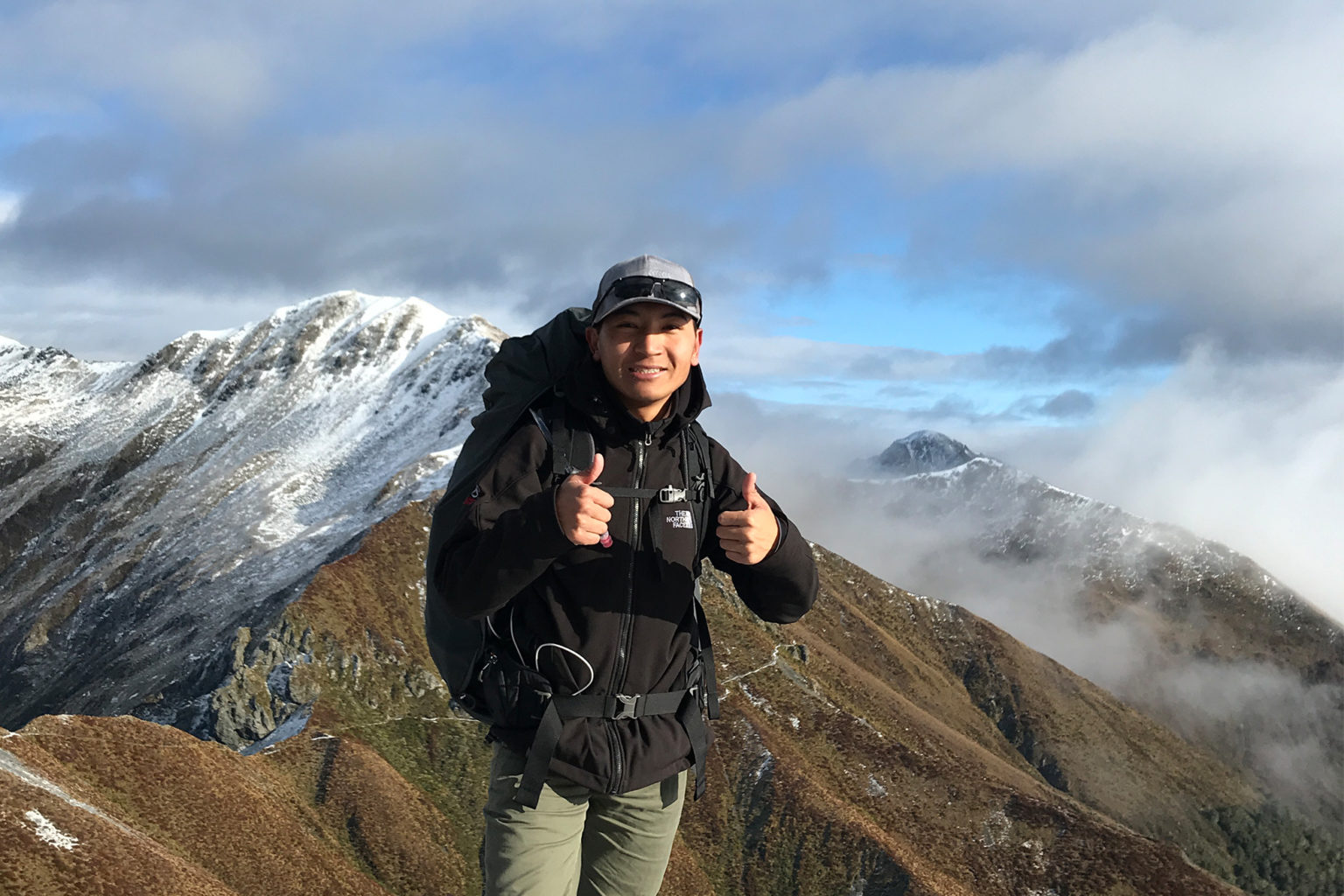
Tsewang Nuru Sherpa is researching environmental management in New Zealand

Tsewang Nuru Sherpa grew up near Everest and sees similarities between efforts to reduce rubbish on the world’s highest mountain and in New Zealand. By Ben Mack

Summiting Everest is the achievement of a lifetime for many mountaineers. But who would know that the world’s highest peak is littered with rubbish.

Helping remove this rubbish is Tsewang Nuru Sherpa. He’s from the Everest area of Nepal and, to him, it’s personal. He also knows the issue isn’t unique to Everest, and believes his research into the Garbage Deposit Scheme (GDS) – in which Everest climbers pay a US$4000 deposit that’s returned only if they bring back at least 8kg of rubbish – could also have implications for wilderness areas in New Zealand.

“One of the best practices that we see with waste management in the Everest area is that it’s mostly local-based,” he explains.

“(New Zealand’s) Department of Conservation does a phenomenal job with caretaking national parks and remote parts of New Zealand. What could also work is implementing locally led approaches, which is about working with local communities and population groups. It’s about working in conjunction with the aims, aspirations and opportunities identified by local communities.”

Tsewang completed a Master’s of Applied Science in Environmental Management at Lincoln University in Christchurch and is now a research assistant at the university. One reason he’s in the South Island is that he was the recipient of the Mingma Norbu Sherpa Memorial Scholarship, established by the World Wildlife Fund (WWF), Lincoln University and the Greater Himalayan Foundation to honour Mingma Norbu Sherpa, a pioneer in the conservation sector and the first student to attend the first school built by Sir Edmund Hillary after he summited Everest.

Tsewang sees similarities between New Zealand and Nepal.

“Although the mountains in Nepal are bigger, taller, more voluminous and perhaps less verdant than New Zealand, the love for the mountains, mountaineering and most importantly mountain stewardship is mutually shared.”

Tsewang falls back on the potential of local stakeholders with local knowledge being involved with conservation work in their area. The outcomes, he says, could bring change beyond removing and reducing rubbish.

“I’ve always loved spending time among nature, and I feel very strongly about the need to protect it, both for its own sake and for the joy it brings to people,” he says.

“We all have the utmost responsibility, to our land, to our people, to ensure that any growth that touches nature is sustainable and respectful, and that our whenua is protected for us and for future generations.”

About the author

Ruth Soukoutou

More From Wild People

Related Topics

Similar Articles

Chasing vertical

Tom’s extraordinary trip to the tippy-top of Tappy

100 peaks in one summer

Trending Now

Apply for the Shaun Barnett Memorial Scholarship

Upgrading to ultralight without replacing everything

Walk1200km‭ ‬in 2026

DOC’s best huts

50 great walks for kids

Subscribe!
Each issue of Wilderness celebrates Aotearoa’s great outdoors — written and photographed with care, not algorithms.Subscribe and help keep our wild stories alive.

Join Wilderness. You'll see more, do more and live more.

Already a subscriber?  to keep reading. Or…

34 years of inspiring New Zealanders to explore the outdoors. Don’t miss out — subscribe today.

Your subscriber-only benefits:

All this for as little as $6.75/month.

1

free articles left this month.

Already a subscriber? Login Now