The welcome swallow (warou) is a self-introduced species from Australia, which makes them a native species as opposed to an endemic one. They were rare vagrant visitors before the late 1950s, but increased greatly through the 1960s and 1970s and now exist throughout New Zealand with the exception of Fiordland.
Although swallows are found more often near coastal and wetland areas, they can live in almost all types of habitat except alpine areas and very dense forest. In colder areas they may migrate seasonally and flocks travel long distances to reach food sources.
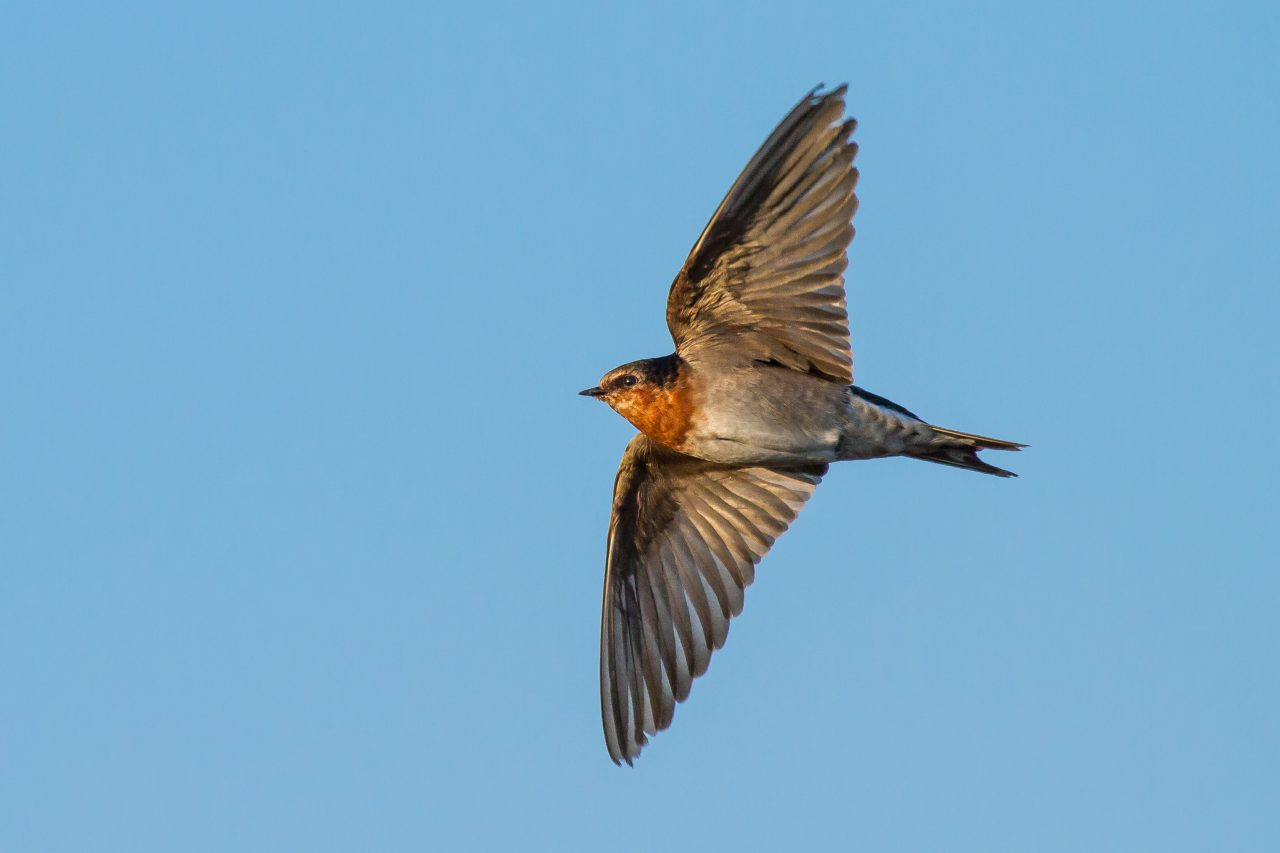
Warou are small, elegant birds with blunt heads, a deeply-forked tail and long pointed wings. The back and upper wings are blue-black and can look iridescent in certain light, while the tail is dark with white spots towards the ends of the feathers. These form a row of dots when the tail is spread in flight. Adults have reddish brown colouring on the forehead, neck and breast with a pale, buff grey on the under parts. They are a relatively small species at about 15cm long and weighing a mere 15g.
During the August to February breeding season, they can raise three broods. Their nests are cup-shaped and built from the base up using mud and grasses. The inner lining consists of fine grasses and feathers. Nest sites are usually on manmade structures such as houses, bridges and culverts, out of direct sunlight. Between three and five eggs (pinkish with brown speckles) are laid in each clutch and incubated by the female for 15 days. Nestlings are fed by both parents and fledge at 18 days old.
Warou catch small invertebrates on the fly, using their acrobatic skills. This type of in-flight feeding is called ‘hawking’. They will occasionally perch on plants to take insects or sweep them up from the water while in flight. Prey is guided into the bird’s mouth with the help of short ‘rictal’ bristles (stiff, hair-like contour feathers that occur in rows projecting outward from the base of the bird’s bill) which act as a funnel.
Warou often drink while flying, scooping water from the surface of a lake or pond.
Each issue of Wilderness celebrates Aotearoa’s great outdoors — written and photographed with care, not algorithms. This Christmas, subscribe or gift a subscription and help keep our wild stories alive. It’s the perfect way to connect with friends and whānau who love the outdoors as much as you do.