Say hello to the wonderful weevils of Aotearoa. By Lily Duval
Where there are plants, there are weevils. These remarkably successful creatures live in almost every habitat, from the Arctic to the subantarctic, from tiny, isolated islands to sprawling metropolises.
There is also a lot of them for weevils make up the largest family group in the animal kingdom. There is a staggering 97,000 species worldwide, with 1500 calling Aotearoa home. It means that there are 15 times more weevils than mammals in the world (there are 6400 mammal species) and seven times as many weevils as birds in Aotearoa.
So, what are weevils, and what are they up to?
Weevils are a type of beetle. They have large, soulful eyes, a trundling gait, and an elongated snout called a rostrum. Most weevils are vegetarian, and many species rely exclusively on one type of plant. In Aotearoa, some of our native weevils depend on specific native plants to complete their life cycle. The plants, in turn, depend on weevils for pollination.
Keep an eye out for these spectacularly snouted, charismatic critters next time you’re in the backcountry.
The steampunk weevil
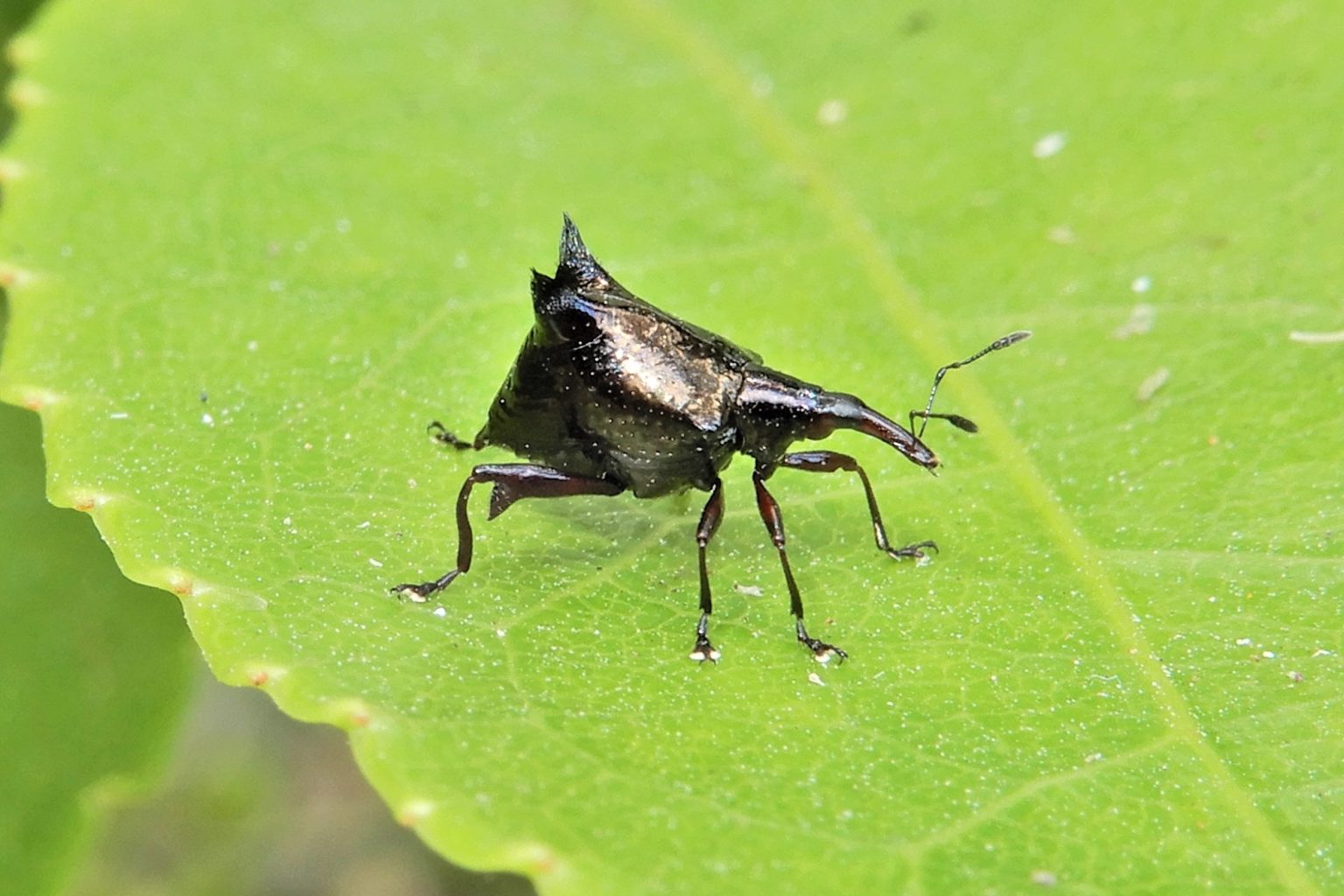
Last summer, after climbing a peak in Fiordland, a black spined weevil (Scolopterus penicillatus) landed on my arm. It was an understatement to say I was excited. These glossy black creatures are the steampunks of the weevil world. They are easy to identify because they have a naturally shiny studded leather jacket (exoskeleton) and four impressive spikes on their back. And, unlike many endemic weevils, they can fly. They belong to the tribe of flower weevils (Eugnomini) and use their wings to get to flowering plants to feast on pollen – you’ll sometimes see them with pollen all over their faces. They’re 5–10mm long (the size of a pea) and live throughout the country from sea level to the alpine zone.
The homebody weevil
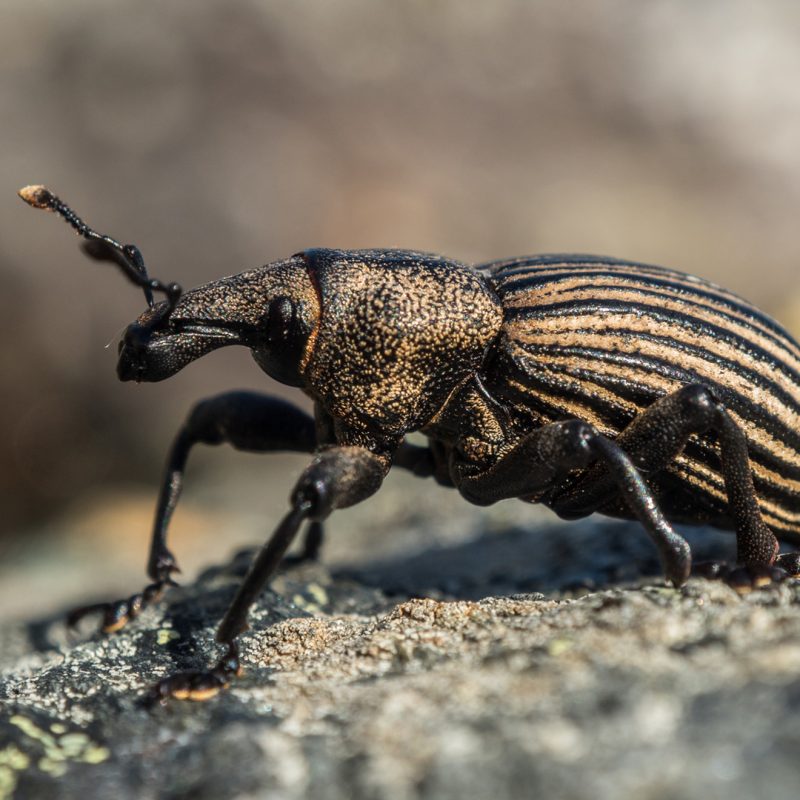
Given their common name, it’s no surprise that speargrass weevils (Lyperobius spp.) are big fans of speargrass (Aciphylla spp.). While trampers go to great lengths to avoid these needle-leafed plants, speargrass weevils love them. They spend their whole lives on the plants, eating the taproot as larvae and the leaves and flower stalks as adults.
All 16 species of speargrass weevils are found only in Aotearoa. They are typically grey and black with ridges running down their backs like stripes. Some of them are quite chonky – the largest grows up to 3cm long.
Because they’re large and flightless, speargrass weevils are convenient snacks for introduced predators like rats. Threats from invasive predators mean you’re far more likely to spot Lyperobius species in alpine areas. Clusters of adult weevils like to hang out and feast on warm days. Keep an eye out for them next time you’re above the tree line on a calm, sunny day.
The record-holding weevil
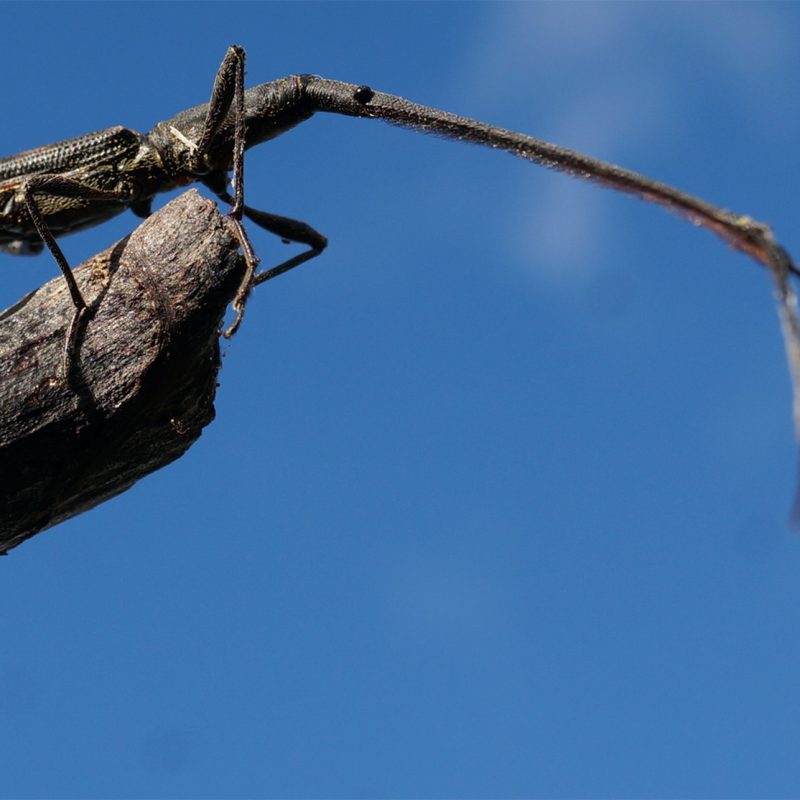
Pepeke nguturoa, the giraffe weevil (Lasiorhynchus barbicornis), is easily our most famous weevil. It’s also the world’s longest; males can grow up to 9cm while females average a more modest 5cm. Males vary in size a lot – some being up to 30 times larger than others – but all possess a rostrum to rival Pinocchio. Males use their incredibly long snout to joust with one another over mates. They can be pretty aggressive, grappling, gouging and shoving their opponents around.
Giraffe weevils are more common to the North Island but can also be spotted in the northwest of the South Island. Females chew little holes in native tree trunks in which to lay their eggs. They lay a single egg per hole and cover it with sawdust and bits of bark. Giraffe weevil larvae spend up to two years burrowing into the wood and feed on a fungus that grows on dead trees. You’ll spot adult giraffe weevils in the warmer months (particularly in February) in lowland forests.
New Zealand’s native weevil species aren’t part of the ‘blood-sucking brigade’, and they’re far too focused on food and mates to bother us. So next time you come across a weevil in the wild, say hello, admire its impressive rostrum and thank it for its services to the environment.