An accessible walk that feels a world away from the city.
This well-formed 8.5km loop has much to offer. The regenerating forest is lush and varied, and due to intensive pest control, there is plenty of birdlife. It’ll also get the heart pounding with an elevation gain of almost 300m, and the feel of a real tramping experience.
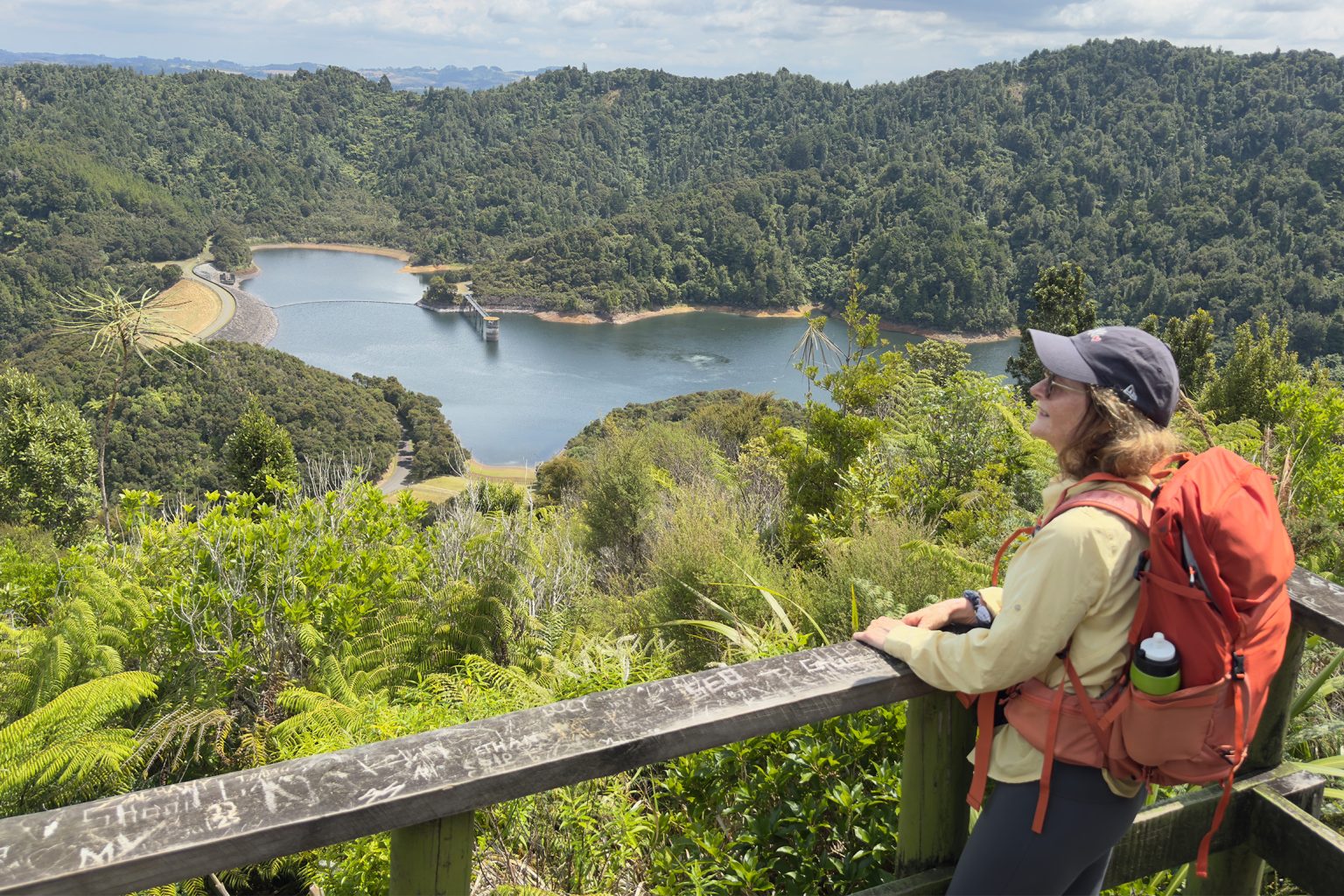
The walk starts from the Otau Road car park, where, after 200m along the road, there’s a boot cleaning station marking the beginning of the Suspension Bridge Track. Cross the bridge over the Wairoa River and climb a series of steps to a seat that reveals a distant view of Wairoa Reservoir. Then, it’s up again via 136 steps to the ridgeline and another seat overlooking farmland.
At the intersection of Wairoa Cosseys Track and Suspension Bridge Track (1.7km), veer right along Suspension Bridge Track towards the Wairoa Dam viewing platform, where an information panel recounts the dam’s history. Cross the crest of the dam and follow Otau Road which gradually climbs inland to the start of Wairoa Loop Track on the left (3.22km).
It’s a gentle ascent to the intersection of a sidetrack leading to the Wairoa Dam lookout; an ideal lunch spot. Gazing across the now-maturing forest, it’s hard to imagine how depleted the land must have looked after European settlers felled the forest from the 1870s.
Tāmaki Māori used the name Te Hūnua, meaning ‘high-lying sterile lands’, to describe the wider area. Ngāi Tai ki Tāmaki are tangata whenua of the ranges. There are many archaeological sites in the park, but no evidence of permanent settlement; the ranges were mostly used as a refuge and a source of timber and food.
Return to the intersection and re-join Wairoa Loop Track. It climbs briefly and continues along the ridge to reach the grassed Repeater Campsite. Repeater Road leads to another seat with a view of the upper Wairoa Reservoir (5.46km) before the track disappears into the forest towards Otau Road car park, roughly 40 minutes away.
The track winds down through the forest into a narrow gorge near the bottom. There’s prolific birdlife, an almost hidden waterfall and pool and abundant ferns. Listen and watch for kererū, tūī, pīwakawaka, kākā, miromiro, kōkako, and perhaps even ruru if the light is fading.