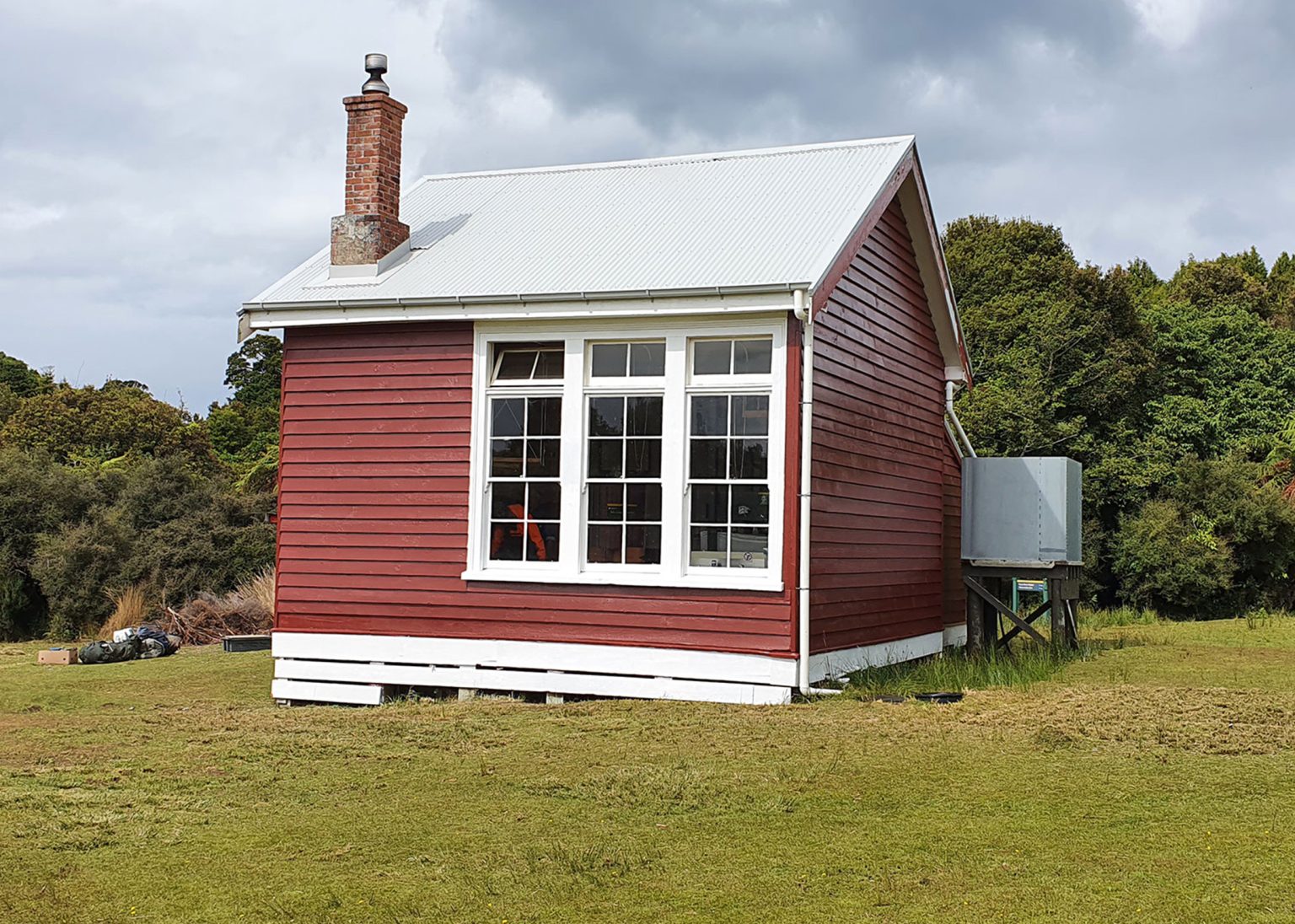
Walk back in time to historic Port Craig and stay in the last remaining building from the logging era.
At the southwestern corner of Te Waewae Bay, a forest of rimu, kahikatea and rātā stretches from the rugged coast of Mussel Beach to the alpine tops of Hump Ridge. This magnificent forest has long drawn people to the bay, although not always for the same reasons. In 1916 this remote corner of Southland hummed with industry as entrepreneurs commenced an ambitious scheme to log the ancient trees using innovative American technology. Mussel Beach was transformed into Port Craig and steamers loaded with consignments of milled rimu churned out of the bay.
Logging lasted for 12 years, and Port Craig School Hut is a solitary testament to the once bustling community.
The walk begins at the starting point of the Hump Ridge Track Great Walk and the South Coast Track. Accordingly, the track to Port Craig is of a high standard.
From the car park the track meanders along a cliff top under a podocarp canopy for 30min before descending steeply to a track by the beach and a swingbridge over the Waikoāu River. It then follows the broad arc of Bluecliffs Beach, with magnificent views. There’s a parallel high-tide 4WD track.
After an hour, at a footbridge over Hump Burn, the 4WD track climbs away from the beach to a swingbridge over Waikoko Stream.
Fiordland National Park begins here. The track winds above the coast through forest for 2.5km to a second swingbridge, over Pipi Tuaraki Stream, followed soon after by the junction with the Hump Ridge Track.
Continue south to descend to Blowholes Beach (Hector’s dolphins may be in the bay), after which the track climbs to cross O Hoka Stream. Another 7km of walking through the forest brings you to Port Craig School Hut on a terrace above Mussel Beach.
A short trail runs from the hut to the beach, complete with signs offering insights into Port Craig’s history.
If you have time, consider continuing south along the South Coast/Hump Ridge track, which follows the former tramway used to bring logs to the mill. The tramway’s construction was no mean feat – the imported 80-tonne American log hauler required construction more akin to a main trunk railway than a bush tramway.
It also required the construction of four colossal wooden viaducts, all of which still stand. The first, at Sandy Hill, is reached after 2hr, followed by Percy Burn and then Edwin Burn another 30min on. A new swingbridge at Edwin Burn provides a good view of the old viaduct. The return trip from Port Craig to the viaducts can take up to five hours.