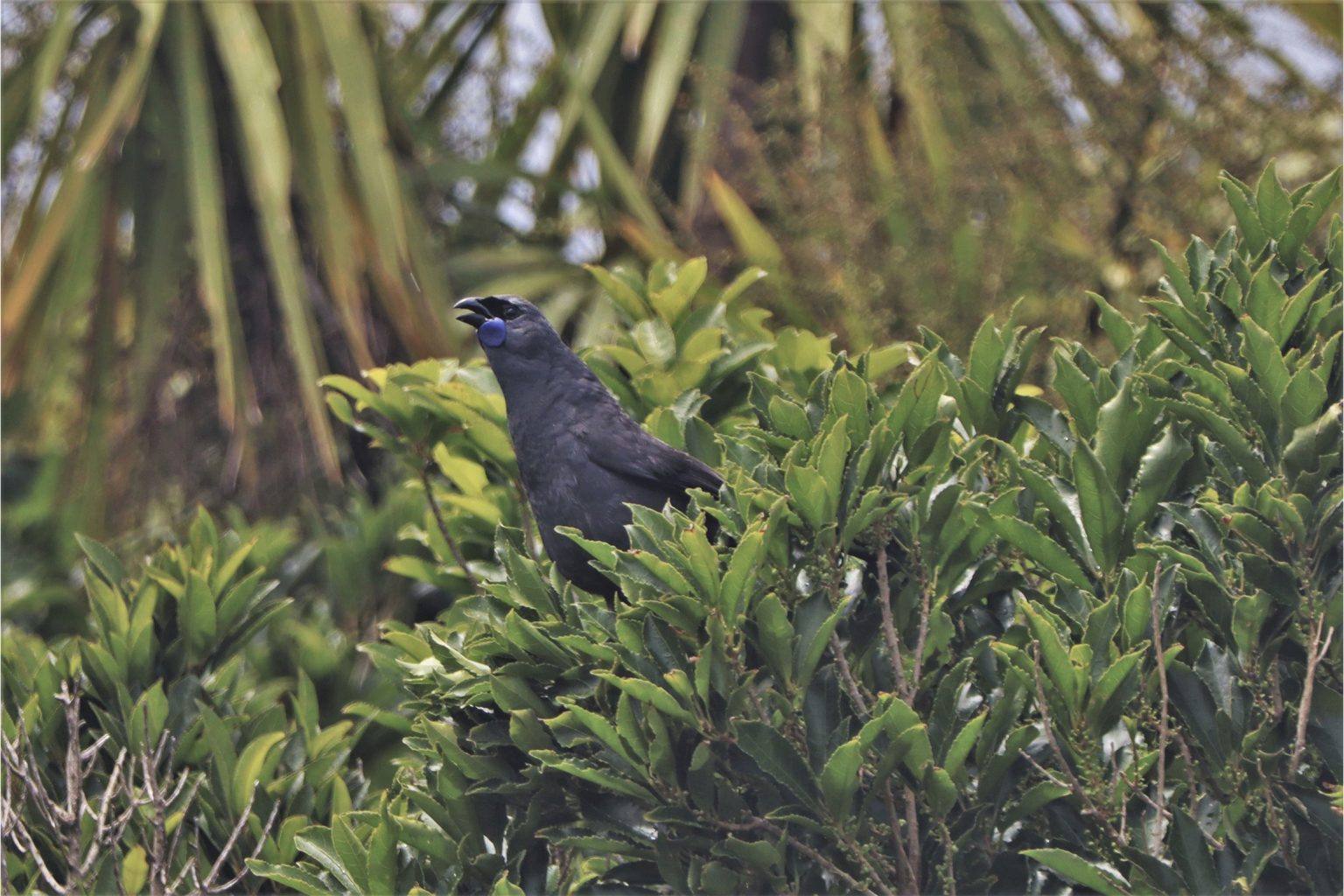
Crowned Bird of the Year in 2016, this blue-wattled beauty stands proud on the $50 note.
The enigmatic North Island kōkako is high on most people’s birds-to-see wish list. Once heard and seen, you won’t soon forget the experience.
The North Island kōkako is a large blue-grey songbird (38cm, 225g) with long legs, a velvet black face mask, a heavy black bill and two royal-blue fleshy wattles at the base of the bill. Adult males and females look alike; juveniles have pink or lilac wattles.
Along with the tīeke saddleback and extinct huia, kōkako belong to an ancient endemic bird family called the New Zealand wattlebirds. They share a common ancestor with the berrypeckers and satinbirds of New Guinea, and bear a resemblance to Australia’s birds of paradise, the riflebirds and bowerbirds.
All the New Zealand wattlebird species have fleshy wattles, long legs and short wings. When they eat forest fruit, they stand on one foot while using the other to hold the fruit.
The closely related orange-wattled South Island kōkako that once inhabited the mainland and Stewart Island is now probably extinct, another victim of introduced predators.
The North Island kōkako was also heading for extinction until environmental campaigns in the 1970s halted native forest logging and conservation efforts increased from the 1990s. There are now 4865 birds in small relict populations at 11 sites in mature native forests in the central North Island and at 15 other North Island sites, including three pest-free offshore islands to which they have been translocated. Numbers are increasing at most of these sites due to pest control, but declining at a handful where pest control needs to be improved.
These blue-wattled beauties form life-long pair bonds and hold permanent territories. They are renowned for their haunting song, which evokes the ancient forests of Aotearoa. Kōkako pairs sing one of the longest duets of any songbird: it can last over an hour and carry for kilometres. They sing their sublime organ-like notes from a high perch at dawn, raising their heads as they do so.
This distinguished forest diva is one of our most precious endemic birds. Seeing one glide down from a high perch on its short, rounded wings with its long tail trailing behind reminded me of an Australian sugar glider sailing through the air between trees.
Fast and agile, kōkako use their athletic legs to bound, hop and run along branches and leap from one branch to another. Look for them gliding across gaps between forest trees or over tracks, and listen for their song or koo-koo-koo contact calls and then watch for movement.
They like eating ripe forest fruit such as tawa, tītoki and nīkau, so if you hear forest fruit dropping to the ground, look up!
If you’re very lucky you might see their ‘archangel’ courtship display, in which the male raises his wings and fans them open like the riflebirds of Australia, and bows his head to the female.
From November to February, pairs build a cupped nest in a tree, up to 25m above the ground, where the female lays two to four speckled eggs. She feeds the chicks for two to three weeks, then both adults feed them until they fledge after four to five weeks. The juveniles typically stay on territory for up to 12 months, during which both adults continue to feed them.
The most accessible places to see these blue-grey ‘birds of paradise’ are Tiritiri Matangi and Kāpiti islands, and the Waitākere and Hūnua ranges. Further afield, but well worth the effort, are Sanctuary Mountain Maungatautari near Cambridge, Kaharoa Kōkako Track near Rotorua, and Pureora State Forest, especially the Waipapa Loop Track and the forest tower near Pureora Village. Last summer while visiting Tiritiri Matangi and Kāpiti islands, I was lucky enough to photograph kōkako singing, in flight and running on the ground.