Trampers love a good deer trail, but the presence of these animals comes at a huge cost to our forest ecosystems.
If you’ve tramped off-track in the New Zealand wilderness, you’ll be familiar with the importance of deer trails – trampled routes where deer travel that make passage through the bush easier. Pick up any guidebook covering off-track travel in New Zealand and you’ll read hundreds of phrases about how useful these trails are. Indeed, Moirs Guide South has a section on route finding that is dedicated to using deer and wapiti trails.
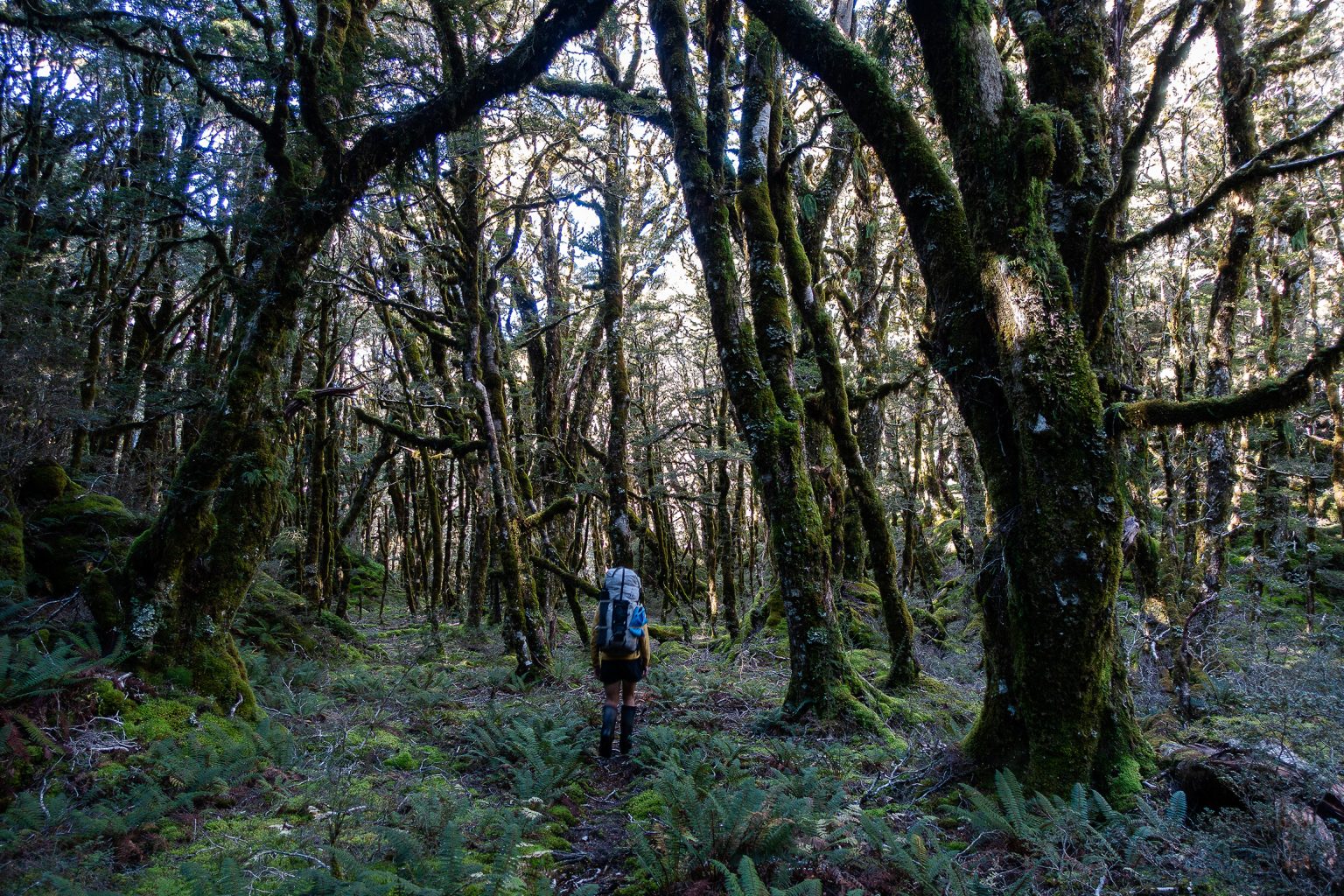
When travelling through untracked thick bush I try to seek out these trails, as they always offer the best travel. Over the years I’ve gotten better at sniffing them out, looking for scuffed leaf litter, deer poo and broken branches or antler rubbings that indicate where they have been. I’ve learnt that deer like spurs and ridges, and they’re very good at following the contour across a slope. They’ll often take the most efficient route, bypassing unnecessary high points on ridges or sidling past an impenetrable windthrow. They’ll cut a nice path through dense, waist-high prickly shield fern. Sometimes on a spur a deer trail can seem like a full-blown tramping track, but most are more subtle, and when I get onto one I do my best to stay on it.
My friend Tarsh Turner, a tramper and outdoor instructor, has spent more time tramping, climbing and working in Fiordland than anywhere else in New Zealand. She says she uses deer trails to move through the bush wherever possible: “Not only do they offer less obstruction from vegetation, but they also show you a route that ‘goes’ – which, in steep Fiordland country, can often take a lot of trial and error otherwise.”
Red deer were first introduced to New Zealand in 1861, and seven other species (including moose) were introduced between then and the early 1900s. Deer are ungulates; other ungulates introduced into New Zealand and now found throughout our forests and alpine areas include goats, tahr, chamois and pigs.
Tahr and chamois also help trampers travel through the backcountry: tahr open up routes through dense subalpine scrub, and scuffed scree along the tops might give a hint as to where a chamois has travelled and potentially show a way through a bluff system.
It’s not all good news
Deer do more than just create trails. They are particularly good at eating out the palatable species of a forest understorey so that the forest becomes easy for humans to move through, even when travelling off-track.
And herein lies the dilemma for trampers. While the presence of deer simplifies backcountry travel, it comes at a huge cost to our forest ecosystems and has resulted in the near loss of many species from forests throughout the motu. In recent decades goats and pigs have also become a major concern, adding further damage to our already degraded bush.
At its worst, the whole forest understorey can be completely bare, especially in drier climates; in wetter forests there might be a good understorey, but if you look closely the palatable species are often rare. For example, broadleaf, large-leafed coprosma, marble leaf, mountain lacebark, fuchsia, wineberry and kāmahi are all species that deer eat and are often missing in the understorey.
With kāpuka broadleaf, for example, it’s common to see only tiny seedlings or mature plants with all foliage removed up to the height that a deer can browse (about two metres), and very few plants in between. Shrubs such as horopito or wiry small-leafed coprosmas and tree ferns are less palatable to deer and may be present. Other unpalatable species such as crown fern, prickly shield fern and bush rice grass often cover the forest floor. The photos we see of a track winding through majestic red beech forest with a ground layer of crown fern tell a story of a forest degraded by many decades of deer browse.
The ecological implications of this are significant. A species-rich forest provides better habitat for birds; a diverse, healthy understorey makes a forest more resilient to storm events and helps hold the soil together, reducing erosion and slowing the flow of water out of a forest. Forest regeneration depends on deer not browsing out young seedlings.
Given the damage to our forest and mountain ecosystems, what is the place of deer in the New Zealand backcountry?
It’s a complicated, delicate issue. Recreational hunting is a popular pastime in Aotearoa, and hunted venison is an important protein source for many people. Trampers also enjoy seeing these animals in the mountains. It’s hard to deny the majesty of a bull tahr in full winter coat, or the excitement of hearing the throaty roar of a stag during an Easter tramp or seeing a herd of chamois descending an impossibly steep bluff.
Trampers care deeply about introduced predators that threaten our birdlife, but there seems to be less awareness and discussion of how deer impact our biodiversity. Many people may be unaware that the forests we tramp through have often been dramatically reshaped by these animals.
Trampers need to start having conversations about the impacts deer and other ungulates are having on our forests. What do we want our future forest landscapes to look like? Are current deer numbers at an acceptable level, or do we want fewer deer in our forests? What about those handy deer trails relied upon so frequently by off-track trampers?
When thinking about travelling in Fiordland with no deer, Turner gives us all something to consider: “Without deer, the bush would have a thick understorey that would be unrelenting to push through … On the flipside, areas that have been really hammered by deer at present would be more alive, vibrant and botanically diverse, which makes for glorious tramping.”