

Prior to 2020, the ratio of New Zealanders to overseas hikers was about 50:50 and about 5000 people visited Lake Angelus every year.
And some get into trouble. Between 2010–2019, search and rescues involved 51 people, including two deaths (2018 and 2019). As of June 2019, MSC calculated the incident rate to be about one in 700 trampers requiring SAR assistance – more than five times higher than the rate across New Zealand of one in 3639. This was high enough that the Department of Conservation, MSC and Police identified Robert Ridge as a route of concern. An advisory group was formed by MSC to examine the issues.
I’ve tramped into Angelus several times, covering all the recognised tracks and routes, in all four seasons. So I had offered to join the group.
Smith is a keen outdoorsman and he’s worked as an Outward Bound instructor in Australia and Canada. He’s brought us together over three days, with a carefully staged programme. We are to get immersed in the issues before identifying possible solutions; a well-established process Smith uses called ‘Design Thinking’. Earlier, we’d had introductions at the DOC office in St Arnaud, talked with the visitor centre staff, then donned packs for the walk up Pinchgut Track to Relax Shelter. It had been sunny at first, but on the tops the cloud lowered and conditions cooled.
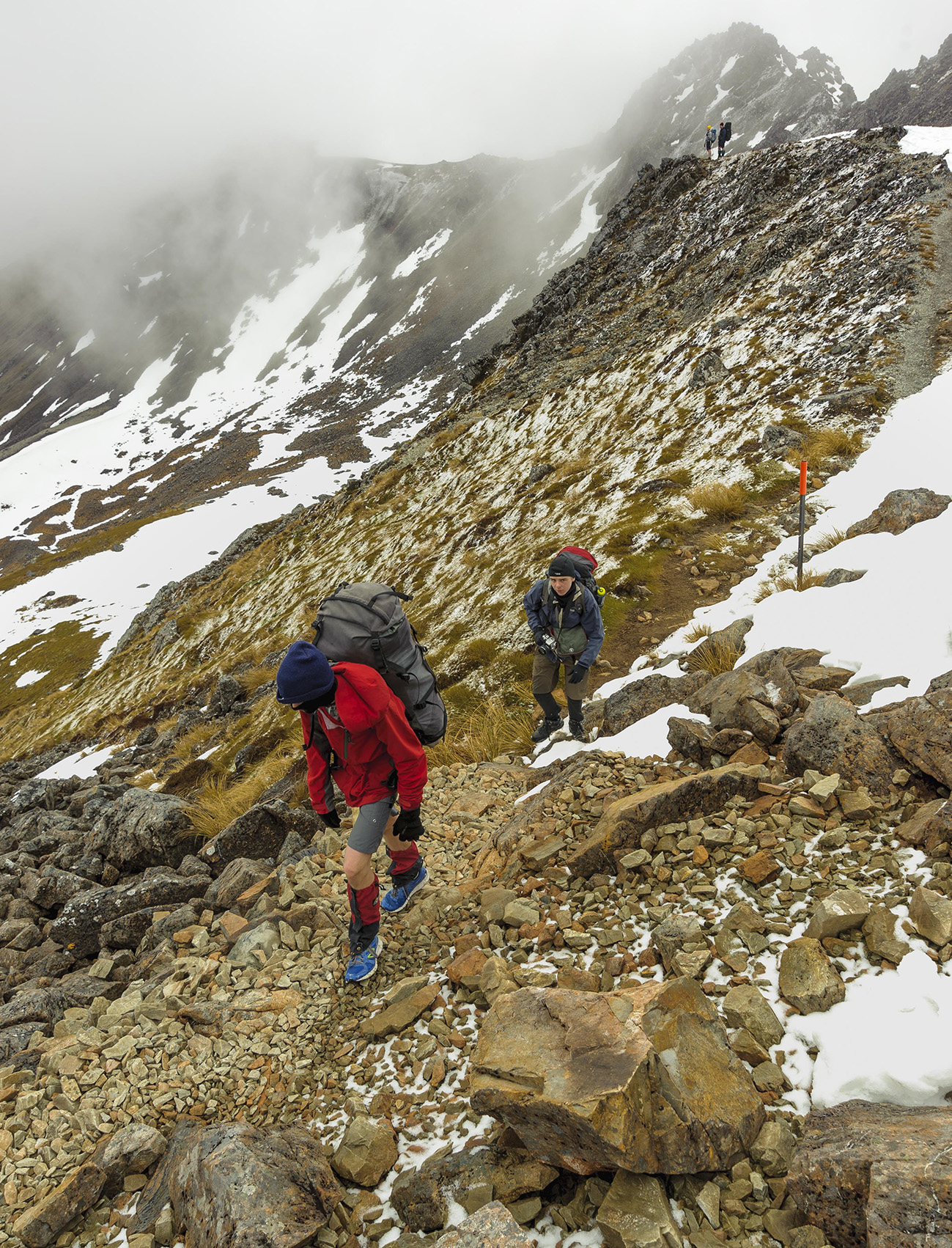
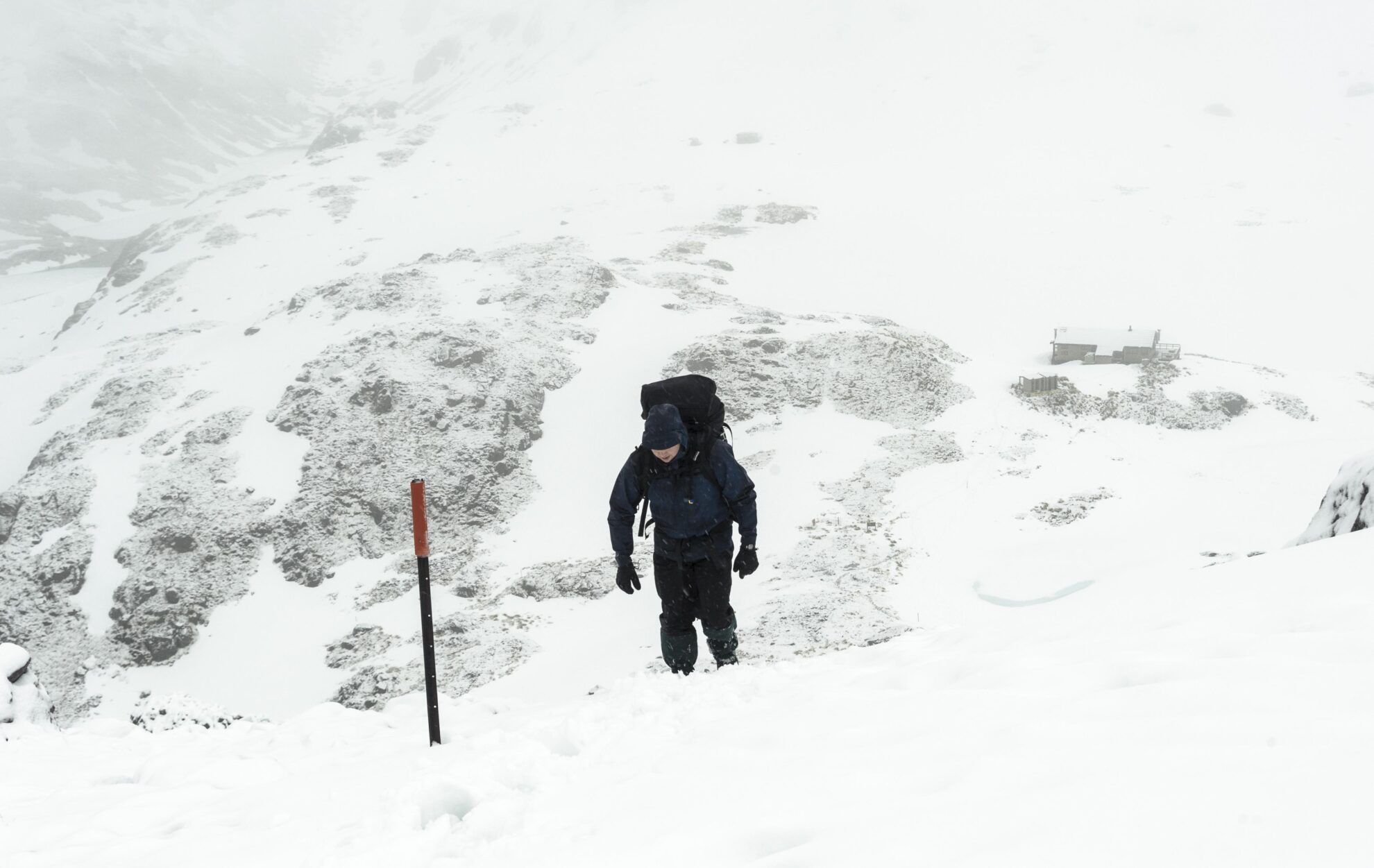
While the 5-7hr Robert Ridge route is marked by poles and cairns, and fairly well defined, it can be something of a terrain trap. Beyond Relax Shelter, the ridge climbs gradually from 1400m to 1800m and the further you go, the higher the chance of there being snow on the ground, even in summer. Although at first the ridge is fairly broad, it narrows considerably later, especially where it sidles the craggy faces below Julius Summit. It’s also exposed from every direction. Average summer temperatures range between 3 and 10 degrees, and it rains (or snows) more than half the year.
Once at Angelus Hut, there are no weather-proof escape options. The fastest route to get below the bushline is the Cascade Route, which drops steeply down Hukere Stream into the Travers Valley. But this can be prone to avalanches and requires fording streams that can become impassable in stormy conditions. Even the easiest route, to Speargrass Hut, requires retracing steps over the most exposed part of Robert Ridge, then a descent into an alpine basin and unbridged crossings of Speargrass Creek. The other two routes over Sunset Saddle or Mt Cedric are even more challenging, especially in a storm.
Beyond Relax Shelter, we carry on climbing gently until reaching the ridge above the second basin (one of five along Robert Ridge), where the former Mt Robert Ski Field was located. While the rope tows are long gone, the lodges remain and it’s here we’ll stay overnight. A colourful collection of nut-crackers, ski paraphernalia and old kerosene lanterns give the lodge a yesteryear atmosphere.
As we prepare dinner, Smith encourages discussion of the issues and facts. This information, like the accident reports at Relax Shelter, has been presented in stages, so we can better understand the material over the course of the weekend.
So far, Smith has offered little opinion. I sense he’s being deliberately reserved, not wanting to pre-empt any of the group’s suggestions. It’s an open process, with no idea being rejected out-of-hand. “Keep an open mind,” he says.
Over the course of the weekend, we’re divided into groups and given tasks. We write ideas on post-it notes, analyse facts, talk, debate, share our own insights and experiences. Everyone has a point of view. DOC’s Mike Davies explains the type of trampers who go to Angelus. Amanda Linklater talks about the groups she guides in the area. Thomas Salas Kostillo talks about the backpackers that come to St Arnaud, where he works. Shelagh Ferguson, from the University of Otago, explains how many times it takes before the public fully absorbs a message (several times over repeated exposure). DOC ranger Daryl Stephens outlines existing safety signs and measures.
Police officer Steve Savage relates first-hand SAR stories like the couple who met on Facebook, decided to tramp to Angelus, got caught in a blizzard in the head of Speargrass Creek and phoned for help near dusk. An SAR team responded but found no one at the coordinates they had been given. By sheer chance, there was phone reception which enabled the team to contact the couple and tell them to flash their torch. They were 900m away. By then the man was nearly dead. Bundled into sleeping bags in a tent, they were lucky to survive and the SAR team later won a national award.
Smith arranges the notes into useful categories. Slowly, some of the more workable ideas float to the surface. But there’s still considerable mahi ahead. Ideas have to be realistic and able to be implemented by DOC and MSC.
It’s a fine dawn over the Second Basin as I watch the sunrise above the St Arnaud Range and catch the curl of smoke wreathing from the lodge chimney. Calm, cool, perfect weather for tramping. We’re headed back along Robert Ridge, then down to Bushline Hut for lunch. Here, we pause and the broad ideas become more refined. We’re gelling, getting to understand each other through shared experience. Smith knows how to get the best out of a group, using skills honed by years of outdoor instruction.
Back in Wellington, he condenses the work into a document and consults with his MSC colleagues. A few weeks later, we all meet again at the MSC office to talk things through.
What will make a tramper consider turning back? How can Robert Ridge best be explained as a potential terrain trap? How can the bullet-proof mentality of many trampers, especially young men, be overcome? Changing behaviour is never easy; especially in a world where social media and internet images show a sparkling lake, smiling hikers and blue skies.

The value of the Angelus Hut booking system is clear but, after paying for a bunk on a specific date, some trampers might go even in marginal weather conditions and against advice from visitor centre staff. A more sophisticated system that allows people to change their booking should help. And weather forecasts could be emailed to them in advance of their trip.
While local trampers might defer their trip if the weather’s closing in, it’s less simple for an Auckland party with a trip planned months in advance. They’re committed and are less likely to abandon plans.
So how about suggesting good, alternative and specific B-plans, which still meet some of their expectations? Alternative destinations in the Nelson area are Lake Sylvester (Kahurangi National Park) or Lake Daniell (Lewis Pass). Both destinations have good huts near attractive lakes but lack the exposed alpine terrain of Robert Ridge. Bushline Hut, on the eastern flanks of Mt Robert, also offers fine views. It’s an alternative overnight destination with a much quicker escape route.
And then, on Robert Ridge, how about signposting key turn-around points? The terrain gets higher, rockier and is more exposed on the second half of the ridge, so ‘go’, or ‘no-go’ assessments could be made well before that point. Relax Shelter and Speargrass Hut are entry points where trampers should consider conditions carefully before continuing. Visitor Centre staff can also suggest that trampers depart by 9am to minimise the risk of getting caught out.
The MSC released its final report in September 2021 and, in partnership with DOC, began to implement some of these recommendations.
Barely a month later, Robert Ridge hit the headlines when the Nelson Marlborough Rescue Helicopter evacuated two under-equipped trampers just 700m from Angelus Hut. They didn’t have a PLB but luckily found a sliver of cellphone reception to alert SAR. Such incidents underscore how often people underestimate the route.
I’m still haunted by the stories I’d read at Relax Shelter. It’s led me to examine my own assumptions; made me think about risk and reward and the tension between the two.
I took my son Tom into Angelus one spring and assumed he would be fine in running shoes. Beyond Julius Summit, however, there was unexpected snow and before we reached the hut, his feet were extremely cold. Too much further and he could have got frost-nip. Lake Angelus was frozen. The following day, we headed to Speargrass Hut in a blizzard. Speargrass Stream was fordable, but may not have been later in the day when heavy rain fell. We managed okay, but I should have had good boots for Tom.
Sometimes disaster can hinge on something as simple as good or poor footwear. Or turning back. Trying the Plan-B and not being sold on the idea of a lake, no matter how sparkling the pictures.



