Four places where you’re guaranteed to see the magnificent tawa
Back in the mid-1990s, I worked for the Department of Conservation at a time when it was establishing a network of bait stations in the Northern Block of Pureora Forest for pest control. One of my jobs was to take a compass bearing through this extensive area of flat forest, establish a line, and mark it with flagging tape.
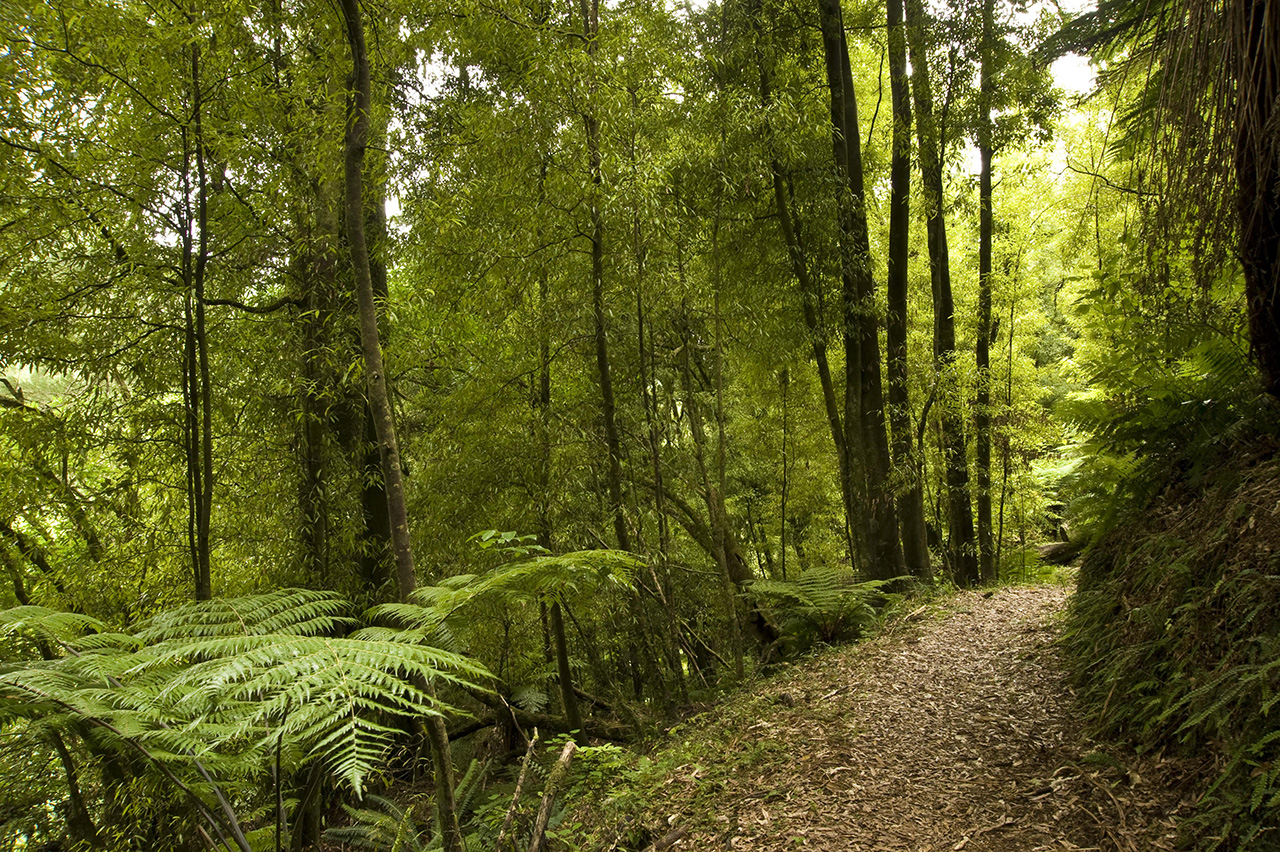
Rarely have I ever walked through such featureless terrain, or found myself immersed in a forest so dominated by one species. Despite being the middle of a sunny day, it was dark, almost like dusk was about to fall. I looked up through tiers upon tiers of branches, from which hung a myriad of thin, green leaves.
These multi-layered trees were tawa, and the density of their leaves cut the light to such an extent that virtually nothing grew in the understorey. This lack of undergrowth made for easy walking, with none of the normal shrubs or vines that might hinder progress in other broadleaf forest types. A thick layer of discarded leaves covered the forest floor, cushioning my boot-fall. Keeping a straight bearing through this sort of forest was simple; but all the same I was glad of my compass and had to fight back a niggling fear that I could become lost in such a flat, monoculture of trees.
Tawa (Beilschmedia tawa) prefers warmer climes, and doesn’t grow in the South Island except for the warmer parts of Nelson, Marlborough and coastal Kaikoura. In many parts of the North Island it dominates the canopy, but as it grows only to about 35m, emergent podocarps will sometimes tower above it. While the delicate flowers are small, its black fruit is large, so much so that only kereru and North Island kokako are big enough to eat them.
When the sun strikes obliquely, tawa leaves glow green-yellow, and then its beauty is truly realised in the dappled light.
1. Whirinaki Forest Park, Bay of Plenty
While Whirinaki is famed for its dense podocarp stands, tawa is very common in the forest, often forming the canopy. You’ll encounter some delightful stands on the two-three day Whirinaki Circuit, notably in the headwaters of the Mangamate and Whirinaki.
2. Pirongia Forest Park, Waikato
The Mangakara Nature Walk is one of the most delightful forest walks in the Waikato. Most easily accessible from Grey Road, the 30-minute loop track passes through some fine stands of tawa. The Link Track through to Ruapanae (723m) and Corcoran Road also has some excellent stands.
3. Pureora Forest Park, King Country
Pureora is perhaps the tawa capital of New Zealand, with vast stands of it in the North Block/Waipapa. A good introduction is the 30-minute Waipapa Loop Walk, from Pureora Forest Park Lodge, which has a notably large tawa beside the track at one point.
4. Otari-Wilton Bush, Wellington
Several walks lead through this important bush remnant in Wellington’s central suburb, with northern rata and rimu dominating an understory of tawa. Birdlife in the area is good thanks to predator control efforts by locals.