

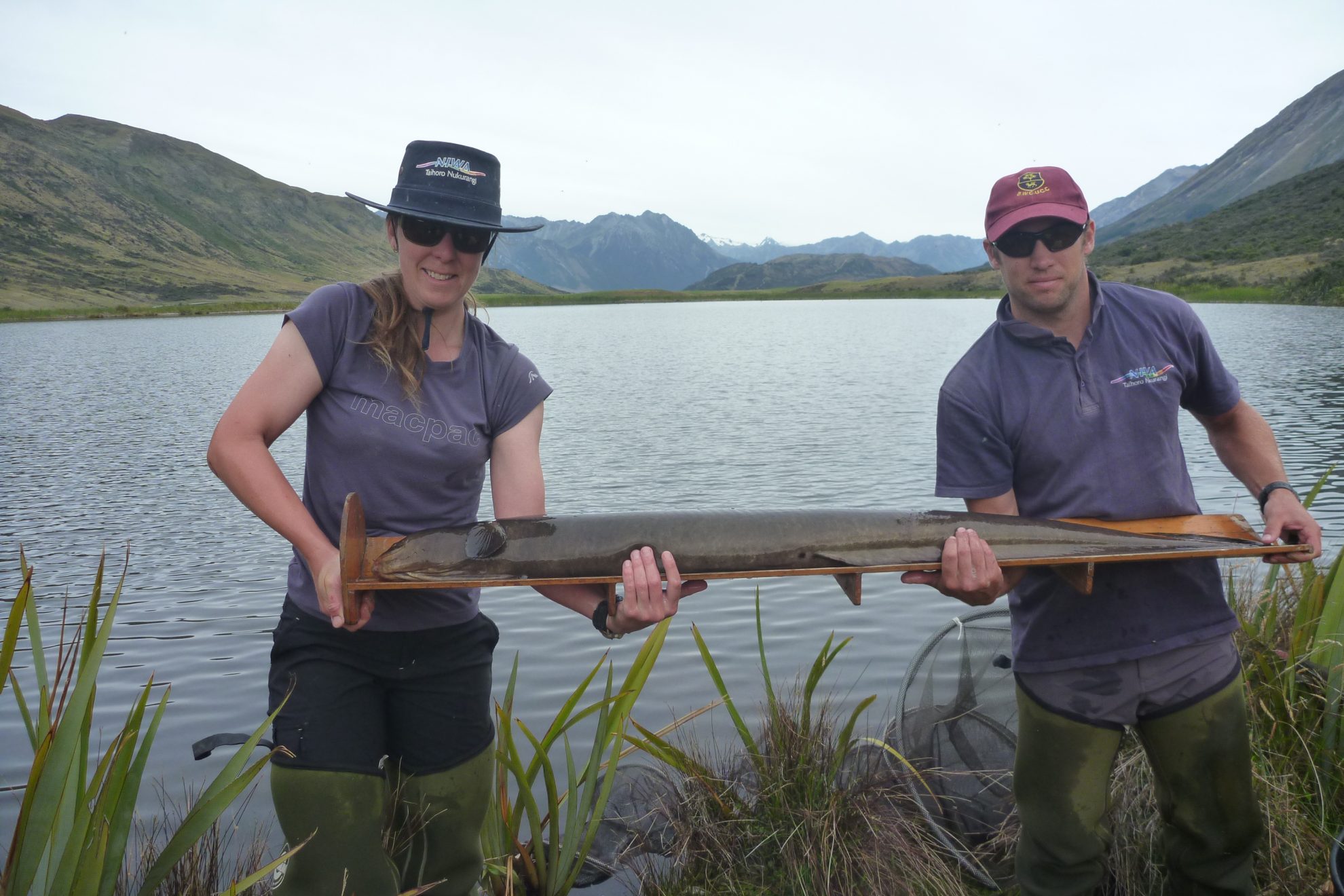
The tags, hooked onto the eel’s skin, continuously measure location, depth and light exposure, and are set to ‘pop off’ at different intervals during the eels’ journey.
Once popped off, the tags will float to the surface and transmit the data to NIWA, hopefully providing a data trail leading to the spawning grounds.
The missing link will provide the next step in the curious life cycle, which begins and ends at a mystery location in the Pacific where the mature eels die after reproduction, leaving the larvae to float back to New Zealand on ocean currents, before swimming and climbing deep into the river systems and lakes.
“Baby eels, or elvers, are fantastic climbers, and longfin eels do a good job of penetrating a long way inland – they can climb big waterfalls as well,” Franklin says.
Dams cause a much bigger obstacle to the elvers, which are usually able to climb steep terrain using surface tension.
“It’s relatively easy to capture elvers as they migrate upstream, as they aggregate at the bottom of dams,” Franklin says.
“But when they’re mature and they start migrating downstream again, their only pathway is through hydro turbines, and you can imagine what sticking an eel in a blender is like.”
Franklin says it’s an ongoing challenge to provide the knowledge to better manage and conserve data-deficient species.
“Trying to make well-informed management decisions can be difficult when you don’t know much about something – it’s a continuous challenge to try and figure out the most important things as quickly as you can, but very often the more you look, the more complicated you find things are.”
Freshwater ecologist Mike Joy says the longfin eel is the second-fastest declining freshwater fish species in New Zealand, and it’s facing a perfect storm of threats.
Despite its classification as an at risk, declining species, it’s still subject to commercial and recreational fishing.
As international eel species are pushed to the brink, demand for our exported taonga is on the rise, Joy says.
Commercial catch is around a fifth of what it was 20 years ago. “It’s reduced because we can’t find them anymore,” Joy says.
The catch per unit effort method of measuring catch is also misleading, Joy says. If you’re catching the same number from the same location every day, it is possible to more accurately gauge the abundance of a species. With eel fisheries, the catch unit doesn’t change, but the location does.
“If you can imagine this over a landscape, you keep fishing in a new place every day, until one day there is none left [anywhere],” he says.
Hydro turbines, irrigation pumps, habitat loss, and recreational angling are also closing the net on the species, and the eel’s monster reputation isn’t doing it any favours.
“I was as guilty as anyone of being a young kid killing eels. They scared me, and it was the macho thing to do. It’s about getting past that attitude.”
With the fate of the species largely in our hands, the eyes of eel conservationists worldwide are fixed on some 20 eels swimming somewhere in the Pacific.
Their secrets just might hold the key to a species on a slippery slope.



