See more… rock bivouacs
While walking up the Young Valley a couple of years ago, I came across a great gash in the forest, with large trees splintered like kindling for hundreds of metres up the hillside. Resting at an oblique angle was the creator of all this destruction: an enormous boulder. It had been loosed from its position higher on the mountain flanks and came crashing through the beech forest to where the easier gradient of the valley finally arrested its momentum. With a bit of work, we could have fashioned a shelter underneath it.
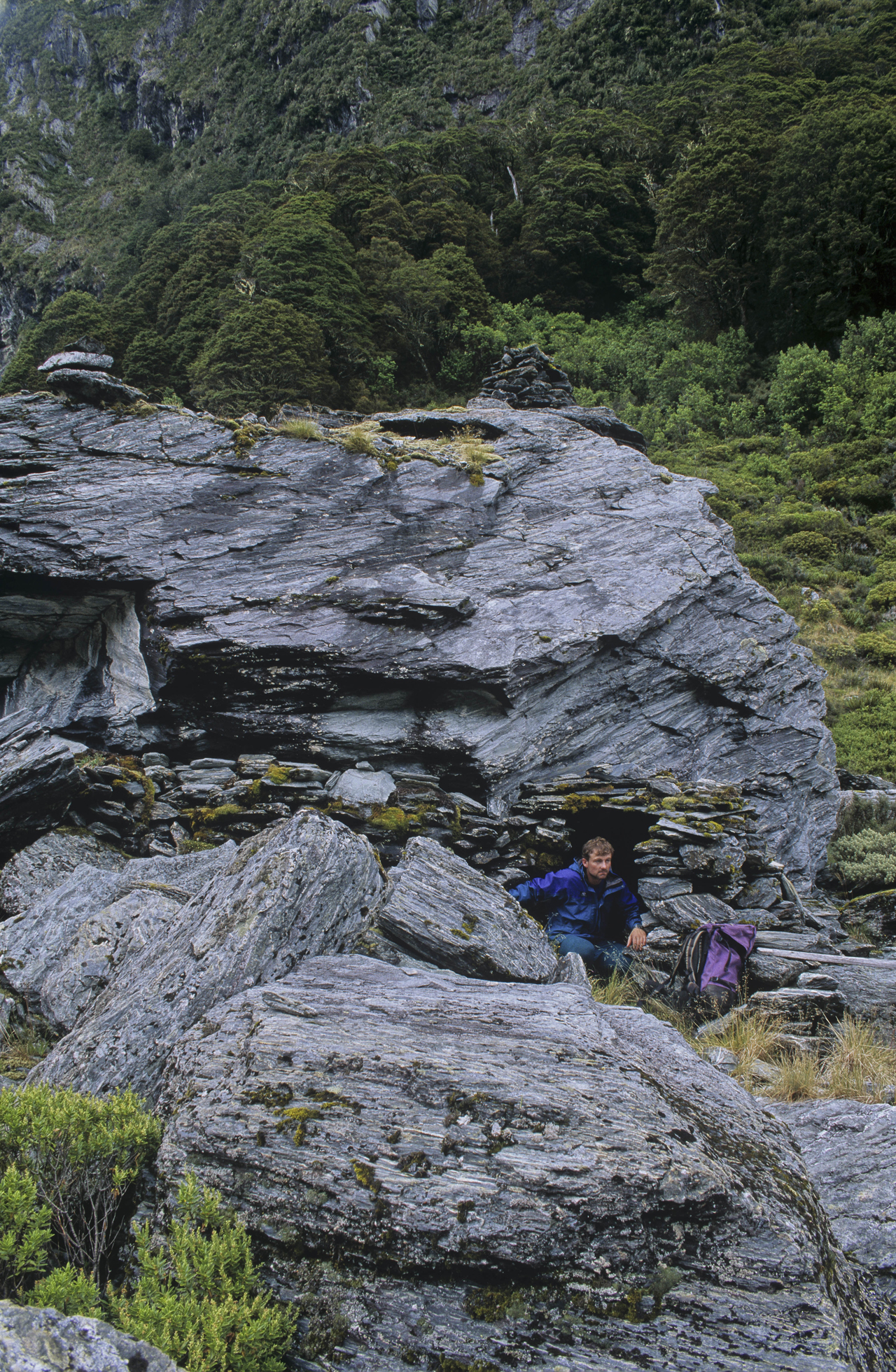
Many rock bivs have probably originated in such events. The best of them have flat ground underneath, have sufficient depth to remain dry in any weather, and are positioned with a good view. Gill’s Biv in Fiordland’s Moraine Valley fits all these criteria, and so does Harpers Rock Biv in Westland Tai Poutini National Park. Some, like the one in the Arawhata River or Turners Biv in the Darran Mountains, are marked and named on maps; others you just chance upon and might never have been used before.
Staying in a rock biv offers an experience somewhere between sleeping in a hut and a tent. Like a hut, rock bivs are solid and won’t suddenly get trashed in a storm. Like a tent, they leave you refreshingly exposed to the sounds of the night: moreporks calling, rivers burbling, wind sighing. However, rock bivs have one major drawback: no protection from sandflies.
Schist seems to have the qualities best suited to forming good rock bivs, and not surprisingly such accommodation abounds in Mt Aspiring National Park. The smallest I’ve slept in was one high above the Kitchener Cirque: barely room for three, and exposed to an easterly. Perhaps the most intriguing was one in the Beans Burn, which had multiple rooms, most requiring a low crawl to access.
The North Island doesn’t boast many rock bivs, although there is one in the Ruahine Range. Recently I discovered a couple in the upper Atiwhakatu Valley of Tararua Forest Park. This section of the river features large boulders and we found a tree-covered collection of these in what must have been an old watercourse. None of them were large, but would serve as emergency shelter at a pinch.
Gridiron Rock Biv, Kahurangi National Park, Nelson
Former New Zealand Forest Service ranger Max Polglaze made a work of art when he and fellow rangers developed this rock biv in the mid 1970s. Over a period of years, Polglaze constructed bunks, fashioned a fireplace, and even built a high extra roof to prevent drips. Sadly, the double bed and swinging chair have gone, but the the biv remains an appealing place to stay in the forest of the delightful Flora Valley. Two more limestone bivs, Salisbury and Growler, exist nearby. The Gridiron Rock Biv is the most accessible of the three described here, taking only 2-3hr from Flora car park.
Mark’s Flat Rock Biv, Hooker-Landsborough Wilderness, West Coast
Set in one of the grandest mountain locations in the Southern Alps, the large Mark’s Flat rock biv offers commanding views and good shelter in the heart of the Hooker-Landsborough Wilderness. It’s often used as a base for climbing parties attempting Mt Hooker, or for tramping parties traversing the Solution Range. There’s no easy way to reach the biv, with most parties needing 2-3 days via the Paringa and Clarke Valleys. In the unlikely event of the biv being occupied, another one exists closer to the Clarke River; it’s smaller and dark, but perfectly dry.
Cattle Flat Rock Biv, Mt Aspiring National Park, Otago
The cave-like Cattle Flat Rock Biv, on the Rees-Dart Track, has ample room for 10 or more, an established rock wall, and even a good fireplace. Situated just off the main track, back in the bush beside Cattle Flat, it provides alternative accommodation to Dart or Daley’s Flat huts.