Use your peripheral vision to spot the rifleman, New Zealand’s smallest bird
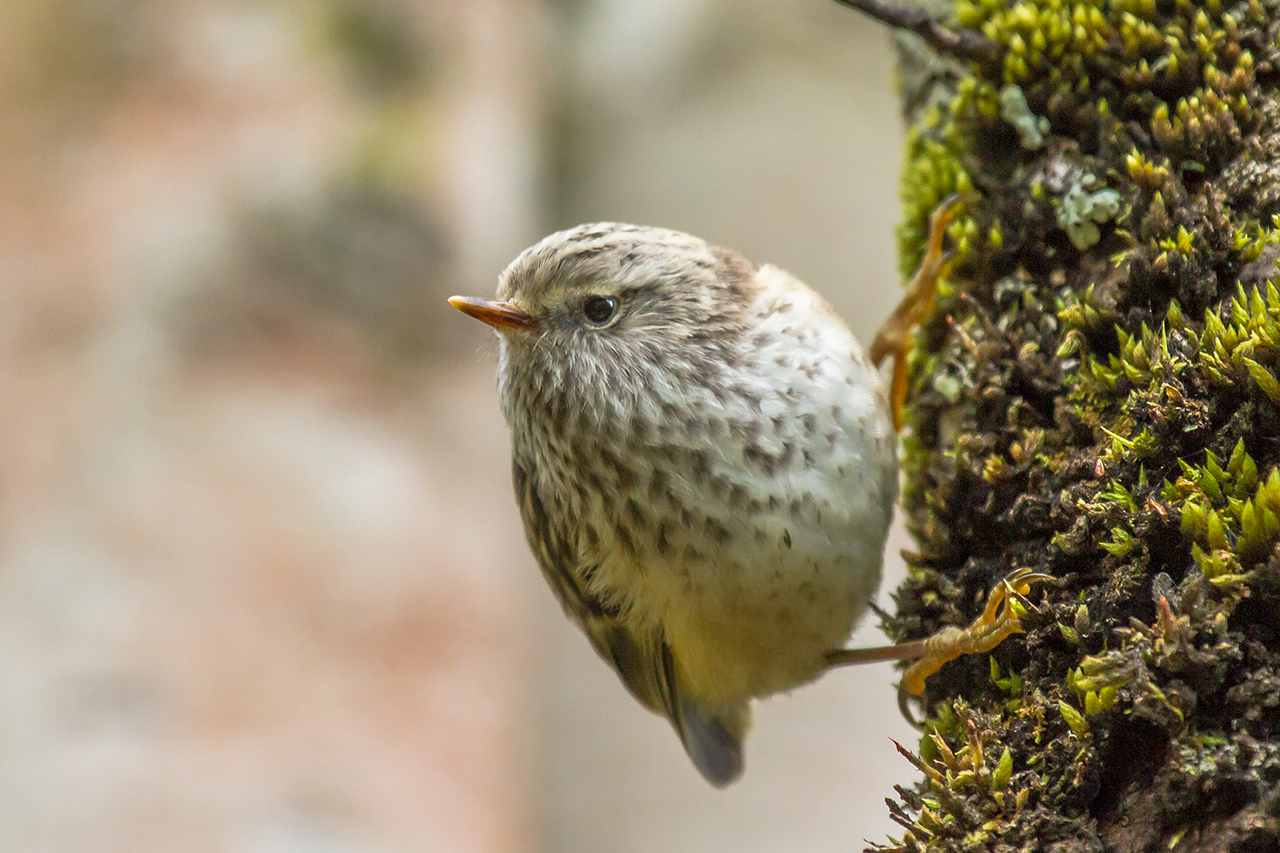
The male rifleman (titi pounamu), at a mere 6g in weight, claims the title of being New Zealand’s smallest bird. Little wonder they are difficult to spot – compounded by the fact they spend most of their time fairly high up in the canopy foraging for a large variety of small invertebrates, particularly beetles, spiders, moths and caterpillars.
Found predominantly in mature, higher altitude forests – especially beech, kauri, kamahi and podocarp – the South Island rifleman populations are found throughout forests of the Main Divide but are less common in the east of the island. The North Island rifleman survives as only three geographically isolated populations, all situated north of the Kaimai Range. One is in Warawara Forest in Northland, one on Little Barrier Island and the third on Tiritiri Matangi Island.
Males are bright green on the head and back, while females are mainly yellow-brown with darker speckles on the head and back. Both sexes have pale grey under-parts and a black slender bill which is finely pointed and angled slightly upwards, ideal for prodding and probing the nooks and crannies of tree trunk bark.
The rifleman is a poor flyer, possessing very short wings and an even shorter tail (it appears as if they have no tail at all).
Riflemen act as a very cooperative family group, whereby related offspring help to raise siblings from subsequent clutches. Their enclosed spherical nests are built in August within existing cavities such as hollow logs, under rocks and banks and crevices of tree bark. The male undertakes the nest building, but both sexes contribute to incubation (20 days) nestling and fledgling care.
Monogamy is practiced in long-term pair-bonds, only replacing a mate if one of the pair dies. A pair can raise up to two clutches per season which goes from August through to February.
While searching for insects, riflemen spend a lot of their time foraging on tree trunks where they will begin from the base of a tree and climb it progressively, spiralling up around the trunk. Upon finishing its search of a particular tree, the bird glides to the foot of a neighbouring tree and begins its search again.
Your best bet to locating and sighting riflemen is to use your ears to pick up their short simple ‘zips’ and ‘pips’. In my experience, looking specifically for a rifleman is less effective than using your peripheral vision to notice movement.
– Matt Winter is a Marlborough-based nature photographer