Is the curious and friendly robin losing its personality because of introduced predators?
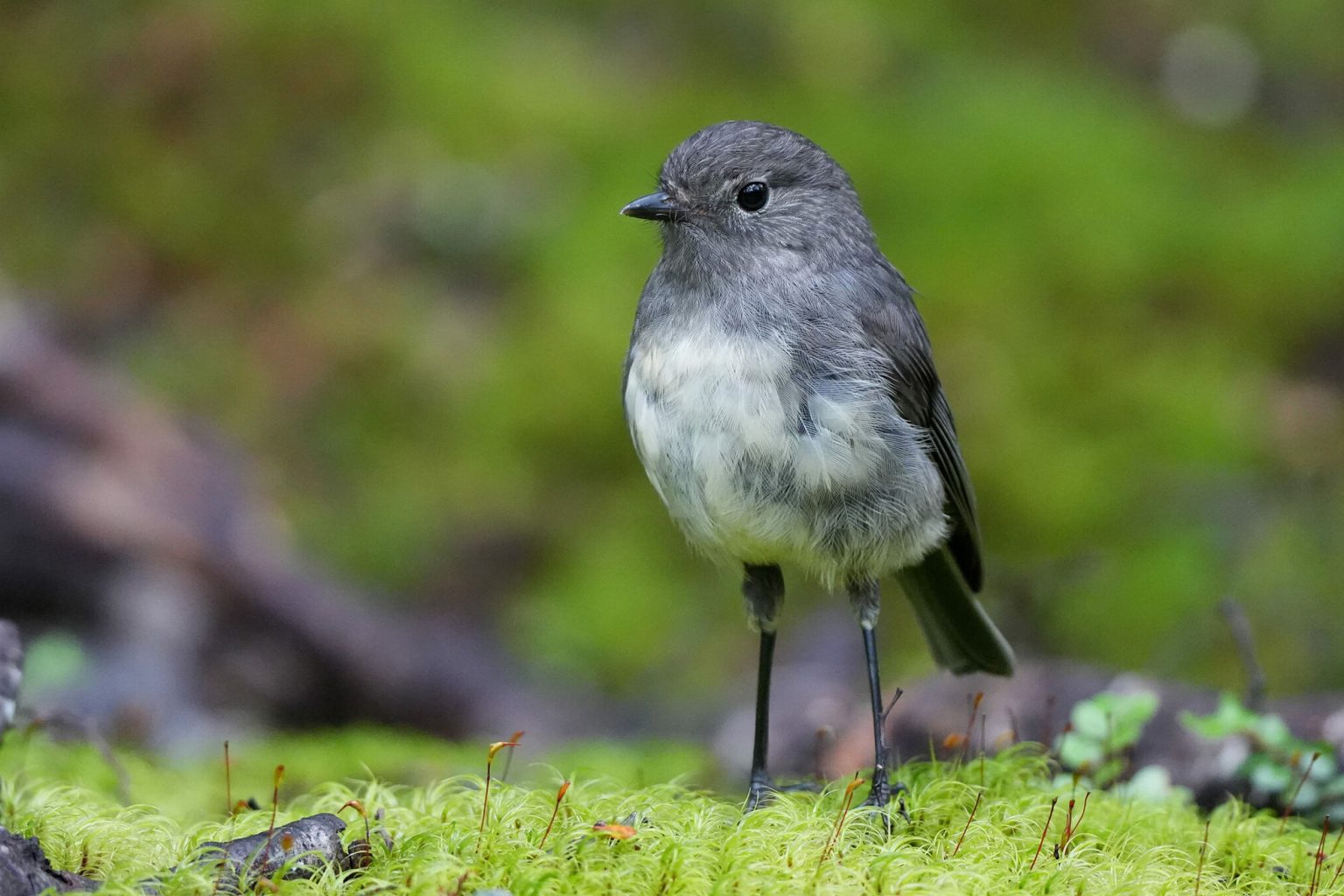
Robins are a pure joy to encounter when tramping in Aotearoa. Those rotund grey birds with toothpicks for legs can make you feel special as they follow along the track, with the boldest hopping onto your boot, shoulder or hat. It’s as though they’ve chosen you as a friend. They haven’t, though. Sadly, you’re only as good as the tasty insects you stir up.
But are robins losing these charms in the presence of introduced predators?
Rats, possums, stoats and feral cats prey on robins’ eggs, nestlings, chicks and incubating females.
Two robin populations were recently compared to determine predator impact. One population is on predator-free Motuara Island in the Marlborough Sounds. The other survives near Kaikōura in mainland bush that is full of introduced predators.
To test the birds’ reactions, researchers timed an individual bird’s willingness to approach and collect a mealworm larva.
Although robins may not view humans as predators, approaching any larger animal would be deemed a risk. The Motuara Island robins strutted right up to the treat without hesitation. Their mainland counterparts took a much more cautious approach.
Constant exposure to predators appears to prompt robins to refine their boldness in favour of caution. This is good for their survival. However, female robins, eggs and chicks still make easy meals during breeding season, leading to male-biased populations.
Their bold behaviour isn’t just a cute novelty. Robin density on Motuara Island is 10 times greater than on the mainland and bold responses help individuals compete for territory, mates and food.
For the mainland robins, does the difference in the two populations show a change to a more cautious species? Researchers say it’s too early to tell whether the different behaviour is genetic or learned. They do agree though that where ‘environmental conditions show directional change, selection can favour one personality tendency, causing it to become more prevalent over time’.
The study has implications for bird translocations. Moving bold individuals from predator-free habitats to predator-rich forests could be disastrous, as they may lack the necessary caution to avoid danger.
Happily, predator control is having a remarkable impact on robin populations. Following a 1080 treatment at Mt Stanley in the Marlborough Sounds, nesting success resulted in seven times more chicks than in untreated areas. Over winter, 84 per cent of the robin population survived versus just 37 per cent in the non-treated area.
Removing introduced predators will help bring nature back into balance so robins can live their best, boldest lives on mainland Aotearoa.
ROBINS
Names: toutouwai in the North Island, kakaruai in the South Island
Conservation status: Declining
Where to find robins: in the central North Island from Taranaki to the Bay of Plenty, Te Hauturu-o-Toi Little Barrier and Kāpiti islands, and mainland sanctuaries such as Zealandia and Bushy Park. In the south, strongholds are in Marlborough, the West Coast, Fiordland and Orokonui Sanctuary.
You can take part by joining a local trapping group – there’s one in nearly every corner of New Zealand. Head to predatorfreenz.org.nz to find a group near you.