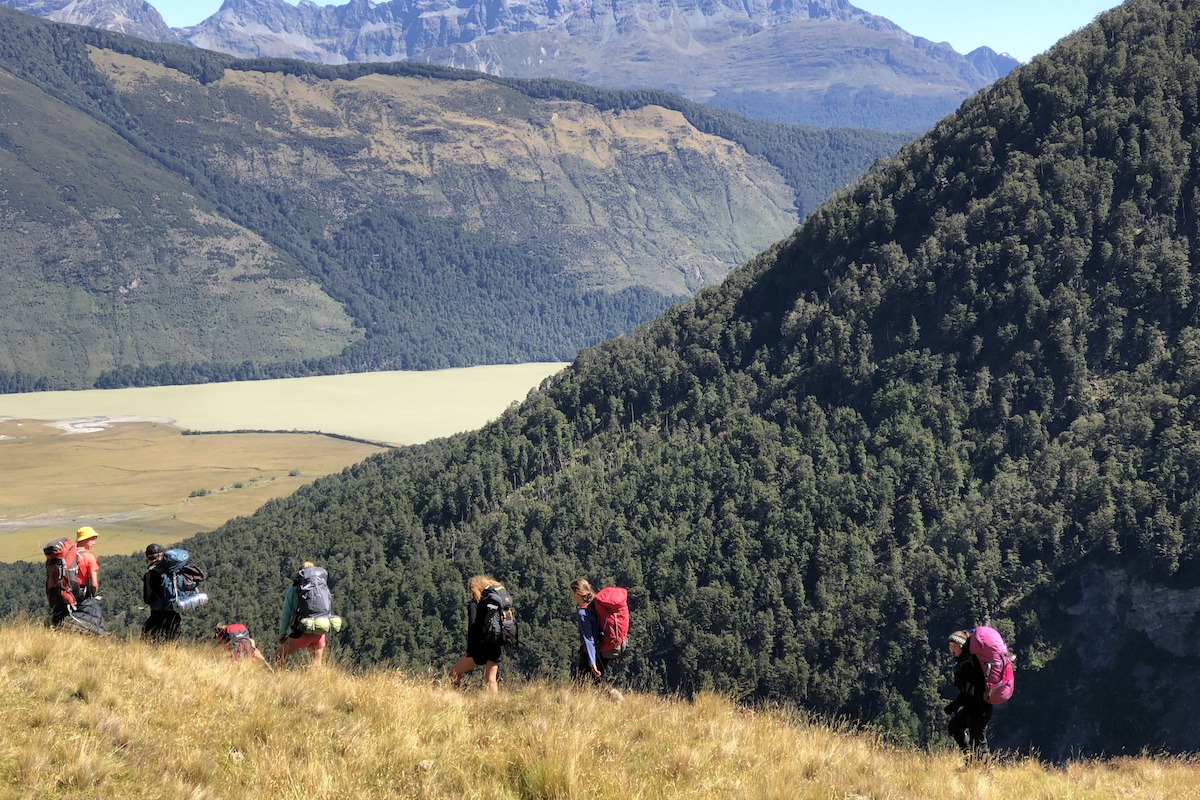
Last month, Education Minister Erica Stanford announced an overhaul of the secondary education curriculum, phasing out NCEA and replacing it with a general subject list. Outdoor education is on the general subject list, but as a Vocational Education and Training subject, meaning it won’t contribute towards university entrance.
A petition to keep outdoor education as part of the secondary school curriculum has amassed over 50,000 signatures.
Fiona McDonald, chief executive of Outdoor Education New Zealand, told Wilderness: “Outdoor Education is a recognised academic discipline that develops critical thinking, problem-solving, risk management, leadership, and environmental understanding. It powerfully engages students by connecting knowledge to the outdoors and real-life challenges, while also providing pathways into teaching, conservation, science, and tourism.
“Over 50,000 New Zealanders have signed the petition. In today’s world, OE is for every rangatahi. Add your voice: sign, share, and write to your MP and Education Minister Erica Stanford.”
Thousands of ‘paper roads’ discovered after public access map upgrade
A major upgrade to public access mapping has, for the first time, clearly identified the full extent of unformed legal roads — often called ‘paper roads’ — across the country.
After two years of work, Herenga ā Nuku Aotearoa, the Outdoor Access Commission, has unveiled a new map showing 55,000km of paper roads and made them available on an interactive online map.
Acting chief executive Phil Culling said the upgrade marks a “significant milestone” for the country’s only mandated public access mapper. The total length of these roads is 55,185km.
The upgrade has also added thousands of new reserves.
One notable example is Wither Hills Farm Park in Marlborough. Previously unseen in Herenga ā Nuku’s maps, the park has now been added following an agreement with Marlborough District Council.
FMC president Megan Dimozantos welcomed the map upgrade, saying it now provides “a fuller picture of public access”, including easements and movable marginal strips. Before the upgrade, data on unformed legal roads (ULRs) and easements were hard to obtain, often requiring direct requests to Herenga ā Nuku Aotearoa. Read the full story from The Press.
The controversial treat that fuels Norwegian hikers
Known as ‘the trip chocolate’, Kvikk Lunsj has fuelled Norwegian outdoor adventures for generations. Ads for the wafers often depict hikers spinning a compass, skiers summiting frosty peaks and people drinking water from rushing rivers.
Today, roughly 60 million Kvikk Lunsj bars are produced each year, about 11 for every Norwegian. So, what makes this chocolate so controversial?
For much of its nine-decade history, this notably Norwegian treat has been accused of being a KitKat knockoff. The chocolate-covered four-fingered wafers are nearly identical in appearance to the famed treat.
It’s widely believed that creator Throne Holst came up with the concept for Kvikk Lunsj after discovering KitKat bars in England following their release in 1935.
Adding to the dispute, Kvikk Lunsj is now owned by Mondelēz, an American multinational company. The Mondelēz connection faced a consumer boycott of its products in 2023 after the company continued trading in Russia after it invaded Ukraine.
Until recently, KitKat and Kvikk Lunsj have stayed a respectful distance. But following news earlier this year that KitKat is entering the Norwegian market, this peaceful coexistence could come to an end. Read the full history of Kvikk Lunsj from the BBC.
Inexperienced young trampers ‘fortunate’ to be rescued
A group of trampers are “extremely fortunate” to have been rescued after getting lost in harsh weather near Middlemarch, police say.
The five young adults were caught unprepared for the conditions on Saturday night, which included snow, rain and gale-force winds, Senior Sergeant Blair Dalton said.
“They did not have adequate clothing or supplies, and they were not experienced trampers. They are extremely fortunate that they were able to call for help in an area with notoriously patchy cellphone coverage.”
The group set out on their tramp to a hut late in the afternoon, despite “extremely poor weather” in the area, police said in a statement. They soon got into difficulty due to the conditions and became lost. Fortunately, they were able to get cellphone reception about 7.30pm to call for help.
Police, search and rescue and local farmers were able to reach the group and walk them out. Snr Sgt Dalton said the incident was a timely reminder to be prepared if you were heading outdoors. Read the full story from Star News.
Wellington’s Watts Peninsula reserve gets the greenlight
A public reserve will finally be established on the iconic Miramar Peninsula – Te Motu Kairangi in Wellington, Conservation Minister Tama Potaka and Land Information Minister Chris Penk have announced.
“Watts Peninsula, also known as Mātai Moana, is a prominent landmark with enormous historical and cultural significance for many New Zealanders,” Mr Potaka says.
“The Watts Peninsula public reserve was first promised to the people of Wellington and New Zealand by the government in 2011,” Mr Penk says.
“I can today confirm that a reserve will be created on the northern tip of Miramar Peninsula, following the transfer of 72 hectares of land from Land Information New Zealand to the Department of Conservation – Te Papa Atawhai (DOC).
“The area is home to pā sites, wāhi tapu (sacred places) and military heritage sites built from the 1880s through to the Second World War, including Fort Ballance.
An official opening of the reserve will take place once it’s ready for public access. Read more from DOC.
Great Taste Trail to get back on track with $1.6m boost
The Government has announced $1.6 million to repair and reopen Tasman’s Great Taste Cycle Trail, which was badly damaged in the region’s two extreme rain events.
Speaking in Richmond on Friday, Tourism and Hospitality Minister Louise Upston said the trail was an important tourism asset for the region, making the level of investment “a bit of a no-brainer”.
The funding meant the trail could reopen in time for the summer, bringing visitors back to the region, and supporting local businesses, jobs and communities, she said.
Two extreme rain events over winter seriously damaged more than 30km of the 200km Great Taste Trail. However, 85% of the trail is already back open. It is expected that the full loop will be rideable by Christmas.
Nelson Tasman Cycle Trails Trust chairperson Gillian Wratt said the $1.6m would cover some of the work that had already been completed, plus some additional work such as preparing bridges. Read the full story from The Press.